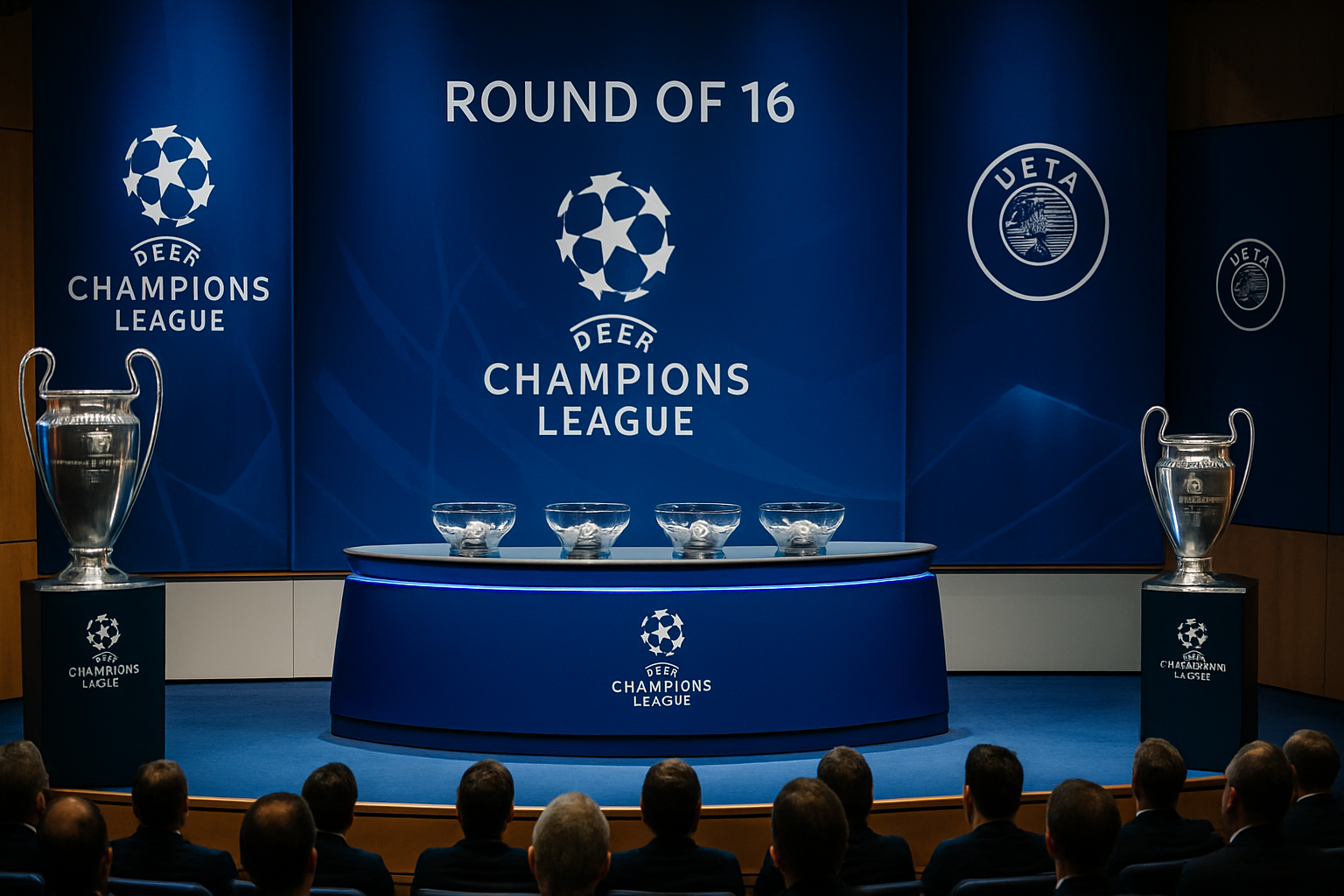
The UEFA Champions League Round of 16 draw produced blockbuster matchups as defending champions Paris Saint-Germain were paired with Chelsea in a rematch of the 2025 Club World Cup final, while Real Madrid face Manchester City in the continuation of European football's most compelling modern rivalry.
Conducted at UEFA headquarters in Nyon, Switzerland on Friday, February 27, the draw set the stage for what promises to be one of the most competitive knockout phases in recent memory, featuring unprecedented Premier League representation and several storylines that will captivate football audiences worldwide.
PSG Seeks Redemption Against Chelsea
The headline fixture pits PSG against Chelsea in what represents a golden opportunity for revenge. The Parisians fell to the London side in the 2025 Club World Cup final, a defeat that still stings for the French champions. This Champions League encounter offers PSG immediate redemption on European football's biggest stage.
Both teams earned their knockout phase berths through contrasting paths. PSG survived a dramatic playoff encounter with AS Monaco, advancing 5-4 on aggregate despite a nervous 2-2 second-leg draw at Parc des Princes. The tie was decided by Monaco's Mamadou Coulibaly receiving a crucial red card in the 58th minute, proving decisive for the Monégasque side's chances.
Chelsea, meanwhile, secured automatic qualification as one of the tournament's top performers, making this draw particularly intriguing as it brings together two teams with recent history and championship aspirations.
Real Madrid vs Manchester City: Europe's Premier Rivalry Renewed
The draw's other marquee fixture sees Real Madrid and Manchester City meet for the 16th time since their rivalry began intensifying in 2012-13. Their head-to-head record from 15 previous encounters stands remarkably balanced: six Real Madrid victories, five Manchester City wins, and four draws.
Real Madrid's path to the Round of 16 was marked by controversy and drama. Los Blancos overcame Benfica 3-1 on aggregate, but their playoff campaign was overshadowed by a serious racism incident. During the first leg at Estádio da Luz, Benfica's Gianluca Prestianni allegedly called Vinicius Junior "mono" (monkey), prompting an 11-minute stoppage under UEFA's anti-racism protocol.
The incident resulted in UEFA provisionally suspending Prestianni for the second leg, with the Argentine winger facing potential sanctions of up to 10 matches under Article 14 discriminatory behavior regulations. Federico Valverde confirmed "something ugly was said," while Kylian Mbappé reportedly stated that Prestianni "called him ape five times."
Historic Premier League Representation
The 2026 Champions League knockout phase features six English clubs – Arsenal, Liverpool, Chelsea, Manchester City, Tottenham, and Newcastle United – representing the strongest Premier League showing in the competition's recent history. This unprecedented representation reflects the continued global dominance of English football's top flight.
Liverpool face Turkish champions Galatasaray, who eliminated Juventus in one of the playoffs' biggest upsets. The Turkish side completed a miraculous 7-5 aggregate victory despite losing the second leg 3-2 in extra time, with Victor Osimhen and Baris Alper Yilmaz scoring crucial goals to seal their progression.
Arsenal were paired with German champions Bayer Leverkusen in a fixture that will feature Algerian midfielder Ibrahim Maza, adding international intrigue to the German side's European campaign.
Remarkable Upsets Shape Tournament Landscape
The tournament's most stunning achievement belongs to Norwegian champions Bodø/Glimt, who eliminated Inter Milan in one of Champions League history's greatest upsets. The Arctic club secured a 5-2 aggregate victory, highlighted by a remarkable 3-1 first-leg win at Aspmyra Stadium in freezing conditions reaching -20°C.
Bodø/Glimt's qualification represents the first time a Norwegian club has reached the Champions League Round of 16. Their achievement becomes even more remarkable considering they previously defeated Manchester City and Atletico Madrid during the group stage, establishing an unprecedented European run for a club from a town of just 50,000 inhabitants.
Coach Kjetil Knutsen has been hailed as a tactical mastermind, while Ståle Solbakken described the achievement as "the greatest club accomplishment in Norwegian football history." The elimination of Serie A leaders Inter Milan sent shockwaves throughout European football.
Tournament Format and Schedule
The Champions League maintains its traditional two-legged knockout format through the semifinals. First legs are scheduled for March 10-11, 2026, with return legs taking place March 17-18, 2026. The quarterfinals will follow on April 7-8 and 14-15, while semifinals are set for April 28-29 and May 5-6.
The tournament will culminate with the final in Munich, providing a fitting climax to what promises to be an extraordinary knockout phase featuring established European powerhouses alongside remarkable breakthrough stories.
Bracket Implications and Potential Pathways
The bracket system means potential blockbuster encounters could emerge in the quarterfinals. Bayern Munich could face either the Real Madrid-Manchester City winner or emerge from their own challenging path, while the strong English representation suggests multiple Premier League clubs could advance deep into the tournament.
For PSG, success against Chelsea would not only provide redemption but also enhance their credentials as defending champions. The Parisians remain determined to repeat their continental triumph while managing domestic pressures in Ligue 1, where they recently reclaimed the summit.
Beyond the Headline Fixtures
While PSG-Chelsea and Real Madrid-Manchester City dominate attention, other fixtures promise compelling narratives. Tottenham face a challenging opponent in their continued European campaign, while Newcastle United's participation represents their return to Champions League football after an extended absence.
The tournament's diversity – spanning from Arctic Norway to Turkish passion, from English efficiency to German precision – exemplifies modern European football's global appeal and competitive balance. Success stories like Bodø/Glimt prove that tactical preparation and unwavering belief can overcome traditional financial and structural advantages.
As teams prepare for the March fixtures, the Champions League Round of 16 presents multiple storylines: revenge narratives, historic achievements, racial justice concerns, and the eternal pursuit of European glory. The stage is set for what could be remembered as one of the competition's most memorable knockout phases, where established powers face unprecedented challenges from emerging forces across the continent.