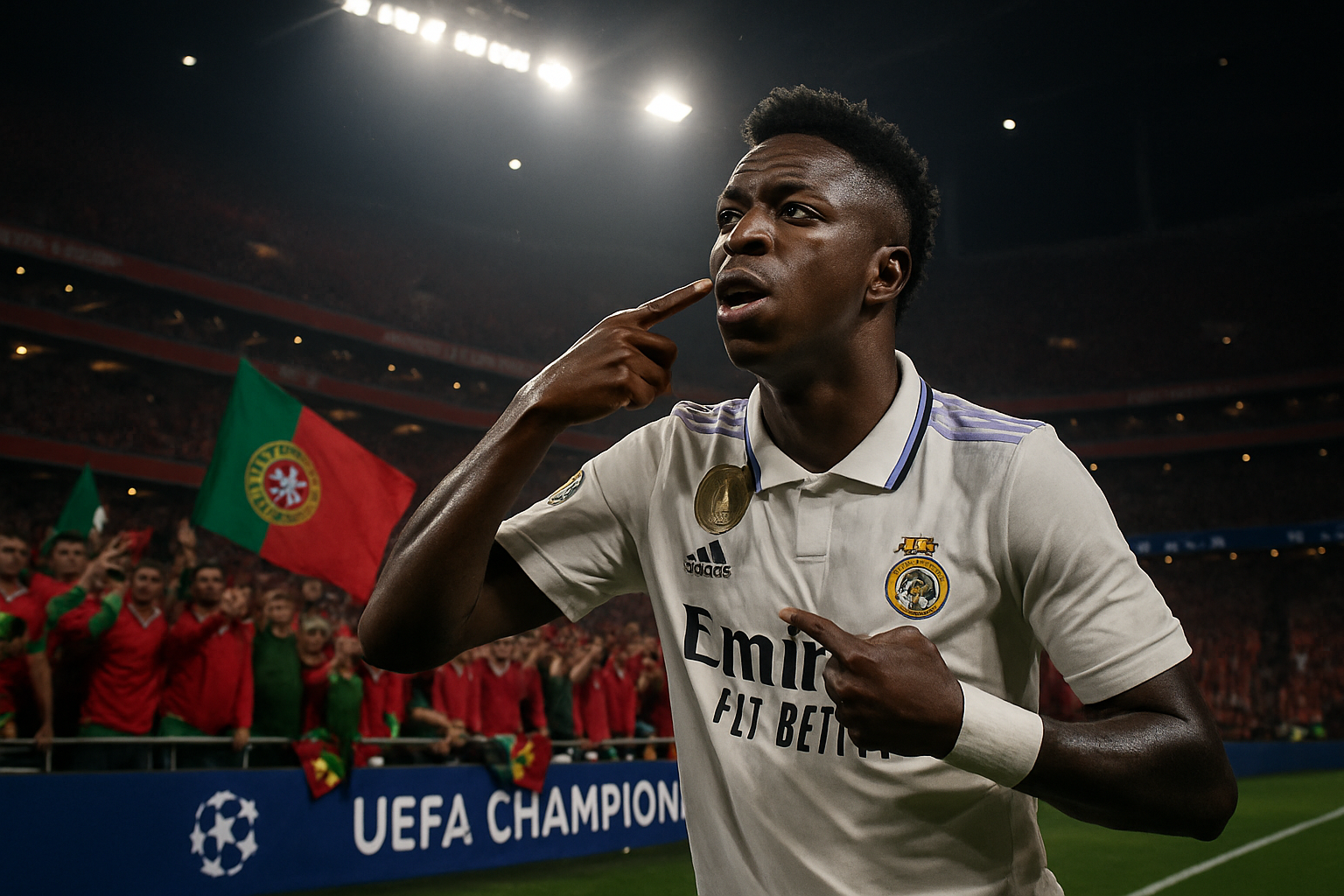
Real Madrid secured a crucial 1-0 victory over Benfica in their Champions League playoff first leg on Tuesday night, but the match at Estádio da Luz was overshadowed by serious allegations of racist abuse directed at Brazilian forward Vinicius Jr., prompting an 11-minute suspension under UEFA's anti-racism protocol.
The incident occurred moments after Vinicius had curled Real Madrid ahead with a sublime second-half winner in the 50th minute. As the Brazilian celebrated his goal, television cameras captured Argentine winger Gianluca Prestianni covering his mouth with his shirt before allegedly making a comment that Vinicius and nearby Real Madrid teammates interpreted as a racial slur.
French referee François Letexier immediately halted the match under FIFA's three-step anti-racism protocol after Vinicius brought the alleged abuse to his attention. The lengthy stoppage created a tense atmosphere that persisted for the remainder of the match, with Real Madrid ultimately holding onto their narrow advantage ahead of the second leg at the Santiago Bernabéu.
Detailed Account of the Incident
According to multiple eyewitness accounts from Real Madrid players, Prestianni allegedly called Vinicius "mono" (monkey) in Spanish during the heated exchange. Teammate Kylian Mbappé later told Swedish media that the Benfica player "called him ape five times," while Federico Valverde confirmed that "something ugly was said" during the confrontation.
The television broadcast showed Prestianni clearly covering his mouth with his jersey during the incident, though audio evidence was insufficient for definitive proof of the exact words spoken. UEFA has launched a comprehensive investigation into the allegations under their 2009 anti-racism protocols.
The match resumption proved challenging, with the atmosphere at Estádio da Luz turning increasingly hostile. Benfica manager José Mourinho was also sent off during the chaotic proceedings, adding to the tension that engulfed the remainder of the encounter.
Mourinho's Controversial Response
In a post-match interview that has generated significant controversy, José Mourinho appeared to question the frequency of such incidents involving Vinicius Jr. The Portuguese coach suggested he sees "a pattern" where the Brazilian is often involved in controversies, drawing sharp criticism for appearing to blame the victim rather than condemn the alleged racist abuse.
"Why does it always happen to Vinicius?" Mourinho asked, prompting immediate backlash from anti-racism campaigners and football authorities who accused him of deflecting attention from the serious nature of the allegations. His comments have been widely interpreted as insensitive victim-blaming at a time when football is attempting to address systemic racism.
Player and Club Reactions
Vinicius Jr. took to social media after the match, posting simply "Racists are cowards" on his official accounts, a message that quickly garnered hundreds of thousands of interactions from supporters worldwide. The 25-year-old Brazilian has faced repeated instances of racist abuse throughout his career in Spanish football, making him one of the most visible targets of discrimination in European football.
"Something ugly was said during that moment. We all heard it, and it's completely unacceptable."
— Federico Valverde, Real Madrid midfielder
Real Madrid released a strongly worded statement condemning the alleged abuse and calling for the "strongest possible sanctions" against any individuals found guilty of racist behavior. The club emphasized their zero-tolerance policy toward discrimination and pledged full cooperation with UEFA's investigation.
Liverpool defender Trent Alexander-Arnold, who was not involved in the match, condemned the incident as a "disgrace" on social media, highlighting the broader football community's solidarity against racism. His intervention demonstrates how the issue transcends club rivalries when fundamental human dignity is at stake.
UEFA's Investigation and Protocol Implementation
UEFA officials have confirmed they are conducting a thorough investigation under their established anti-racism framework, which includes potential sanctions ranging from stadium closures to point deductions. The European governing body implemented a three-step protocol in 2009 that allows referees to suspend, abandon, or continue matches depending on the severity of discriminatory behavior.
The 11-minute suspension represents the protocol's second step, indicating referee Letexier deemed the situation serious enough to warrant significant intervention but not complete match abandonment. UEFA's disciplinary committee will review all available evidence, including television footage, audio recordings, and witness statements from players and officials.
Potential sanctions for Benfica could include partial or complete stadium closures for future European matches, significant financial penalties, or even forfeiture of the playoff tie if the allegations are substantiated. Individual sanctions against Prestianni could range from lengthy suspensions to permanent bans from UEFA competitions.
Historical Context of Racism in European Football
This latest incident highlights the persistent challenge of racism in European football, despite decades of anti-discrimination campaigns and educational initiatives. Vinicius Jr. has become an unwitting symbol of this struggle, having faced repeated abuse in Spanish stadiums since joining Real Madrid from Flamengo in 2018.
The Brazilian's experiences mirror those of other Black players across European leagues, where racial abuse remains a disturbingly common occurrence. Recent high-profile incidents involving players like Marcus Rashford, Bukayo Saka, and Jadon Sancho have demonstrated that the problem extends across national boundaries and competition levels.
UEFA's "Respect" campaign and FIFA's various anti-racism initiatives have achieved limited success in eliminating discriminatory behavior from football stadiums. Critics argue that sanctions remain insufficiently severe to deter racist conduct, while enforcement mechanisms often prove inadequate for addressing the complex social dynamics underlying discrimination.
Impact on the Playoff Tie
Despite the controversy surrounding the match, Real Madrid's 1-0 victory gives them a significant advantage heading into the second leg at the Santiago Bernabéu next week. Vinicius Jr.'s winner, a curled effort from the edge of the area that found the bottom corner with precision, demonstrated his resilience in the face of adversity.
The Brazilian's goal celebration, which occurred just before the alleged racist abuse, showed him pointing to his skin in what many interpreted as a defiant response to previous discrimination he has faced. This gesture has become a recurring theme in his career as he continues to confront racism both on and off the pitch.
Benfica face an uphill battle to overturn the deficit in Madrid, with the added distraction of the ongoing UEFA investigation potentially affecting their preparation. The Portuguese champions will need to score at least twice at the Santiago Bernabéu while preventing Real Madrid from adding to their advantage.
Broader Implications for Football
The incident at Estádio da Luz represents another critical test for football's commitment to eliminating racism from the sport. The response from UEFA, national federations, and the broader football community will be closely scrutinized as a measure of genuine progress toward meaningful change.
Anti-racism campaigners have called for more severe sanctions, including automatic forfeiture of matches where racist incidents occur, to create genuine deterrence against discriminatory behavior. They argue that current penalties remain insufficient to address the scale and persistence of racism in football.
The incident also raises questions about the effectiveness of existing educational programs and whether football authorities are doing enough to address the root causes of discrimination rather than simply responding to its symptoms after incidents occur.
Looking Ahead
UEFA is expected to conclude its investigation within the coming weeks, with any sanctions to be announced before the second leg of the playoff tie. The timing of the decision could significantly impact both teams' preparation and the atmosphere surrounding the return match at the Santiago Bernabéu.
For Vinicius Jr., this latest incident represents another chapter in his ongoing battle against racism in football. His continued excellence on the pitch, combined with his dignified responses to abuse, has made him an important voice in the fight against discrimination in sport.
The broader football community now awaits UEFA's response to determine whether European football's governing body will take sufficiently strong action to send a clear message that racist behavior will not be tolerated at any level of the game.