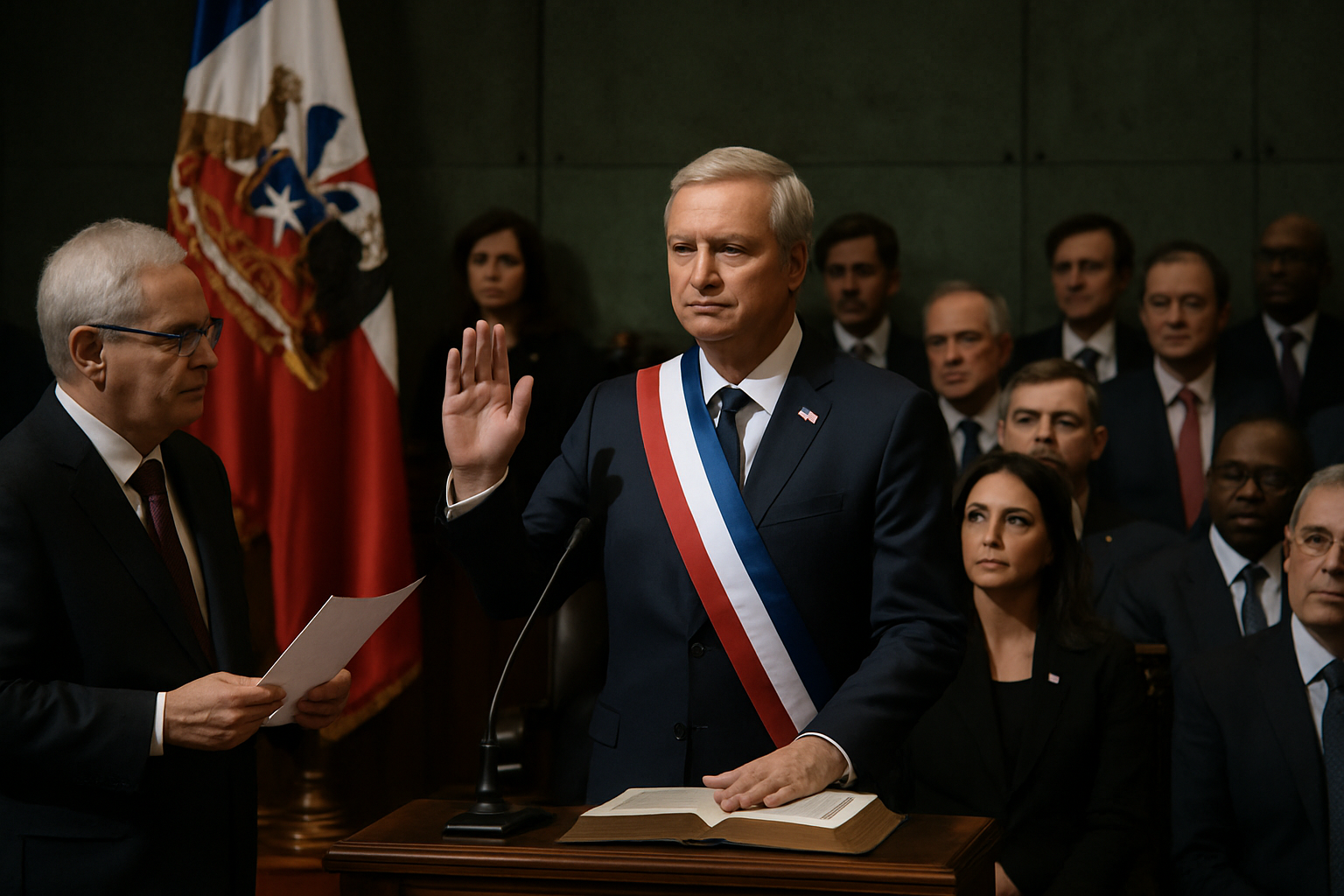
José Antonio Kast was inaugurated as Chile's president on March 11, 2026, marking the most significant conservative shift in Chilean politics since the end of the Pinochet dictatorship in 1990, as the 60-year-old lawyer takes office promising an "emergency government" focused on security, economic deregulation, and immigration control.
The inauguration ceremony in Valparaíso, located 120 kilometers from Santiago, saw Kast receive the presidential sash from outgoing left-wing President Gabriel Boric in a peaceful democratic transition that nonetheless carries profound symbolic weight. The ceremony occurred exactly 36 years after the Pinochet era ended, making Kast the first Chilean president since the return to democracy to publicly defend aspects of the military regime.
International Attendance and Regional Implications
The inauguration drew significant international attention, with attendees including Argentina's Javier Milei, Ecuador's Daniel Noboa, Paraguay's Santiago Peña, Spain's King Felipe VI, and Venezuelan opposition leader María Corina Machado. Notably absent were representatives from several left-leaning governments in the region, highlighting the polarized reception of Kast's rise to power.
According to sources familiar with the ceremony, Kast wore a tie personally chosen by Italian Prime Minister Giorgia Meloni, symbolizing the growing alliance between conservative leaders across continents. The presence of these international figures underscores the emergence of a new conservative axis in Latin American politics, contrasting sharply with the traditional left-leaning regional blocs that dominated in the 2000s.
Campaign Promises and Policy Platform
Kast's victory came after a landslide win in December 2025, following his narrow defeat to Boric in the 2021 election. His campaign, explicitly inspired by Donald Trump's law-and-order approach, promised to combat crime and curb illegal immigration—messages that resonated with Chilean voters concerned about security and economic stability.
"We will implement an emergency government that puts Chile first, restoring order and prosperity to our nation."
— José Antonio Kast, at his first presidential address
The new president's first official act was to deliver his inaugural speech at the Augusto D'Halmar High School in Ñuñoa, where he praised the role of students and teachers in national development. This choice of venue was seen as symbolic, emphasizing education as a cornerstone of his administration while maintaining his conservative credentials.
Migration Crisis and Venezuelan Community
One of Kast's most pressing challenges involves managing Chile's migration situation, particularly the Venezuelan community that comprises 42% of the country's estimated 2 million migrants. His campaign rhetoric about tightening immigration controls has created uncertainty among migrant communities, who fear potential deportations or restriction of services.
The timing of Kast's inauguration coincided with a controversial meeting between Haitian Prime Minister Alix Didier Fils-Aimé and the Haitian diaspora in Santiago. According to sources, the meeting primarily included embassy invitees rather than a broad representation of the Haitian community, raising questions about the new government's approach to migrant engagement.
Economic Policy and Deregulation Agenda
Kast's economic platform centers on market-friendly policies and deregulation, positioning Chile as a pro-business destination in South America. His administration has announced plans to review Chinese infrastructure projects, including controversial undersea cable installations, as part of a broader strategy to align more closely with U.S. economic interests.
The president's team has indicated that economic policy will prioritize reducing bureaucracy, lowering corporate taxes, and attracting foreign investment while maintaining Chile's reputation for fiscal responsibility. These policies align with the broader conservative realignment across Latin America, where leaders like Argentina's Milei are implementing similar free-market reforms.
Security Concerns and Authoritarian Governance Questions
Security concerns shadowed the inauguration, reflecting campaign promises for what critics describe as authoritarian-style governance. Kast's administration has pledged to strengthen law enforcement capabilities and implement stricter criminal justice policies, drawing comparisons to the hardline approaches taken by leaders like El Salvador's Nayib Bukele.
Human rights organizations have expressed concern about Kast's past statements defending certain aspects of the Pinochet regime, particularly regarding security policies. His administration will face scrutiny over how it balances security measures with democratic civil liberties, a challenge that will test Chile's institutional strength.
Regional Conservative Alliance
Kast's presidency represents part of a broader conservative realignment across Latin America. Plans are already underway for El Salvador's Bukele to visit Chile in May 2026 for security cooperation discussions, signaling the formation of a new right-wing regional bloc focused on law enforcement and economic liberalization.
This conservative partnership contrasts sharply with the traditional left-leaning regional organizations that dominated Latin American politics in the 2000s, such as UNASUR and ALBA. The new alignment suggests a fundamental shift in regional political dynamics, with implications for trade, security cooperation, and democratic governance across the continent.
Opposition Response and Democratic Concerns
The Chilean opposition, led by Boric's coalition, has vowed to maintain democratic oversight of the Kast administration while respecting the peaceful transition of power. Former President Michelle Bachelet, recently nominated for UN Secretary-General with support from Mexico and Brazil, represents the alternative vision of Chilean politics that Kast's victory has temporarily sidelined.
International observers have praised Chile's peaceful democratic transition while expressing concern about the potential impact of far-right governance on civil liberties and minority rights. The successful inauguration demonstrates the strength of Chilean democratic institutions, even as questions remain about their resilience under conservative pressure.
Looking Forward: Challenges and Opportunities
Kast's presidency serves as a crucial test case for how established democracies adapt to strongman leadership demands while maintaining democratic integrity. His administration faces immediate challenges including managing economic pressures, addressing migration concerns, and navigating international relationships with both allies and critics.
The success or failure of Kast's "emergency government" will likely influence conservative movements across Latin America and globally. His ability to deliver on campaign promises while preserving democratic norms will determine not only Chile's trajectory but also the viability of authoritarian-inspired governance within democratic frameworks.
As Chile begins this new chapter under its most conservative leadership in decades, the country stands at a crossroads between its democratic traditions and the populist demands that brought Kast to power. The world will be watching to see whether Chilean democracy proves resilient enough to maintain its institutions while accommodating this dramatic political shift.