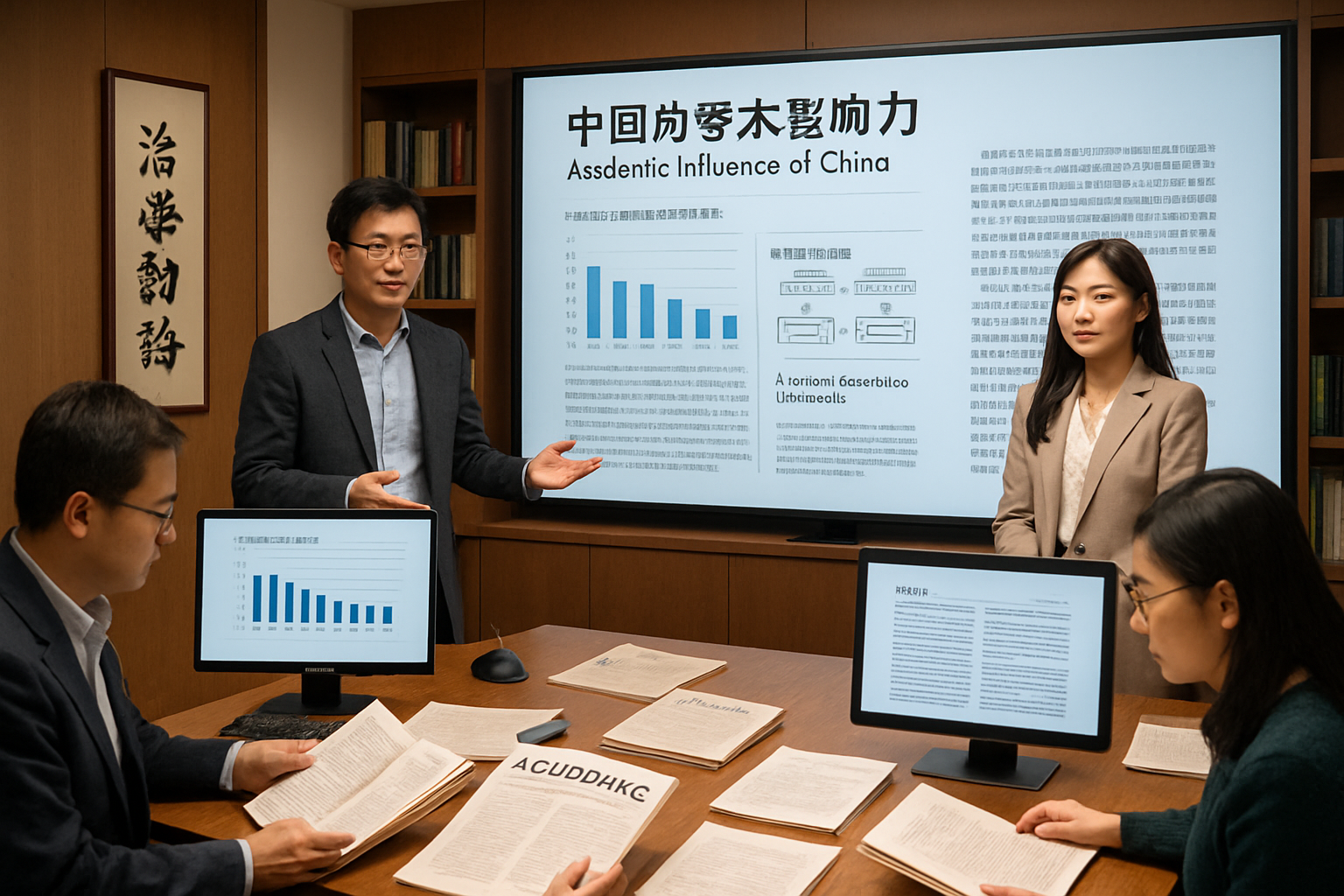
Chinese researchers have introduced a revolutionary methodology for evaluating medical and life science journals worldwide that abandons the traditional "impact factor" system, representing China's most significant challenge to Western academic publishing dominance in decades.
The Dongbi Index, unveiled in Shanghai on March 21, 2026, encompasses 4,027 medical journals and 3,064 life-science publications selected from more than 40,000 worldwide periodicals. Academic experts view this systematic departure from established Western metrics as part of China's broader strategy to strengthen its "academic discourse power" on the global stage.
Breaking From Western Academic Paradigms
The new evaluation system represents a fundamental shift from the impact factor model that has dominated academic publishing since its introduction by Eugene Garfield in the 1960s. While traditional impact factors measure citation frequency, the Dongbi Index employs alternative criteria that Chinese researchers argue provide more comprehensive assessments of scholarly value.
This development aligns with broader Chinese educational reforms documented throughout 2026, where universities have systematically replaced traditional language degree programs with comprehensive regional and area studies courses emphasizing "Chinese analytical frameworks" rather than Western academic models.
Strategic Context and Global Implications
The timing of this announcement is particularly significant, occurring during what observers have termed China's "academic sovereignty movement." This initiative parallels China's technological advancement across multiple sectors, from achieving breakthrough AI capabilities despite export restrictions to developing indigenous space technologies that rival Western competitors.
The Dongbi Index launch comes amid China's remarkable scientific achievements in 2026, including successful AI-powered analysis of lunar far-side samples and revolutionary advances in quantum computing applications for healthcare. These developments collectively signal China's transition from technology recipient to innovation leader across multiple domains.
"This represents China developing uniquely Chinese frameworks for understanding world affairs independent of Western academic paradigms."
— Academic Policy Expert, Shanghai Institute
International Academic Response
The international academic community has responded with mixed reactions to China's departure from established evaluation systems. While some scholars welcome alternative approaches to measuring academic impact, others express concern about potential fragmentation of global academic standards.
European universities, already grappling with funding challenges and evolving research partnerships, now face decisions about whether to engage with Chinese evaluation frameworks. The development particularly impacts institutions that have invested heavily in improving their traditional impact factor rankings.
Technical Innovation Behind the System
The Dongbi Index incorporates advanced analytical techniques, including AI-powered content analysis and comprehensive peer review networks spanning multiple languages and cultural contexts. This technological sophistication reflects China's broader integration of artificial intelligence across academic and research institutions.
The system's development required substantial faculty retraining and curriculum development, but Chinese officials argue it creates opportunities for innovative educational approaches that combine traditional Chinese scholarly traditions with contemporary analytical requirements.
Economic and Political Dimensions
Beyond academic implications, the Dongbi Index represents an economic and political statement about intellectual independence. China's control over critical research evaluation systems could influence international collaboration patterns, funding decisions, and career advancement pathways for scholars worldwide.
This initiative occurs alongside China's expansion of international academic programs, including the Zhiyuan AI research initiative attracting global talent to Beijing, and strategic partnerships across the Global South that emphasize knowledge sharing over traditional academic hierarchies.
Future of Global Academic Publishing
The success or failure of the Dongbi Index will likely influence academic policy decisions across Asia and other regions seeking to develop independent analytical capabilities. Countries from Africa to Latin America are closely monitoring whether China's approach provides a viable alternative to Western-dominated academic discourse.
Industry experts predict that the emergence of competing evaluation systems could lead to a more multipolar academic landscape, where different regions employ distinct metrics for measuring scholarly achievement. This fragmentation raises questions about international research collaboration and standardization.
Challenges and Implementation
Despite its ambitions, the Dongbi Index faces significant implementation challenges. International publishers, editorial boards, and tenure committees worldwide remain heavily invested in traditional impact factor systems. Convincing global academic institutions to recognize alternative metrics will require sustained effort and demonstrated value.
The system must also prove its credibility through transparent methodology and consistent application across diverse research fields. Critics argue that any evaluation system risks political bias, particularly when developed by a single nation's institutions.
As China continues to assert its academic independence through initiatives like the Dongbi Index, the global research community stands at a crossroads. Whether this represents the beginning of a more diverse and inclusive approach to academic evaluation, or the fragmentation of international scholarly standards, remains to be determined through the practical implementation of these revolutionary assessment frameworks.