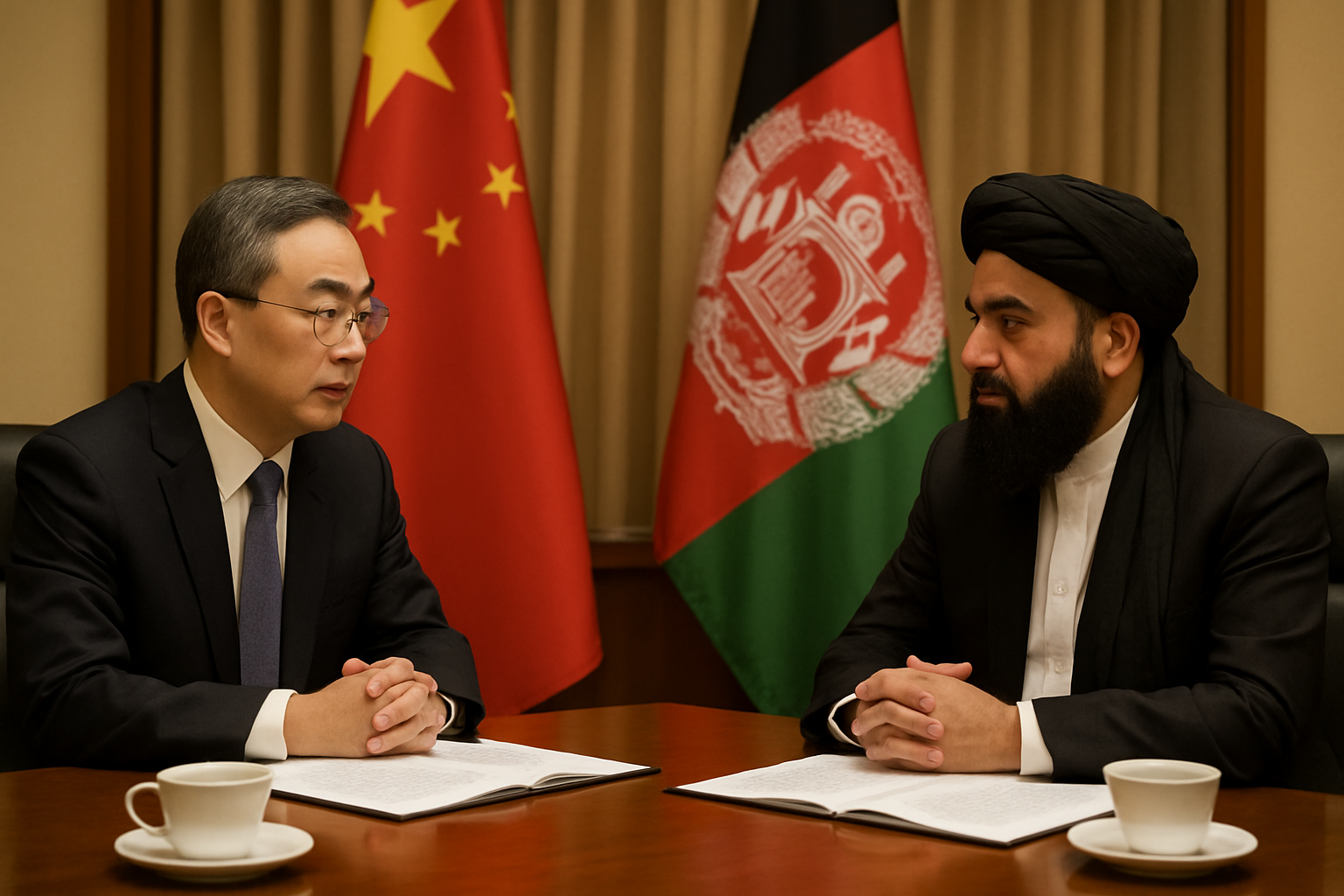
China's Ambassador to Kabul, Zhao Xing, has told Afghanistan's Foreign Minister Amir Khan Muttaqi that Beijing is actively working to create an atmosphere of trust between Afghanistan and Pakistan through neutral cooperation and sustained diplomatic dialogue.
The high-level meeting, which took place in the context of ongoing regional tensions, focused on bilateral cooperation, regional developments, and the continuing dialogue process between Afghanistan and Pakistan. According to a statement from Afghanistan's Ministry of Foreign Affairs, the discussions were held against the backdrop of talks that have been taking place in the Chinese city of Urumqi.
Chinese Mediation Framework
Ambassador Zhao emphasized China's commitment to maintaining neutrality while facilitating constructive dialogue between the two neighboring countries. During the meeting, he expressed hope that, given an understanding of the regional geopolitical situation, the process of confidence-building, goodwill, and tension-free relations between Afghanistan and Pakistan would continue to gain momentum.
The Chinese diplomatic initiative comes at a critical juncture in regional security, as Pakistan and Afghanistan have experienced months of escalating tensions along their disputed border. The crisis, which began in February 2026 following a deadly attack in Pakistan's Bajaur district that killed 11 Pakistani soldiers, has evolved into the most serious military confrontation between the two countries since the Taliban's return to power in 2021.
Historical Context of Regional Tensions
The current diplomatic crisis has deep roots in the disputed nature of the 2,640-kilometer Durand Line, the colonial-era border established by the British in 1893 that has never been formally recognized by Afghan governments. Pakistan maintains that the Tehreek-e-Taliban Pakistan (TTP) operates "with impunity from Afghan soil," while the Taliban government categorically denies providing sanctuary to militant groups.
"China hopes both sides maintain calm, conduct face-to-face talks as soon as possible, establish a ceasefire, and resolve disputes through dialogue."
— Wang Yi, Chinese Foreign Minister
The escalation reached its peak in February 2026 when Pakistani Defense Minister Khawaja Asif declared "open war" against the Taliban government, launching Operation Ghazab-ul-Haq. The sustained military campaign has resulted in significant civilian casualties and economic devastation, with bilateral trade between the two countries collapsing by 59% over seven months.
Humanitarian Impact and Regional Consequences
The ongoing crisis has created a severe humanitarian emergency across the region. According to the UN Office for the Coordination of Humanitarian Affairs (OCHA), over 16,370 families have been newly displaced across 10 Afghan provinces. The UN Assistance Mission in Afghanistan (UNAMA) has documented 289 civilian casualties, including 76 deaths and 213 injuries, with the majority being women and children.
The World Health Organization has been forced to provide emergency medical oxygen to only 23 hospitals, while hundreds of health centers have been closed due to security concerns and lack of funding. The economic warfare has particularly affected border communities, with traditional trade routes through Chaman-Spin Boldak and Torkham facing repeated closures.
International Mediation Efforts
China's current diplomatic intervention represents the latest in a series of international mediation attempts. Previous efforts by Saudi Arabia, Turkey, Iran, and Russia have achieved only temporary successes, including a brief Eid al-Fitr ceasefire in March 2026 that was immediately violated.
Foreign Minister Muttaqi expressed gratitude to his Chinese counterpart and their diplomatic team for facilitating and hosting the Urumqi talks, acknowledging China's growing role as a regional mediator. The Chinese initiative is particularly significant given Beijing's substantial economic interests in both countries through the China-Pakistan Economic Corridor (CPEC) and its strategic partnerships across Central Asia.
Nuclear Dimensions and Regional Security
The crisis has taken on additional urgency due to Pakistan's nuclear capabilities, making this the most serious confrontation involving a nuclear-armed power since the Taliban's return to governance. Chinese officials have repeatedly warned the UN Security Council about the presence of ISIS-K, al-Qaeda, and the East Turkestan Islamic Movement (ETIM) in Afghanistan, claims that contradict the Taliban's assertions about having defeated terrorism.
Pakistan has acknowledged its diminished regional influence compared to wealthier powers such as Turkey, UAE, Qatar, Saudi Arabia, and China itself, leading to an increased reliance on military solutions. This dynamic has complicated traditional diplomatic approaches and heightened the importance of neutral mediation by powers like China.
Economic Warfare and Trade Disruption
The conflict has resulted in devastating economic consequences that extend far beyond the immediate border regions. Pakistan's exports to Afghanistan have plummeted from $550 million to $228 million over a seven-month period, representing one of the steepest bilateral trade collapses in recent regional history.
This economic disruption compounds Afghanistan's existing humanitarian crisis, where 88% of female-headed households are unable to meet minimum living requirements according to UN data. The closure of traditional trade routes has particularly affected remote communities in provinces like Nuristan, where residents have appealed for road reopening due to severe supply shortages of essential goods and medical supplies.
Challenges to Sustainable Peace
Despite China's diplomatic efforts and the temporary successes achieved through religious diplomacy during Ramadan, significant challenges remain to achieving lasting peace. The fundamental disagreement over territorial sovereignty versus transnational terrorism management continues to fuel tensions between the two neighbors.
The Taliban maintains that "the path of talks remains open" and seeks resolution through "mutual understanding and respect," while Pakistan indicates it has "no rush" to end its military campaign without concrete measures against anti-Pakistan militant groups. This divergence in positions highlights the complex nature of the security challenges that any mediation effort must address.
Template for 21st-Century Conflict Resolution
The success or failure of China's mediation efforts will have implications far beyond the immediate region, potentially serving as a template for managing similar conflicts where territorial sovereignty disputes intersect with transnational terrorism concerns. The crisis tests whether innovative diplomatic frameworks can effectively balance security imperatives with territorial integrity, civilian protection, and international law compliance.
The involvement of multiple regional and international actors—from Saudi Arabia and Turkey to Russia and Iran—demonstrates the global concern over preventing a broader regional confrontation. The stakes extend beyond bilateral relations to affect international security architecture and regional stability mechanisms worldwide.
Looking Forward
As China continues its diplomatic intervention, the coming weeks will be crucial in determining whether sustained international mediation can overcome the cycle of military escalation. The Chinese approach, emphasizing neutrality and practical cooperation, offers a potential pathway forward that acknowledges the legitimate security concerns of both parties while prioritizing civilian welfare and regional stability.
The international community faces increasing pressure to develop effective conflict prevention mechanisms before the crisis escalates into a broader regional confrontation with potentially catastrophic consequences for millions of civilians caught between two nuclear-armed neighbors. China's diplomatic efforts represent both an opportunity and a test of whether sustained engagement can address the root causes of one of the most serious security challenges in contemporary South Asian geopolitics.