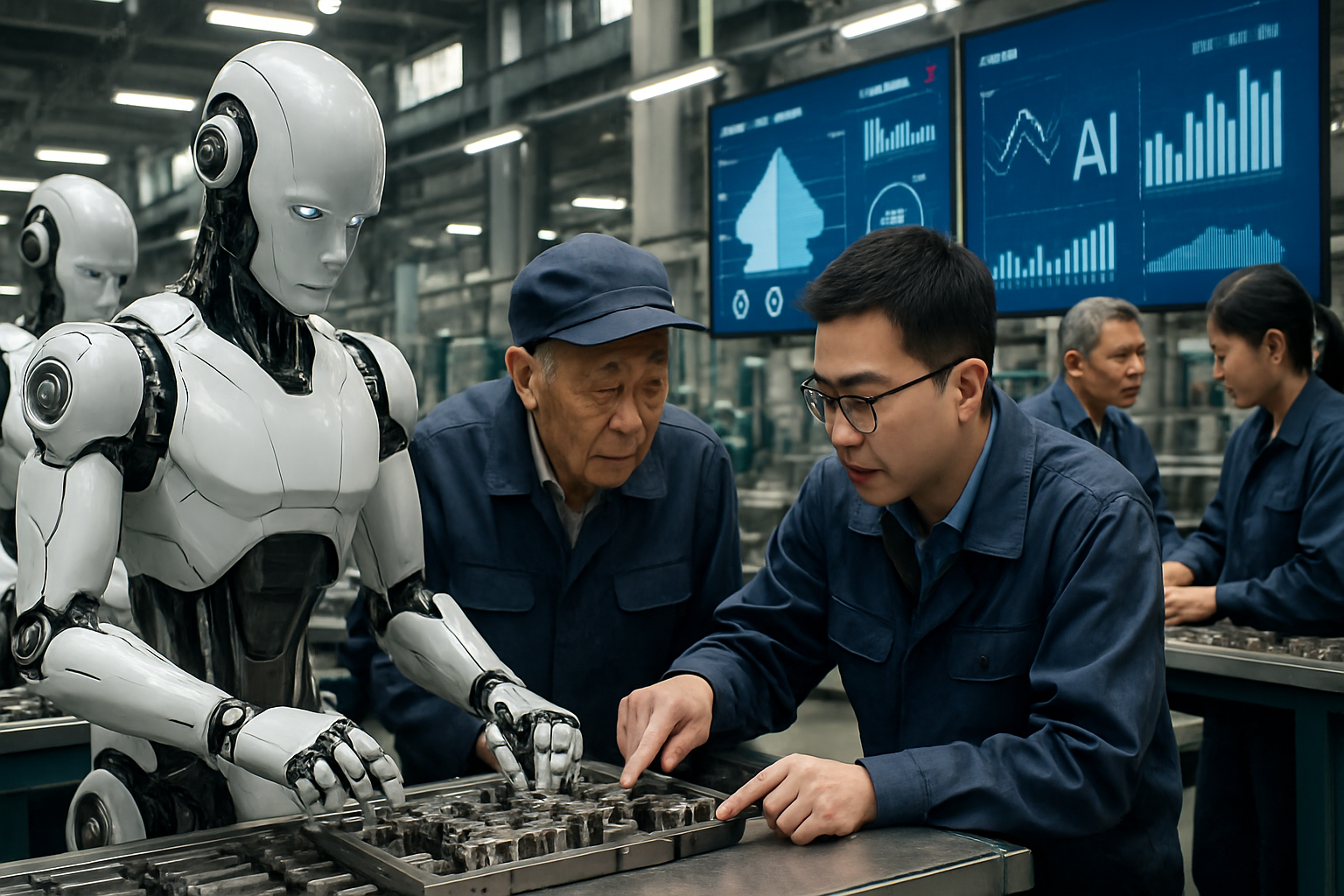
China's aggressive artificial intelligence adoption and robotics development is emerging as a strategic response to mitigate the severe economic impacts of the world's most rapidly aging population, according to analysts at Bank of America Global Research who argue that demographic pressures are accelerating investment in technological solutions across Asia's major economies.
The analysis comes as China confronts an unprecedented demographic crisis, with recent data showing the nation's birth rate has plummeted to historic lows while its working-age population shrinks rapidly. However, rather than accepting inevitable economic decline, Chinese companies and policymakers are betting heavily on artificial intelligence and automation to maintain productivity levels despite workforce contraction.
Demographic Crisis Drives Innovation Investment
Bank of America analysts note that demographic pressure is "accelerating investment in robotics and artificial intelligence in rapidly aging yet technologically advanced countries," specifically citing China alongside South Korea and Japan. This represents a fundamental shift in how major economies are approaching the traditional relationship between population growth and economic expansion.
The urgency of this technological pivot becomes clear when examining China's demographic trajectory. The nation faces what demographers call the "4-2-1 problem," where single children must support four aging parents and grandparents - a consequence of decades of population control policies that created today's inverted population pyramid.
"Demographic pressure is accelerating investment in robotics and artificial intelligence in these rapidly aging yet technologically advanced countries, helping offset labor shortages and sustain productivity even as populations shrink."
— Bank of America Global Research Analysts
This demographic reality has sparked unprecedented innovation in China's technology sector. Recent developments include Unitree Robotics scaling humanoid robot production from 5,500 to 20,000+ units, representing one of the world's largest commercial robotics expansions. Chinese companies demonstrated sophisticated kung fu and lion dance capabilities during Spring Festival celebrations, marking the transition from laboratory research to mass production deployment.
AI Integration Across Economic Sectors
China's response extends far beyond individual company initiatives. The government's 15th Five-Year Plan has elevated "AI Plus" as a national priority, emphasizing "safe and orderly development" while maintaining competitive advantage in global technology markets. This comprehensive approach integrates artificial intelligence throughout the economy rather than treating it as a standalone sector.
The strategy appears to be producing measurable results. China recently achieved a logistics automation efficiency record with a 13.9% GDP ratio, demonstrating how systematic AI implementation can drive productivity gains that potentially offset demographic headwinds. This efficiency breakthrough suggests that technological adoption may indeed provide pathways to sustained economic growth despite population decline.
Major technology companies are responding with massive investment commitments. Midea Group, which owns German robotics manufacturer Kuka, recently committed 60 billion yuan ($8.7 billion) over three years for "AI, embodied intelligence and other cutting-edge areas" - matching their total spending over the previous five years. This acceleration reflects the urgency Chinese leadership places on technological solutions to demographic challenges.
Global Context and Competitive Dynamics
China's demographic-driven AI strategy is unfolding within a broader global context of technological competition and infrastructure constraints. The world currently faces a severe semiconductor shortage with memory chip prices surging sixfold, affecting major manufacturers Samsung, SK Hynix, and Micron until at least 2027. Despite these constraints, Chinese companies continue aggressive expansion, often developing memory-efficient algorithms and alternative processing architectures.
This technological adaptation amid resource scarcity demonstrates China's systematic approach to overcoming traditional limitations. While Western companies like Alphabet and Amazon have committed $185 billion and $1 trillion respectively to AI infrastructure, China's approach emphasizes optimization and efficiency over raw computational power - potentially providing sustainable competitive advantages.

Successful Implementation Models
Early evidence suggests China's human-AI collaboration approach may be succeeding where other models have failed. The nation operates the world's first AI-integrated Islamic school in partnership with Malaysia, demonstrating culturally sensitive technological integration. Additionally, Chinese companies are implementing comprehensive worker transition programs rather than mass layoffs, showing commitment to maintaining social stability during technological transformation.
These implementation strategies reflect lessons learned from other Asian economies facing similar demographic pressures. Japan, with 30% of its population over 65, and South Korea, experiencing even more severe birth rate declines, provide cautionary examples of the economic consequences of aging populations without adequate technological adaptation.
Regional Leadership in AI Governance
China's approach increasingly positions the country as a leader in responsible AI development. Recent regulatory frameworks require comprehensive AI content labeling and emphasize "safe and orderly development" - potentially providing global templates for managing AI integration while preserving social stability.
This regulatory sophistication, combined with massive technological investment, positions China uniquely among major economies confronting demographic transitions. Unlike purely market-driven approaches in Western countries or purely technological solutions, China's model integrates social stability, cultural preservation, and economic transformation.
Economic Impact and Global Implications
The success or failure of China's AI-demographic strategy carries implications far beyond national borders. As the world's second-largest economy and largest manufacturing base, China's ability to maintain productivity growth despite population decline could reshape global economic assumptions about the relationship between demographics and development.
Recent trade data shows China achieved a 21.8% export surge in early 2026, suggesting that technological adaptation may already be producing measurable economic benefits. This performance occurs despite conservative GDP growth targets of 4.5-5% - the first time below 5% in thirty years - indicating that quality of growth may be replacing quantity as the primary metric.
International cooperation patterns are also evolving. China recently announced zero-tariff access for all 53 African countries with diplomatic relations, effective May 2026, demonstrating how technological capabilities can support expanded international engagement even amid domestic demographic pressures.
Challenges and Critical Decisions Ahead
Despite promising early indicators, significant challenges remain. The global infrastructure crisis, including semiconductor shortages and massive AI water demands projected at 4.2-6.6 billion cubic meters by 2027, could constrain China's technological expansion. Additionally, maintaining social cohesion during rapid technological transformation requires unprecedented coordination between government, companies, and civil society.
International observers note that March 2026 represents a "critical inflection point" for AI development globally. China's demographic-driven approach must prove sustainable not just economically, but socially and environmentally. Success could establish templates for other aging societies, while failure might necessitate more dramatic economic adjustments.
"This is the most critical AI juncture since the technology boom began. Success requires unprecedented coordination between innovation acceleration and safety governance, commercial interests and human welfare."
— Technology Policy Analysts
The stakes extend beyond economic metrics to fundamental questions about human dignity, cultural preservation, and the role of technology in society. China's approach emphasizes technology as a tool for enhancing human capabilities rather than replacing them - a philosophy that could influence global AI development patterns for decades.
Looking Forward: A Model for Global Aging
As demographic transitions accelerate worldwide, China's AI integration strategy provides crucial data points for other nations facing similar challenges. The combination of massive technological investment, comprehensive social support systems, and regulatory frameworks designed to preserve human welfare while enabling innovation represents a sophisticated response to one of the 21st century's defining challenges.
Whether this approach proves successful will largely determine not only China's economic trajectory but global patterns of technological adoption in aging societies. The next several years will provide critical evidence about whether artificial intelligence can indeed mitigate the economic impacts of demographic decline while preserving the human elements that define social prosperity.
For policymakers worldwide, China's demographic-AI experiment offers both inspiration and caution. The scale of investment and systematic implementation demonstrates what comprehensive technological adaptation looks like, while the social and environmental challenges highlight the complexity of managing such transitions responsibly.
As the world watches China navigate this unprecedented combination of demographic decline and technological acceleration, the results will influence approaches to aging populations, AI governance, and economic development strategies across the globe. The success of this grand experiment may well determine whether technology serves humanity's highest aspirations or merely postpones more fundamental reckonings with demographic reality.