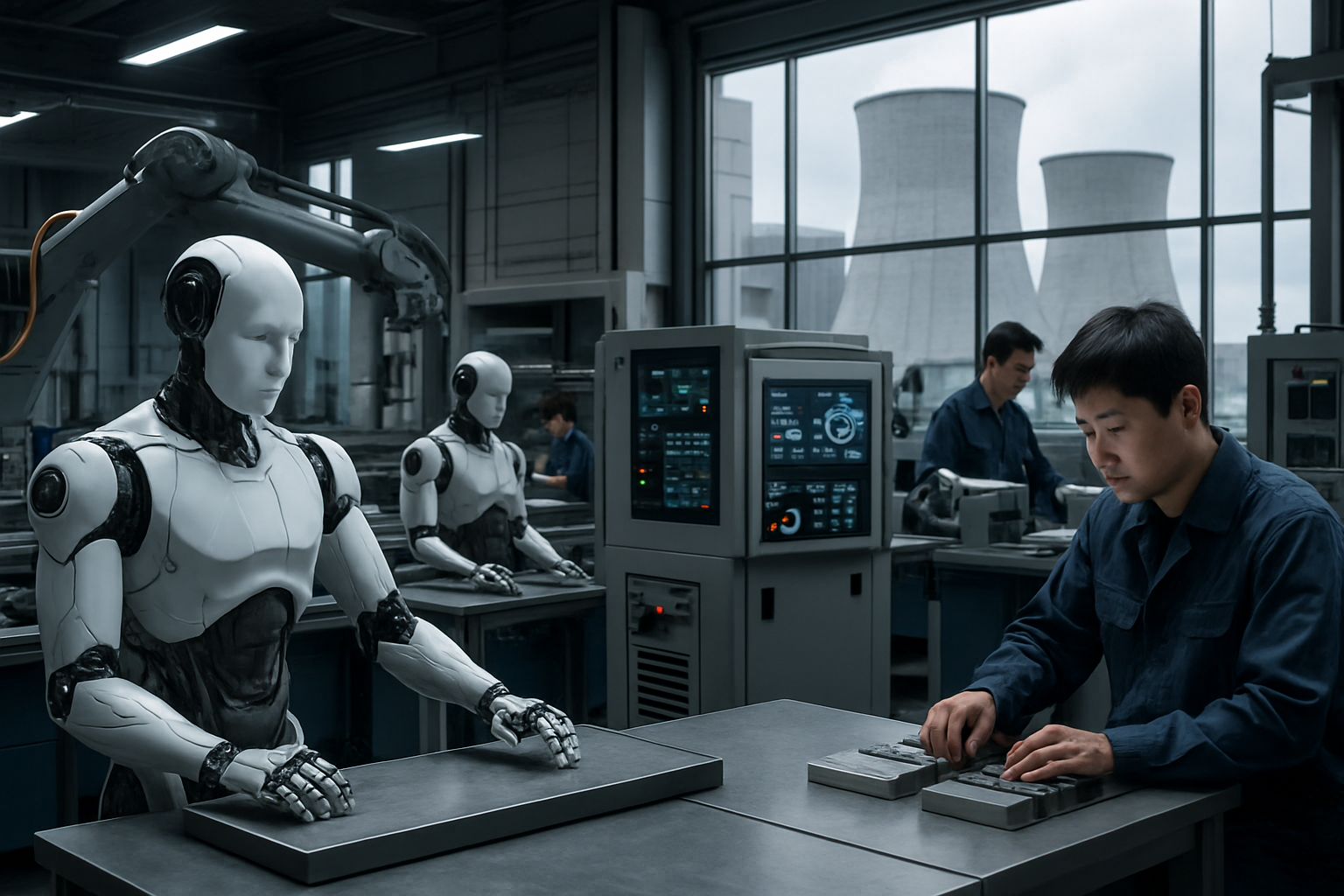
China is rapidly transforming its industrial landscape through a dual technological revolution: robots are taking over dangerous, dirty, and dull factory jobs while the nation has claimed the world's top position in nuclear power capacity, reaching approximately 125 million kW according to the "China Nuclear Energy Development Report 2026."
This unprecedented technological acceleration represents China's strategic response to what experts term the "4-2-1 problem" – a demographic crisis where single children must support four aging parents and grandparents, a consequence of decades of population control policies. The convergence of artificial intelligence, robotics, and nuclear power positions China at the center of what industry analysts describe as a "civilizational choice point" in 2026.
Robotics Revolution Reshapes Manufacturing
Chinese factories are witnessing a fundamental transformation as robots rapidly replace human workers in what industry professionals call "3D jobs" – those that are dirty, dangerous, and dull. This shift is reshaping the country's industrial workforce in ways that were unimaginable just a few years ago.
The pace of this robotics adoption is staggering. Unitree Robotics, one of China's leading humanoid robot manufacturers, has scaled production from 5,500 units in 2025 to over 20,000 units in 2026, representing the fastest laboratory-to-commercial transition in global robotics history. During Spring Festival 2026, four major Chinese companies – Unitree, Galbot, Noetix, and MagicLab – showcased sophisticated humanoid robots performing kung fu and lion dances to over 600 million global viewers.
"We are witnessing the most significant workplace transformation since the Industrial Revolution, but this time it's happening at unprecedented speed and scale."
— Industry analyst tracking China's robotics expansion
Chinese companies are pursuing what experts describe as a "human-centered automation" approach, emphasizing worker transition programs and reskilling rather than mass layoffs. This contrasts sharply with Western approaches that have often resulted in widespread job displacement. Xiaomi Corporation has already deployed humanoid robots in electric vehicle manufacturing facilities for complex assembly, quality control, and material handling operations.
Nuclear Power Leadership Achieved
Parallel to the robotics revolution, China has achieved a milestone that positions it as the global leader in nuclear energy capacity. According to the "China Nuclear Energy Development Report 2026," the nation now boasts approximately 125 million kW of installed nuclear power capacity, surpassing all other countries.
This nuclear leadership comes at a critical time when global energy security faces unprecedented challenges. The achievement represents not just technological prowess but strategic foresight in developing clean energy infrastructure capable of supporting the massive computational demands of AI and robotics systems.
The timing is particularly significant given China's National Energy Administration's recent declaration of hydrogen as a "strategic lever" for energy resilience amid Middle East conflicts. The integration of nuclear power with hydrogen production capabilities could provide China with a comprehensive clean energy advantage that supports both domestic industrial transformation and international competitiveness.
Strategic Response to Demographic Crisis
China's aggressive push into AI and robotics is fundamentally driven by demographic necessity. The "4-2-1 problem" creates an urgent need for technological solutions to maintain productivity and social stability as the population ages rapidly. Bank of America analysis reveals this AI and robotics development as a strategic response to mitigate severe economic impacts of the world's most rapidly aging population.
The systematic deployment of AI and robotics across Chinese industry has already produced measurable results. China achieved a logistics automation efficiency record of 13.9% of GDP ratio through systematic AI implementation, demonstrating tangible productivity gains that could offset demographic headwinds.
This approach differs markedly from Western strategies. While companies in North America and Europe often pursue AI adoption for cost reduction through workforce elimination, Chinese firms are implementing comprehensive transition programs that maintain social stability while boosting technological capabilities.
Global Competition Intensifies
China's technological advancement occurs during what experts characterize as March 2026's "critical inflection point" – the transition of AI from experimental technology to essential global infrastructure. This transformation is happening amid a global semiconductor crisis that has driven memory chip prices to surge sixfold, affecting major manufacturers like Samsung, SK Hynix, and Micron until at least 2027.
Despite these constraints, China continues aggressive expansion by developing memory-efficient algorithms and alternative architectures. The nation's success with restricted technology access, including breakthroughs like DeepSeek's language models despite US export controls, demonstrates sophisticated technological adaptation capabilities.
International responses include massive Western investments: Alphabet committed $185 billion to AI infrastructure in 2026 (the largest single-year corporate tech investment in history), while Amazon outlined plans exceeding $1 trillion for AI development. However, China's infrastructure-first approach may provide more sustainable advantages than purely financial investments.
Infrastructure Advantages Drive Success
Alibaba Chairman Joe Tsai recently attributed China's AI competitive edge to three strategic advantages: superior power grid infrastructure providing stable energy for massive AI computational requirements, strategic commitment to open-source AI models enabling collaborative development, and complete domestic manufacturing supply chains reducing vulnerability to geopolitical disruptions.
These foundational advantages become even more significant as the World Bank projects AI water demand of 4.2-6.6 billion cubic meters annually by 2027 for data center cooling – equivalent to 4-6 times Denmark's total annual consumption. China's proactive electrical grid modernization positions the country to meet these enormous energy demands more effectively than competitors.
The nation's manufacturing integration provides additional resilience against supply chain vulnerabilities affecting Western competitors. China controls 60% of critical mineral production and 90% of refining capacity, offering strategic supply chain leverage during the current global semiconductor shortage.
International Implications
The success or failure of China's AI-demographic strategy carries implications far beyond national borders. As the world's second-largest economy and largest manufacturing base, China's approach could reshape global assumptions about the relationship between demographics and development, providing a template for other aging societies facing similar technological adaptation challenges.
China's zero-tariff access to all 53 African countries, effective May 2026, demonstrates how technological capabilities support expanded international engagement. The nation's 21.8% export surge in early 2026 suggests technological adaptation is producing measurable economic benefits despite conservative GDP growth targets.
The UN has established an Independent International Scientific Panel with 40 experts for the first fully independent global AI assessment, while European nations intensify regulatory frameworks. Spain implemented the world's first criminal executive liability for tech platforms, and France conducted AI cybercrime raids, representing the most sophisticated global technology governance efforts since internet commercialization.
Human-Centered Approach Sets Precedent
Perhaps most significantly, China's approach emphasizes AI as amplification tools rather than replacement mechanisms, aligning with successful international models like Canada's AI teaching assistants that maintain critical thinking standards, Malaysia's world-first AI-integrated Islamic school, and Singapore's WonderBot 2.0 heritage education program.
This human-centered philosophy contrasts with the "SaaSpocalypse" occurring in Western markets, where hundreds of billions in traditional software market capitalization has been eliminated as AI demonstrates direct replacement capabilities for conventional solutions.
Critical Juncture for Global Technology
Industry experts characterize April 2026 as a critical juncture determining whether AI serves human flourishing versus becoming an exploitation tool beyond democratic accountability. The convergence of China's robotics deployment, nuclear power leadership, and systematic AI integration occurs during what many consider a "civilizational choice point" for technology development.
Success in managing this transformation requires unprecedented coordination between governments, companies, institutions, and civil society to balance innovation acceleration with responsible governance, commercial interests with human welfare, and national competitiveness with international cooperation.
The most promising path forward involves sophisticated human-AI collaboration that amplifies capabilities while preserving creativity, cultural understanding, and ethical reasoning that define human potential. As the window for coordinated action narrows, decisions made in 2026 will establish human-AI relationship patterns for decades to come.
China's dual revolution in robotics and nuclear power represents more than technological advancement – it embodies a comprehensive strategy for maintaining societal stability and economic competitiveness during one of the most significant technological transitions in human history. Whether this approach serves as a model for global adoption or creates new forms of international competition will largely determine the trajectory of technological development for the remainder of the 21st century.