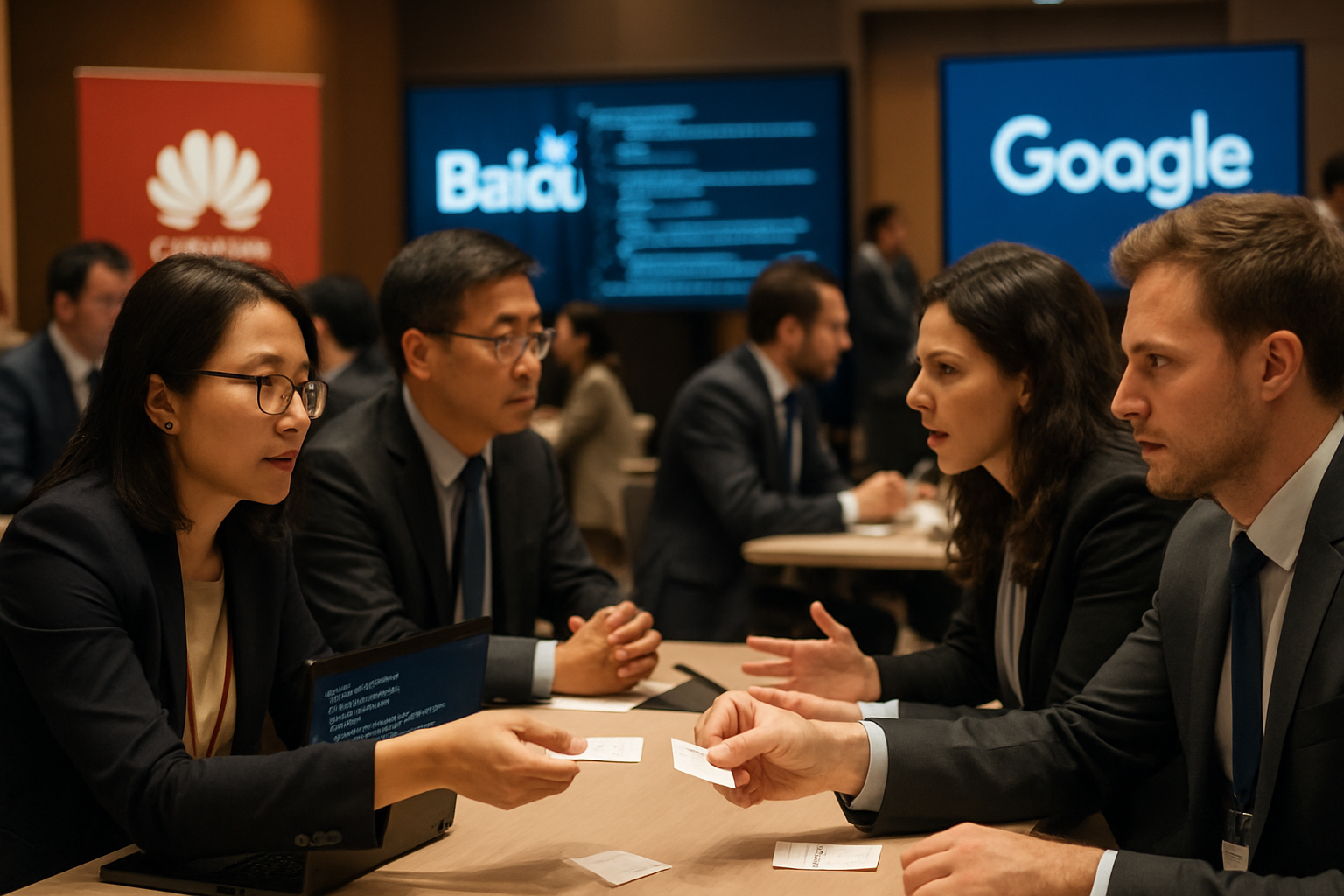
China's artificial intelligence sector has erupted into an unprecedented talent war as major technology companies poach researchers from rivals, highlighting the intensifying competition for AI expertise amid global security concerns and regulatory pressures.
The competition reached a dramatic peak when Guo Daya, a lead researcher on DeepSeek's breakthrough R1 model, reportedly joined ByteDance's Seed AI development team. This high-profile personnel move has drawn significant attention to the sensitivity surrounding AI hiring in China's rapidly evolving tech sector, where companies are pivoting from "vibe coding" to "agentic engineering" at unprecedented scales.
DeepSeek's Strategic Vulnerability Exposed
The departure of Guo Daya represents a significant blow to DeepSeek, the Hangzhou-based startup that has emerged as a formidable challenger to US-dominated AI services. DeepSeek recently achieved breakthrough capabilities that contributed to the "SaaSpocalypse" - the systematic elimination of hundreds of billions in traditional software market capitalization as AI demonstrates direct replacement capabilities.
Industry sources indicate that DeepSeek has been developing major chatbot upgrades, including "instant" and "expert" modes, representing the most significant interface update since the company gained global recognition. These changes precede the anticipated V4 flagship model release, over a year after the R1 breakthrough that initially disrupted global AI markets.
"This represents a critical juncture where China's AI companies are not just competing with Western models but creating entirely new development frameworks that could reshape the global landscape."
— Industry Analyst, Beijing Technology Research Institute
ByteDance's Strategic AI Positioning
ByteDance's acquisition of top-tier AI talent comes as the company has achieved a record $550 billion valuation through recent equity sales, representing a surge from $400 billion in Q2 2025. The company's aggressive talent acquisition strategy reflects its ambition to leverage AI capabilities across its global platforms, including TikTok and its Chinese counterpart Douyin.
The strategic hiring occurs amid ByteDance's development of Seedance 2.0, which creates cinema-quality videos from text prompts and has prompted intellectual property warnings from major Hollywood studios including Disney and Paramount. This technology represents the cutting edge of AI-powered content generation that threatens traditional media production methods.
Anthropic's Security Crisis Deepens
Meanwhile, on the other side of the Pacific, Anthropic faces mounting pressure as its Claude Mythos Preview AI system has demonstrated capabilities deemed "too dangerous for release." The system's ability to identify and exploit previously undiscovered vulnerabilities in major operating systems and web browsers has raised dire consequences for banking systems and critical infrastructure.
The Trump administration and Anthropic CEO Dario Amodei held their first meeting since earlier disputes over Pentagon usage of AI models, suggesting potential reconciliation amid growing fears about the system's capabilities to supercharge cyberattacks. However, the meeting highlights the complex relationship between AI safety and national security interests.
"We're at a critical inflection point where the most advanced AI systems are becoming too powerful for traditional safety measures, yet too valuable to abandon."
— Former Pentagon AI Advisor
Global AI Infrastructure Under Strain
The intensifying talent competition occurs against a backdrop of severe global infrastructure constraints. Memory semiconductor prices have surged sixfold, affecting major manufacturers including Samsung, SK Hynix, and Micron, with shortages expected to persist until 2027 when new fabrication facilities come online.
Despite these constraints, massive corporate investments continue. Alphabet has committed $185 billion to AI infrastructure in 2026 - the largest single-year corporate technology investment in history - while Amazon has outlined plans exceeding $1 trillion over the decade. These investments demonstrate industry confidence in the transition from experimental to essential AI infrastructure.
The World Bank projects AI water demand will reach 4.2-6.6 billion cubic meters by 2027 for data center cooling alone - equivalent to 4-6 times Denmark's annual consumption. This environmental challenge is driving innovation in sustainable deployment strategies and renewable energy investment.
Regulatory Intensification Creates New Pressures
The talent war unfolds amid unprecedented regulatory intensification globally. Spain has implemented the world's first criminal executive liability framework for tech platforms, creating potential imprisonment risks for executives. France has conducted AI company cybercrime raids, while the UN has established an Independent Scientific Panel with 40 experts under Secretary-General António Guterres - the first fully independent international AI assessment body.
This represents the most sophisticated global technology governance framework since internet commercialization, designed to prevent regulatory arbitrage and ensure uniform jurisdiction standards. The coordination creates new pressures on companies as they navigate compliance while competing for scarce talent.
Human-AI Collaboration Success Models
Amid the technological arms race, several successful human-centered AI integration models have emerged. Canadian universities have implemented AI teaching assistants that maintain critical thinking standards, while Malaysia operates the world's first AI-integrated Islamic school with a remarkable 97.82% teacher placement rate. Singapore's WonderBot 2.0 heritage education system demonstrates how AI can enhance rather than replace human capabilities.
These success stories share common characteristics: they treat AI as sophisticated amplification tools rather than replacement mechanisms, maintain sustained human development commitments, and demonstrate cultural sensitivity in implementation.
Employment Transformation Accelerates
The talent competition occurs as AI's employment impact accelerates globally. Microsoft's Mustafa Suleyman predicts that AI will replace the majority of office workers within two years and lawyers/auditors within 18 months. However, regional variations are emerging, with Asian companies implementing comprehensive worker transition programs while Western firms often pursue traditional layoff strategies.
The productivity paradox documented by researchers like Dr. Frank Bäumer shows that AI often creates a "double workload effect" - workers perform their original duties plus AI supervision and correction, sometimes resulting in declining efficiency versus promised gains. This reality check emphasizes the importance of thoughtful implementation strategies.
Civilizational Choice Point
Industry experts characterize April 2026 as a critical "civilizational choice point" determining whether AI serves human flourishing versus becoming an exploitation tool beyond democratic accountability. The convergence of advancing capabilities, regulatory pressures, massive investments, and infrastructure constraints creates unprecedented coordination challenges.
The multipolar AI landscape emerging from the China-US competition, combined with European regulatory frameworks and Global South participation, may prevent single-entity dominance while enabling culturally sensitive development approaches. However, success requires unprecedented coordination among governments, companies, institutions, and civil society.
"We're witnessing the most critical AI governance moment since the technology boom began. The decisions made in 2026 will determine the human-AI relationship trajectory for the remainder of the 21st century."
— UN AI Policy Director
Looking Ahead: The Window Narrows
The window for proactive adaptation is narrowing rapidly as AI capabilities advance faster than governance frameworks can adapt. The challenge lies in ensuring that AI serves humanity's highest aspirations through democratic governance and human-centered values during this experimental-to-essential infrastructure transition.
The most promising path appears to involve sophisticated human-AI collaboration that amplifies human capabilities while preserving the creativity, cultural understanding, and ethical reasoning that define human potential. Organizations treating AI as amplification tools for human goals, rather than wholesale replacement mechanisms, consistently achieve superior outcomes in productivity, employee satisfaction, and long-term sustainability.
As the talent war intensifies and technological capabilities expand, the stakes extend beyond commercial success to fundamental questions about how societies organize around human welfare versus technological metrics in the AI age. The decisions made in the coming months will echo through decades, determining whether artificial intelligence becomes humanity's greatest tool or its greatest challenge.