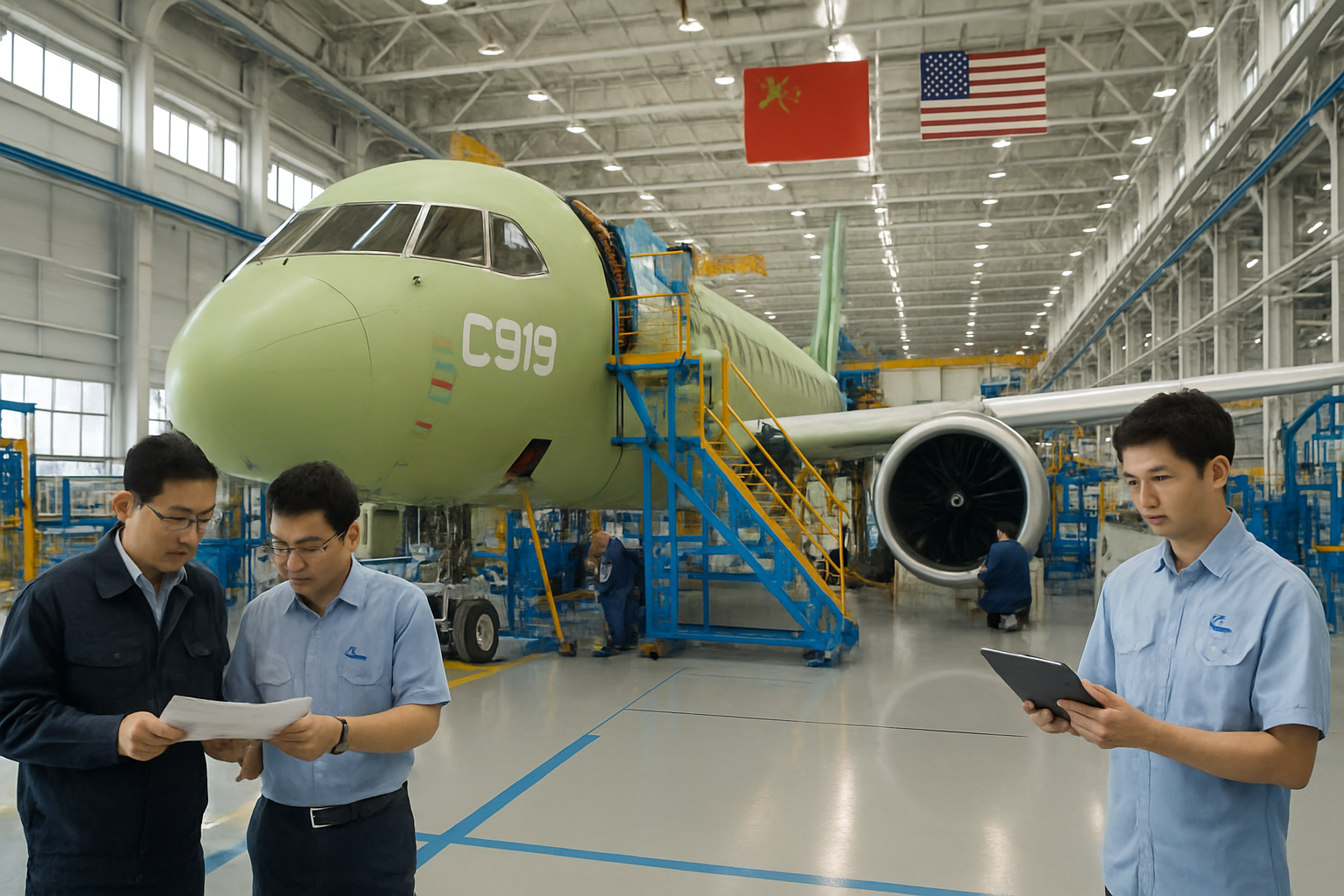
China has announced ambitious five-year targets for its domestic aviation industry, setting the stage for an unprecedented expansion of homegrown aircraft production including the C919 narrowbody jet and development of domestically produced engines to reduce reliance on foreign suppliers.
Beijing's comprehensive national aviation development plan through 2030 represents a direct challenge to the Boeing-Airbus duopoly that has dominated commercial aviation for decades. The initiative encompasses three flagship aircraft models: the C909 regional plane, C919 narrowbody, and C929 widebody aircraft, with particular emphasis on accelerating production and achieving critical component localization.
Strategic Framework for Aviation Independence
The five-year plan calls for dramatic increases in aircraft production capacity, development of indigenous engine technology, and the strategic roll-out of domestically developed propulsion systems. This represents China's most ambitious aviation industry development program since the establishment of the Commercial Aircraft Corporation of China (COMAC).
The next five years will prove vital to the success of China's three aircraft models and the continued localization of critical parts such as engines, avionics, and advanced materials. Industry analysts note that achieving these targets would position China as the world's third major commercial aircraft manufacturer, breaking the Western duopoly that has persisted since the 1970s.
C919 Production Expansion Plans
Central to China's aviation strategy is the aggressive expansion of C919 narrowbody aircraft production. The aircraft, which represents China's answer to the Boeing 737 and Airbus A320 families, has already begun commercial operations with China Eastern Airlines and other domestic carriers.
Recent regulatory developments have strengthened the C919's competitive position. The Civil Aviation Administration of China (CAAC) has proposed allowing C919 aircraft to operate on narrow runways at smaller airports through "special conditions" based on the aircraft's specific design features. This strategic regulatory approach would enable the C919 to access underserved markets, particularly in Southeast Asia where many airports feature narrow runways that larger Western aircraft cannot accommodate.
This regulatory flexibility represents a significant competitive advantage, potentially opening new market segments and routes that have been challenging for Boeing and Airbus to serve effectively. The strategy aligns with China's broader Belt and Road Initiative, positioning Chinese aircraft as optimal solutions for developing aviation markets across Asia, Africa, and Latin America.
Indigenous Engine Development Priority
Perhaps the most critical element of China's five-year aviation plan is the emphasis on developing domestically produced aircraft engines. Currently, the C919 relies on CFM International LEAP-1C engines, a joint venture between American GE and French Safran, making China dependent on Western technology for its flagship commercial aircraft.
The development of indigenous engines represents both a technological challenge and a strategic imperative. Modern commercial aircraft engines require decades of development, extensive testing, and sophisticated manufacturing capabilities. China's push for engine independence reflects broader concerns about technological sovereignty and supply chain security in an era of increasing geopolitical tensions.
Industry experts note that successful engine development would mark a watershed moment for China's aviation industry, providing complete technological independence and eliminating potential vulnerabilities to foreign sanctions or export restrictions. The timeline for achieving operational indigenous engines remains ambitious, with preliminary targets set for the late 2020s.
Global Market Competition Intensifies
China's aviation expansion occurs within a rapidly evolving global aerospace landscape. Recent developments have highlighted both opportunities and challenges for Chinese aircraft manufacturers seeking international market share.
The ongoing recovery of global aviation following pandemic disruptions has created substantial demand for new aircraft. Airlines worldwide are seeking to modernize fleets with fuel-efficient, technologically advanced aircraft. This market environment provides opportunities for Chinese manufacturers to gain footholds with international carriers seeking alternatives to traditional Western suppliers.
Recent diplomatic and trade developments have created additional market opportunities. During German Chancellor Friedrich Merz's February 2026 visit to Beijing, Chinese airlines secured orders for 120 Airbus aircraft, demonstrating continued international aviation cooperation despite broader technological competition. This balanced approach suggests that aviation partnerships can continue even as nations pursue technological independence.
Regional Market Strategy
China's aviation development strategy specifically targets regional markets where infrastructure limitations and operational requirements favor smaller, more flexible aircraft. The proposed CAAC regulations allowing C919 operations on narrow runways exemplify this focused approach to market development.
Southeast Asian aviation markets present particularly attractive opportunities for Chinese aircraft. Many regional airports feature infrastructure constraints that limit operations by larger Western aircraft, while growing regional economies generate increasing demand for air connectivity. Countries including Thailand, Vietnam, Indonesia, and the Philippines represent potential early adopters of Chinese commercial aircraft.
The strategy extends beyond aircraft sales to encompass comprehensive aviation partnerships. China's approach includes pilot training programs, maintenance support, financing arrangements, and infrastructure development assistance, creating integrated aviation ecosystem partnerships that strengthen long-term relationships with customer nations.
Technology Transfer and Innovation
China's aviation development benefits from strategic technology acquisition, international partnerships, and domestic innovation capabilities. The five-year plan emphasizes not merely copying existing technologies but developing indigenous innovations that could provide competitive advantages.
Advanced manufacturing techniques, materials science innovations, and digital technologies are central to China's aviation development strategy. Modern aircraft development requires sophisticated capabilities in composite materials, advanced avionics, fly-by-wire systems, and integrated manufacturing processes.
International cooperation continues despite broader technological competition. European aerospace companies maintain significant partnerships with Chinese manufacturers, providing technology transfer opportunities while accessing China's massive domestic market. This balance between cooperation and competition characterizes the current global aviation landscape.
Economic and Strategic Implications
China's aviation industry development carries significant economic and strategic implications extending far beyond commercial aircraft production. Success would establish China as a comprehensive aerospace power capable of supporting both civilian and military aviation requirements independently.
The economic multiplier effects of a successful aviation industry include high-value manufacturing employment, advanced technology development, international export revenues, and strengthened industrial capabilities. Aviation represents one of the most technologically sophisticated manufacturing sectors, requiring capabilities that strengthen broader industrial competitiveness.
Strategically, aviation independence reduces vulnerabilities to foreign sanctions or export restrictions while providing leverage in international negotiations. Countries with indigenous aviation capabilities possess enhanced strategic autonomy and diplomatic influence, particularly in relationships with nations seeking advanced transportation solutions.
Implementation Challenges
Despite ambitious targets, China's aviation development faces significant implementation challenges requiring sustained investment and technological breakthroughs. Aircraft development timelines are notoriously lengthy and expensive, with high risks of delays and cost overruns.
Certification and international acceptance represent additional challenges. While Chinese aircraft may achieve domestic certification, gaining international airworthiness certifications from authorities including the Federal Aviation Administration (FAA) and European Union Aviation Safety Agency (EASA) requires demonstrating compliance with stringent international standards.
Market acceptance beyond initial government and state-owned enterprise customers requires proving reliability, efficiency, and cost-effectiveness compared to established competitors. Airlines worldwide make aircraft procurement decisions based on rigorous economic analyses, operational requirements, and long-term support considerations.
International Response and Competition
Western aerospace manufacturers are responding to Chinese competition through innovation acceleration, market diversification, and strategic partnerships. Boeing and Airbus continue developing next-generation aircraft technologies while strengthening relationships with traditional customer bases.
European and American governments are implementing policies to maintain technological advantages while managing competitive pressures. These include export controls on sensitive technologies, research and development investments, and support for domestic aerospace industries.
The emergence of Chinese aviation competition is prompting broader discussions about supply chain security, technological sovereignty, and the future structure of global aerospace markets. Traditional Western dominance in commercial aviation faces its first serious challenge since the industry's establishment.
Future Outlook
The success of China's five-year aviation development plan could fundamentally reshape global aerospace markets. Achievement of production targets and technological milestones would establish China as a permanent fixture in international aviation, providing alternatives to Western aircraft for airlines worldwide.
Industry forecasts suggest that successful implementation could capture 10-15% of global commercial aircraft market share by 2035, representing hundreds of billions of dollars in revenues and thousands of high-technology employment opportunities.
The broader implications extend to geopolitical influence, technological capability, and economic competitiveness. Aviation serves as both a symbol and substance of national technological achievement, with successful programs enhancing international prestige and strategic influence.
As China enters this critical five-year period for aviation development, the global aerospace industry watches closely. The outcomes will determine whether commercial aviation remains a Western duopoly or evolves into a more competitive, multipolar marketplace offering greater choices for airlines and passengers worldwide.