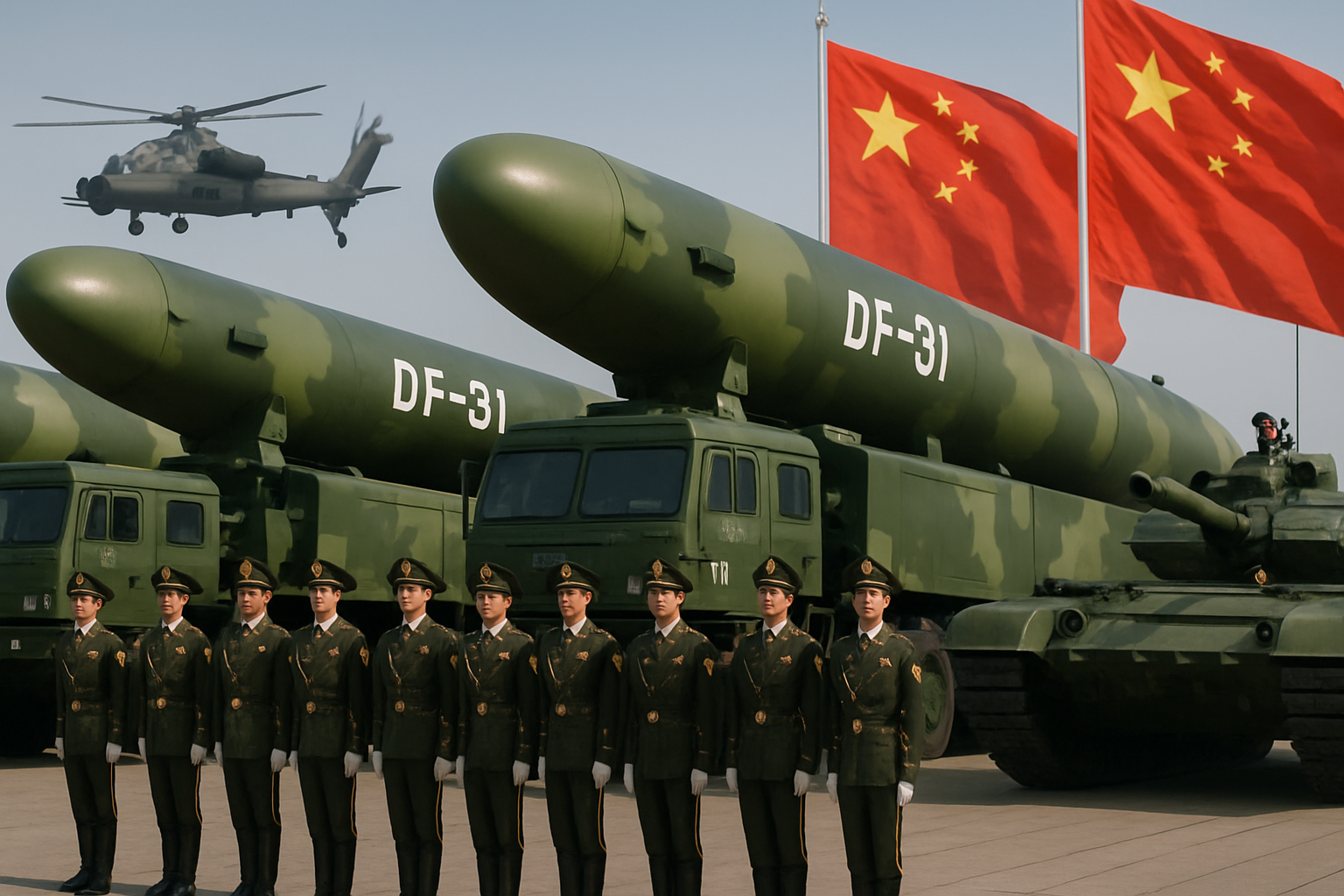
China has announced a 7% increase in military spending for 2026, bringing its defense budget to €238.7 billion ($259 billion), as Beijing seeks to modernize its armed forces amid rising regional tensions and economic challenges.
The defense budget announcement came during China's annual "Two Sessions" parliamentary meetings in Beijing, representing the most significant policy-setting gatherings for the world's second-largest economy. Despite the substantial increase, China's military expenditure remains approximately one-third of the United States' defense spending, according to international comparisons.
Strategic Context and Regional Implications
The defense budget increase comes against a backdrop of heightened tensions across the Indo-Pacific region. Chinese military activity around Taiwan has surged 23% in 2025, with daily aircraft deployments designed to "exhaust" the Taiwanese population, according to Taiwan's Defense Minister Wellington Koo. These sustained pressure campaigns have drawn international attention and concern from regional allies.
The timing is particularly significant given Japan's recent political transformation. Prime Minister Sanae Takaichi's Liberal Democratic Party achieved a historic supermajority in February 2026 elections, providing her with unprecedented authority to pursue constitutional reforms that could enhance Japan's defense capabilities. This development has prompted Beijing to reassess its regional strategic approach.
"China's military modernization continues at an unprecedented pace, requiring sustained international attention and coordinated responses from democratic allies."
— Regional Security Analyst
Economic Targets and Domestic Priorities
Alongside the defense budget announcement, China revealed a five-year economic plan emphasizing investments in innovation, high-tech industries, and scientific research. The government has set a GDP growth target of 4.5%-5% for 2026, signaling tolerance for slower economic expansion as Beijing focuses on technological advancement and strategic capabilities.
This dual approach of military strengthening and economic modernization reflects China's comprehensive national strategy. The country continues to invest heavily in critical infrastructure projects, including what officials describe as the world's most complex railway construction through southwestern China's mountainous terrain, expected for completion by 2030.
International Response and Alliance Dynamics
The defense budget increase has drawn varied international responses. European leaders, including German Chancellor Friedrich Merz during his recent Beijing visit, emphasized the need for "fair" economic competition while acknowledging China's evolution from a "lucrative market to competitive threat" in high-tech manufacturing.
China's strategic positioning has been further complicated by President Trump's planned March 31-April 2 summit with Xi Jinping, following recent diplomatic engagement that established frameworks for managing competition. However, Taiwan remains the central issue in US-China relations, with Xi Jinping calling it "the most important issue" during recent high-level communications.
Military Modernization and Technological Advancement
The increased defense spending will likely support China's ongoing military modernization efforts, including advances in hypersonic weapons technology and naval capabilities. Recent reports indicate significant progress in defense technology, with new systems described as representing major advancements in China's military portfolio.
China's defense industry has demonstrated resilience despite international sanctions and export restrictions. The country continues to develop sophisticated capabilities in artificial intelligence applications for military use, autonomous systems, and advanced manufacturing technologies crucial for modern warfare.
Regional Security Architecture
The defense budget announcement occurs during a period of significant geopolitical realignment in Asia-Pacific. North Korea's military parade in February 2026, featuring 14,000 troops but notably excluding nuclear weapons displays, alongside conditional diplomatic overtures toward the United States, adds complexity to regional security calculations.
China's relationship with Russia has also evolved, particularly following the restoration of US-Russia military communications in February 2026 after a four-year suspension. This diplomatic breakthrough, achieved during Abu Dhabi trilateral talks, represents a shift in great power dynamics that Beijing must navigate carefully.
Economic and Trade Dimensions
China's defense spending increase comes amid mixed economic signals. While the country announced zero-tariff access for 53 African countries beginning May 2026 in the most comprehensive China-Africa trade expansion in history, it faces challenges from memory semiconductor shortages affecting major companies like Lenovo, which reported a 21% profit decline.
The government's unified national power market reforms support its 2030 carbon-peak targets, demonstrating an attempt to balance environmental commitments with strategic resource allocation for defense purposes.
Looking Forward: Strategic Implications
China's 7% defense budget increase reflects Beijing's assessment that military strength remains essential for achieving its strategic objectives. The sustained investment in defense capabilities, combined with technological advancement and infrastructure development, positions China as a comprehensive challenger to existing international power structures.
As regional tensions continue to evolve, the international community faces the challenge of managing competition with a militarily strengthened China while maintaining opportunities for cooperation on global challenges. The success of diplomatic frameworks in preventing military escalation will largely determine the trajectory of Asia-Pacific security for years to come.
The defense budget announcement ultimately represents more than financial allocation—it signals China's commitment to reshaping regional and global power dynamics through sustained military modernization, technological advancement, and strategic patience in pursuing its long-term objectives.