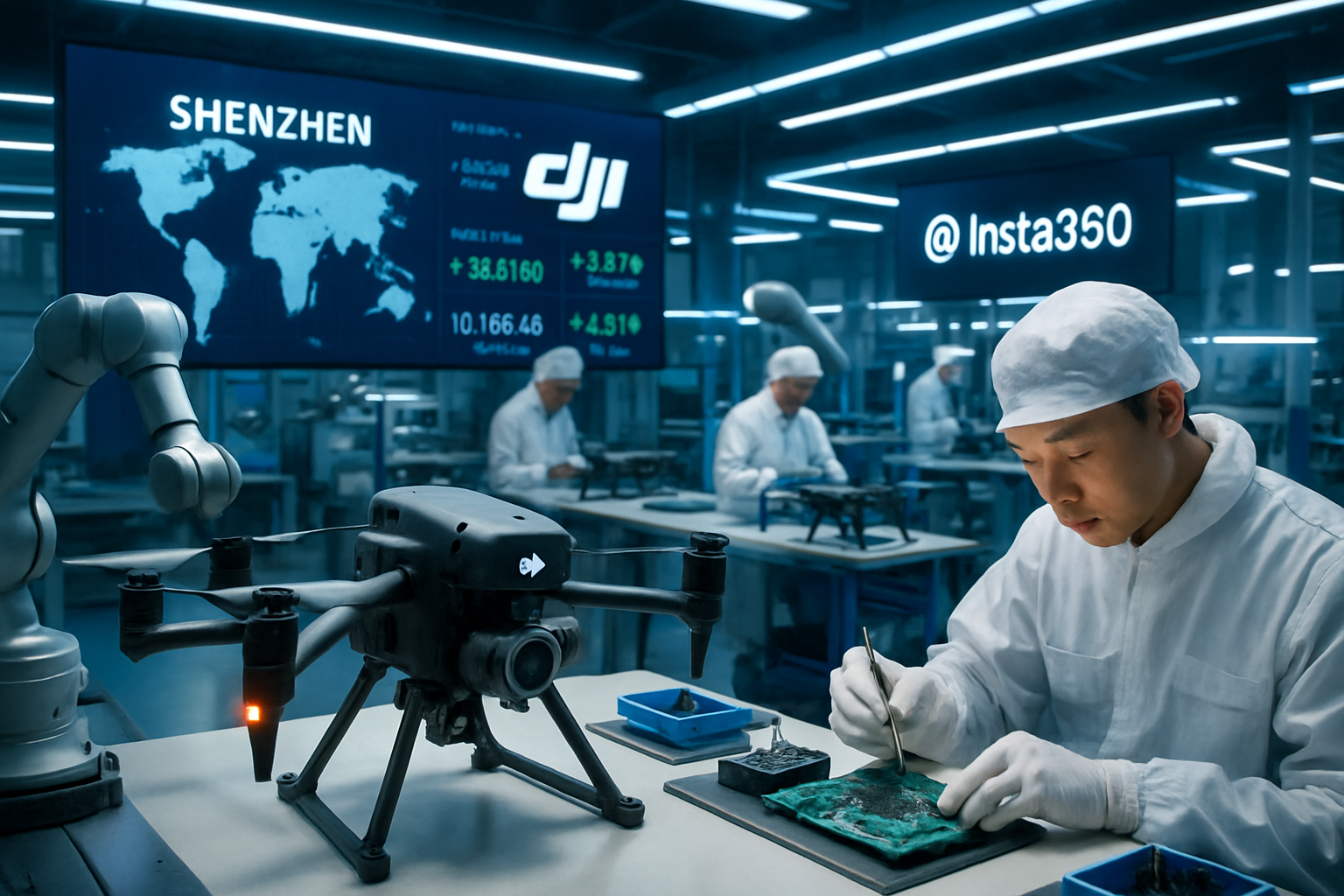
In Shenzhen's sprawling tech hub, a neighborhood rivalry between drone giant DJI and camera innovator Insta360 has evolved into a microcosm of China's ambitious drive for global hardware supremacy—a campaign unfolding against the backdrop of escalating US scrutiny and technological restrictions.
The two companies, once celebrated as complementary champions of Chinese innovation, now find themselves locked in an increasingly fierce competition that extends far beyond their shared Nanshan district headquarters. This corporate duel represents a pivotal moment for China's technology sector as it navigates mounting geopolitical pressures while pursuing unprecedented technological sovereignty.
The Shenzhen Silicon Valley: Where Innovation Meets Competition
DJI's dominance in consumer drones and Insta360's leadership in panoramic cameras once seemed like perfect examples of specialized innovation within China's hardware ecosystem. Both companies flourished in Shenzhen's unique environment—a city that has evolved from manufacturing hub to global technology center in just four decades.
However, as global markets mature and US restrictions intensify, these former allies are expanding into each other's territories. DJI's recent push into action cameras directly challenges Insta360's core market, while Insta360's exploration of drone-mounted camera systems encroaches on DJI's aerial imaging dominance.
"The competition between these two companies reflects a broader transformation in China's approach to global hardware markets," explains a senior industry analyst familiar with both companies.
— Industry Observer, Speaking on Background
China's Comprehensive Hardware Strategy
The DJI-Insta360 rivalry occurs within China's larger technological sovereignty campaign, which has accelerated dramatically throughout 2026. From memory semiconductor development to AI infrastructure, Chinese companies are pursuing comprehensive capabilities across the entire technology stack.
This strategic approach gained urgency following the global semiconductor crisis that drove memory chip prices sixfold higher, affecting Samsung, SK Hynix, and Micron through 2027. China's response has been characteristically systematic—developing indigenous alternatives while maximizing existing advantages in manufacturing scale and supply chain control.
China maintains 60% of global critical materials production and 90% of refining capacity for lithium, cobalt, and rare earth elements essential for advanced electronics. This dominance provides Chinese hardware manufacturers with structural advantages that competitors struggle to replicate.
Navigating US Regulatory Pressure
The intensifying competition unfolds amid unprecedented US regulatory scrutiny of Chinese technology companies. Export controls on advanced semiconductors, restrictions on AI development tools, and enhanced security reviews have fundamentally altered the competitive landscape for Chinese hardware manufacturers.
DJI, in particular, faces sustained pressure from US authorities concerned about data security and potential surveillance capabilities. These restrictions have accelerated the company's innovation in alternative markets and pushed it toward greater technological independence.
Similarly, the broader Chinese technology sector has adapted to restrictions through innovative circumvention strategies, memory-efficient algorithms, and alternative partnership frameworks. Companies like DeepSeek have demonstrated the ability to achieve breakthrough AI capabilities using restricted hardware, while manufacturing giants like Unitree Robotics scaled production from 5,500 to 20,000+ humanoid robots in 2026.
The Global Hardware Transformation
The rivalry between DJI and Insta360 reflects broader shifts in global hardware markets, where traditional product categories are blurring and companies must either expand or risk obsolescence. The "SaaSpocalypse"—the elimination of hundreds of billions in traditional software market value due to AI disruption—has intensified pressure on hardware companies to differentiate through integrated software-hardware solutions.
This transformation requires unprecedented investment in research and development. Despite infrastructure constraints, major technology companies continue massive investments: Alphabet committed $185 billion to AI infrastructure in 2026, while Amazon outlined $1+ trillion development plans. Chinese companies are pursuing similar scales of investment while emphasizing open-source collaboration and domestic supply chain development.
Technological Innovation Under Pressure
The current hardware crisis has paradoxically spurred innovation. Memory-efficient algorithms, sustainable deployment strategies, and alternative processing architectures have emerged from constraint-driven innovation. Chinese companies have proven particularly adept at maximizing capabilities while minimizing hardware requirements.
DJI's advancement in aerial refueling AI systems for military applications and hybrid propulsion technology for battlefield drones demonstrates the company's evolution beyond consumer products. Meanwhile, Insta360's exploration of professional cinematography and virtual production technology positions it for emerging entertainment markets.
"We're witnessing a fundamental shift from competing on individual products to competing on comprehensive technological ecosystems."
— Shenzhen Technology Development Official
International Implications
The success of Chinese hardware companies carries implications extending far beyond corporate competition. China's technological advancement challenges traditional Western dominance in high-technology sectors while creating new dependencies for global supply chains.
European responses have included the "Made in Europe" industrial policy requiring European participation in strategic sectors, while maintaining pragmatic economic cooperation. Germany's recent trade missions to China, despite acknowledging the country's evolution from "lucrative market to competitive threat," demonstrate the complexity of managing technological competition alongside economic interdependence.
The United States has pursued more confrontational approaches through export controls and security reviews, though constitutional limitations on tariff authority have shifted focus toward alternative mechanisms for managing technology transfer and competition.
The Path Forward
As DJI and Insta360 continue their neighborhood rivalry, the stakes extend well beyond corporate market share to fundamental questions about technological sovereignty, international cooperation, and economic security in an increasingly multipolar world.
The April 2026 period has been characterized by industry experts as a "civilizational choice point"—a critical juncture determining whether technological advancement serves human flourishing through democratic governance or becomes a tool for surveillance and control. The outcomes of competitions like DJI versus Insta360 will influence this trajectory for decades.
Success will likely depend on companies' ability to balance innovation acceleration with responsible development, commercial interests with human welfare, and national competitiveness with international cooperation. The most promising path appears to be sophisticated human-technology collaboration that amplifies capabilities while preserving creativity, cultural understanding, and ethical reasoning.
For China's hardware sector, the DJI-Insta360 rivalry represents both opportunity and challenge. Victory requires not just technological superiority but also the ability to navigate complex geopolitical pressures while maintaining global market access and partnership opportunities.
The winner of this Shenzhen showdown may ultimately determine not just market leadership in drones and cameras, but the broader trajectory of China's technological ascendance in an era of great power competition.