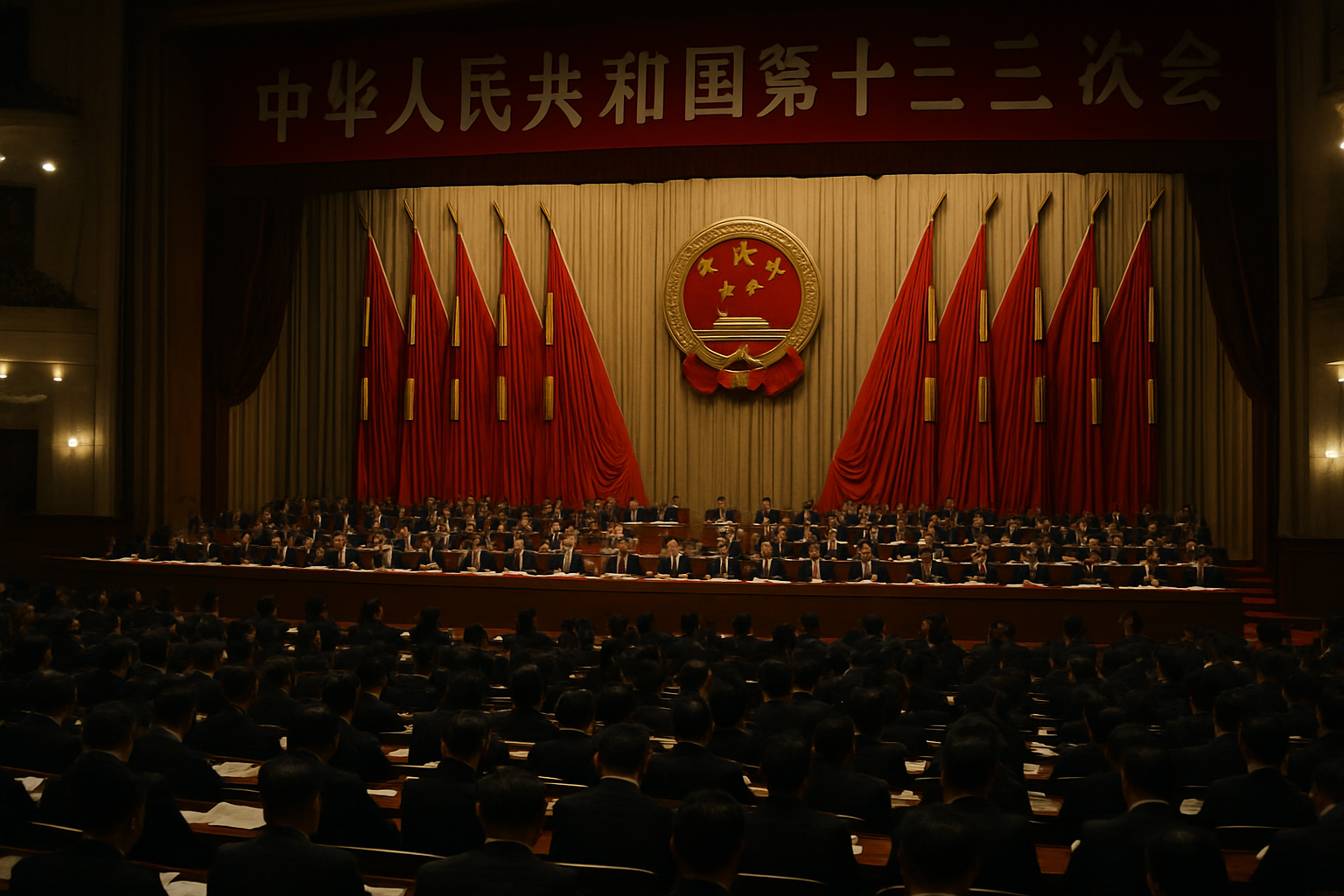
China has set its lowest economic growth target since 1991, aiming for 4.5-5% GDP growth in 2026, marking a significant shift from high-speed expansion to what President Xi Jinping calls "high-quality development" focused on technological innovation and strategic resilience.
The announcement came during the opening of China's "Two Sessions" - the annual meetings of the National People's Congress and Chinese People's Political Consultative Conference - in Beijing on Thursday, March 5, 2026. This target represents the first time in three decades that China has set a growth goal below 5%, acknowledging mounting economic pressures while prioritizing strategic technological advancement.
Defense Spending Outpaces Economic Growth
Despite the modest growth target, China allocated 1.91 trillion yuan (US$277 billion) for defense spending, representing a 7% increase from the previous year. This military budget growth significantly exceeds the economic expansion target, underscoring Beijing's commitment to military modernization even amid economic constraints.
The defense budget increase, though slightly down from last year's 7.2% rise, maintains China's steady military investment trajectory as the country approaches its 2035 military modernization deadline. The spending reflects China's assessment that military strength remains essential for achieving long-term strategic objectives in an increasingly complex global environment.
"We will seize the commanding heights of science and technological development and seek decisive breakthroughs in key core technologies."
— Chinese Five-Year Plan Document, March 2026
Technological Innovation Takes Center Stage
China's new five-year policy blueprint reveals unprecedented ambitions for artificial intelligence integration throughout the economy. The plan calls for aggressive AI adoption across all sectors and aims to dominate emerging technologies including quantum computing and humanoid robots.
President Xi Jinping, addressing deputies from Jiangsu province, emphasized that major regional economies must lead in developing "new quality productive forces" - referring to emerging industries that will drive future growth. This technological focus represents a fundamental shift from traditional manufacturing-heavy economic models toward innovation-driven development.
According to a separate report from China's state planning body, the country now leads globally in research and development across AI, biomedicine, robotics, and quantum technology. "China now leads the world in research and development and application in fields such as AI, biomedicine, robotics and quantum technology, and new breakthroughs were made in the independent R&D of chips," the report stated.
Economic Transition Amid Global Challenges
The conservative growth target reflects China's recognition of structural economic challenges, including an aging population, property sector difficulties, and ongoing trade tensions. The shift toward "high-quality growth" acknowledges that the era of double-digit expansion driven by massive infrastructure investment and export manufacturing is ending.
China's diplomatic budget also received significant attention, expanding by 9.3% to 70.975 billion yuan (US$10.28 billion) - the highest increase in three years. This expansion signals Beijing's plans to consolidate its geopolitical influence as global instability mounts, particularly as the United States reduces its international commitments.
Regional and International Implications
The economic recalibration comes as China faces intensified regional security challenges. Chinese military activity around Taiwan increased 23% in 2025, with daily aircraft deployments designed to pressure the island's population, according to Taiwan's Defense Minister Wellington Koo.
China's approach contrasts sharply with the confrontational trade policies of the Trump administration, which recently saw its global tariff authority struck down by the U.S. Supreme Court. Beijing has pursued selective cooperation with international partners, including significant tariff reductions for EU dairy products and zero-tariff access for 53 African countries starting May 1, 2026.
The policy announcement occurs against the backdrop of China's strengthening position in global supply chains, controlling 60% of critical minerals production and 90% of refining capacity. This dominance provides Beijing with considerable leverage in international negotiations, particularly regarding renewable energy infrastructure essential for global climate goals.
Domestic Development Balance
China's Two Sessions also highlighted the government's dual approach of maintaining military capabilities while providing tangible domestic benefits. The completion of a massive 50,000-unit housing project in Beijing's Hwasong Area demonstrates the regime's commitment to improving living standards despite economic constraints.
However, the transition to slower growth presents challenges for a system accustomed to rapid expansion. Rural poverty prevention mechanisms and comprehensive social welfare programs are being strengthened to ensure economic stability during the transition period.
Strategic Competition and Cooperation
China's measured approach to economic targets comes as it navigates complex international relationships. The upcoming Trump-Xi summit scheduled for March 31-April 2 in Beijing will test whether diplomatic engagement can produce sustainable frameworks for managing the defining geopolitical relationship of the 21st century.
The economic strategy reflects what analysts describe as China's preparation for sustained strategic competition while maintaining opportunities for cooperation. By setting realistic growth expectations and investing heavily in technological capabilities, Beijing appears to be positioning itself for long-term competition rather than pursuing short-term economic gains.
As China's "Two Sessions" continue, the world's second-largest economy is clearly signaling a fundamental shift in its development model. The move from high-speed to high-quality growth, backed by unprecedented investment in defense and technology, marks a new chapter in China's economic evolution with profound implications for global economics and security.