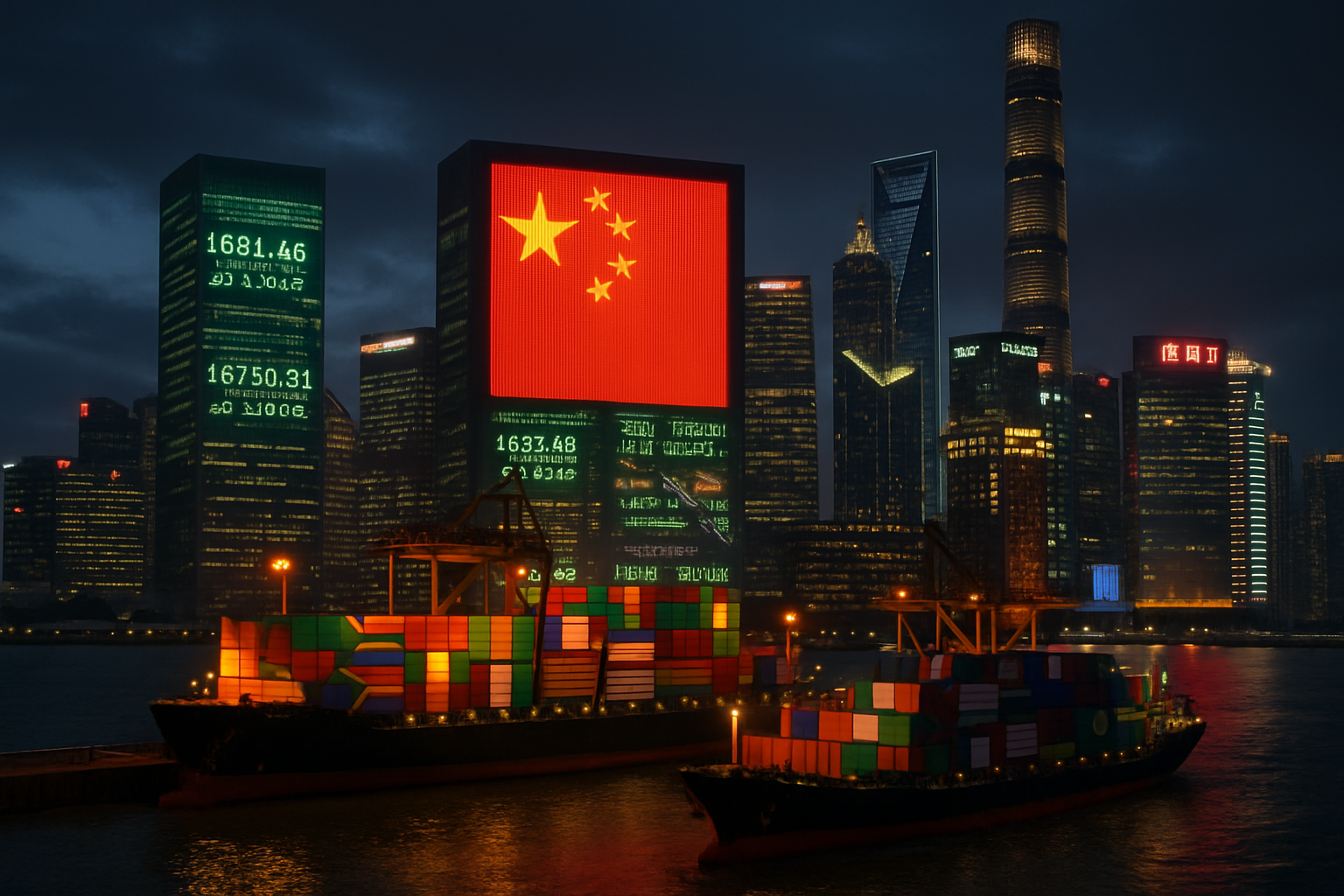
China's Foreign Ministry spokesperson Mao Ning declared that the country's long-term economic fundamentals remain sound despite setting its first GDP growth target below 5% in three decades, as Beijing navigates complex trade relationships and addresses significant data discrepancies with key partners including South Africa.
Speaking at a regular press briefing on Friday, Mao emphasized that China is "fully aware of the difficulties and challenges it faces" but stressed that the underlying conditions supporting the economy's long-term positive trajectory "have not changed." Her remarks came as China announced a modest 4.5%-5% GDP growth target for 2026 during the National People's Congress, marking a deliberate policy shift toward sustainable development over rapid expansion.
Historic Export Performance Defies Economic Headwinds
Despite the cautious growth projections, China's trade performance has delivered remarkable results in early 2026. Export data released by customs authorities revealed a stunning 21.8% surge in the first two months of the year, reaching $656.58 billion in combined January-February figures. This represents a dramatic acceleration from the 6.6% growth recorded in December 2025 and the 5.5% annual growth rate for all of 2025.
The export boom demonstrates China's resilience in international markets and suggests strong momentum for the remainder of the year, according to trade experts. The performance is particularly noteworthy given last year's high baseline, indicating that Chinese manufacturers and exporters have successfully adapted to evolving global demand patterns.
"China has both institutional strengths and the advantages of a large economy. The country's development prospects will remain promising as long as it makes full use of these strengths and properly addresses challenges."
— Mao Ning, Foreign Ministry Spokesperson
South Africa Trade Data Mystery Creates Bilateral Tensions
However, China's trade relationships face scrutiny over significant data discrepancies that complicate bilateral assessments. A particularly striking case involves South Africa, where the two countries report vastly different trade balances that differ by approximately $17 billion.
According to Chinese customs data, China recorded $30.58 billion in imports from South Africa, suggesting that South Africa actually maintains a trade surplus with the world's second-largest economy—a finding that contradicts South African officials' long-standing complaints about trade imbalances favoring China. The discrepancy has become a recurring issue when South African and Chinese officials meet to discuss trade relations.
This data inconsistency highlights broader challenges in measuring bilateral trade flows in an era of complex global supply chains, re-exports through third countries, and different statistical methodologies. The inability to agree on basic trade figures complicates efforts to address legitimate concerns about trade balance and market access.
Strategic Economic Recalibration
The deliberately lower GDP growth target for 2026 represents what analysts describe as a "rewriting of the growth playbook" rather than an admission of economic weakness. This strategic pivot comes as China faces multiple challenges including property sector adjustments, demographic pressures from an aging population, and the need to transition toward a more consumption-driven economic model.
During the Two Sessions parliamentary meetings, Premier Li Qiang outlined achievements from the 14th Five-Year Plan period (2021-2025), noting that China's economic output reached new levels with an increase of approximately 10 trillion yuan. The government work report emphasized the need for high-quality development that balances growth targets with environmental sustainability and social welfare improvements.
Global Trade Relationships Under Pressure
China's trade policies are being closely watched as the country navigates complex relationships with major partners amid shifting global dynamics. The export surge comes at a time when China has announced significant policy changes, including zero-tariff access for 53 African countries beginning May 1, 2026—representing the most comprehensive expansion of China-Africa trade relations in modern history.
This initiative, coupled with recent reductions in EU dairy import tariffs from 21.9%-42.7% to 7.4%-11.7%, demonstrates China's selective approach to trade liberalization. The dairy tariff reduction, affecting over $500 million in trade, concluded an 18-month anti-dumping investigation and provides European exporters with predictability for a five-year period.
Meanwhile, China continues to face pressure from the US-EU-Japan Critical Minerals Partnership, which involves 55 countries working to challenge China's dominance in critical mineral production (60% of global output) and refining (90% of global capacity). This competition for supply chain influence adds another dimension to China's trade relationships.
Domestic Challenges Amid International Success
While export performance remains strong, China faces internal challenges that underscore the government's cautious approach to growth projections. Technology companies like Lenovo have reported significant difficulties, with the computer manufacturer posting a 21% profit decline due to global memory shortages—what CEO Yang Yuanqing described as a "structural issue affecting the entire tech sector."
The government is simultaneously implementing unified national power market reforms to support energy security objectives and the 2030 carbon-peak target, demonstrating the complex balancing act between economic growth and environmental commitments.
Regional Integration and Strategic Positioning
For Hong Kong, China's economic recalibration presents both challenges and opportunities. As one analysis noted, Beijing's policy shifts represent "a test of whether policy alignment can be converted into institutional credibility." Hong Kong's role as a financial gateway for China's international expansion remains crucial as the mainland economy adapts to new growth paradigms.
The province's success in maintaining its position will depend on how effectively it can facilitate China's evolving trade relationships while demonstrating the institutional credibility that international partners seek in an era of heightened geopolitical tensions.
Looking Ahead: Sustainable Growth Model
China's approach to 2026 reflects a maturation of its economic strategy, prioritizing sustainability and quality over pure quantitative expansion. The combination of robust export performance and measured domestic growth targets suggests confidence in China's ability to navigate global uncertainties while building a more resilient economic foundation.
As Foreign Ministry spokesperson Mao Ning emphasized, China's institutional strengths and large economy advantages remain intact. The key challenge will be leveraging these assets effectively while addressing legitimate concerns from trading partners about data transparency and market access—issues that the South Africa trade data discrepancy exemplifies.
The coming months will test whether China's recalibrated economic approach can maintain international competitiveness while building the domestic foundations for long-term prosperity. Success in this balancing act could establish a new model for sustainable development among major economies facing similar pressures between growth imperatives and structural transformation needs.