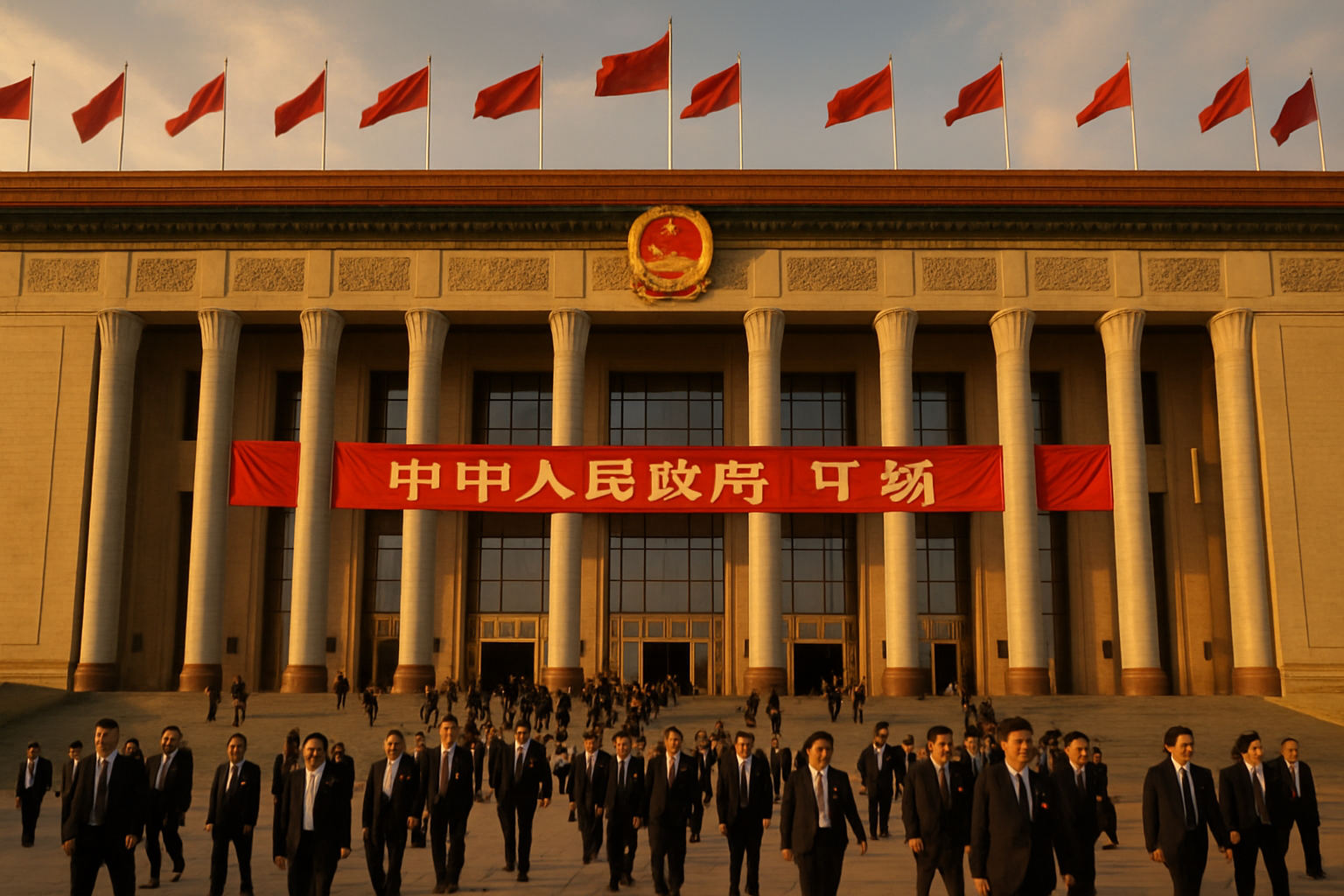
China's leadership has unveiled a comprehensive policy agenda during the ongoing Two Sessions legislative meetings, setting the country's first GDP growth target below 5% in three decades while simultaneously expanding global partnerships and addressing mounting geopolitical pressures.
Historic Economic Recalibration
During the Fourth Session of the 14th National People's Congress, Chinese lawmakers approved a 4.5-5% GDP growth target for 2026, marking the first time since 1991 that the world's second-largest economy has set such a conservative goal. This represents a fundamental shift from high-speed to "high-quality development" focused on technological innovation and sustainable growth.
Premier Li Qiang emphasized the government's commitment to balancing economic momentum with structural transformation, outlining achievements from the 14th Five-Year Plan period (2021-2025) that saw economic output reach new levels with approximately 10 trillion yuan increase.
"We are rewriting the growth playbook, prioritizing technological advancement and sustainable development over pure quantitative expansion."
— Chinese Economic Policy Analyst
The conservative growth target comes alongside robust export performance, with China achieving a remarkable 21.8% export surge in the first two months of 2026, reaching $656.58 billion and representing a dramatic acceleration from the 6.6% December growth rate.
Defense Spending and Regional Security
Despite the measured economic targets, China announced a 7% increase in defense spending for 2026, reaching 1.91 trillion yuan ($277 billion). While this represents the lowest growth rate in five years, the military budget continues to outpace economic growth targets, reflecting Beijing's commitment to military modernization by the 2035 deadline.
The defense spending increase occurs against the backdrop of intensified regional tensions, with Chinese military activity around Taiwan having increased by 23% in 2025. Defense officials emphasized the need for "advanced combat capabilities" and enhanced readiness to address what they termed growing security challenges in the Asia-Pacific region.
Expanding African Partnerships
In a significant diplomatic move, Foreign Minister Wang Yi confirmed the implementation of complete tariff exemption for all African products starting May 1, 2026. This historic trade expansion covers all 53 African countries maintaining diplomatic relations with China, representing the most comprehensive China-Africa trade relationship in modern history.
The zero-tariff policy extends beyond the previous framework that covered 33 least-developed countries, now including agricultural products, minerals, manufactured goods, and textiles from nations across the continent, including Zimbabwe despite ongoing international sanctions.
Legislative Focus on Rural Development
The legislative sessions highlighted China's continued emphasis on rural revitalization and poverty alleviation. Deputies from Yunnan Province shared remarkable stories of transformation, including a teacher who spent 40 years in a village that once housed leprosy patients, helping 126 children receive education, and young entrepreneurs who modernized traditional pig farming operations.
These grassroots success stories underscore China's broader commitment to balanced development, ensuring that economic growth benefits reach rural communities that have historically been marginalized from rapid urbanization and industrialization.
International Media Attention and Global Implications
The Two Sessions have attracted unprecedented international media attention, with foreign journalists and envoys closely monitoring the proceedings for signals about China's development trajectory and global implications. The gathering is being described as a crucial window into policy direction and a source of stability in an increasingly uncertain world.
Russian media representatives and other international observers have particularly focused on how China's economic policies might affect global supply chains and energy markets, especially given the country's significant role in critical minerals production and manufacturing.
Military and Strategic Communications
Military deputies attending the legislative session have engaged in detailed discussions about President Xi Jinping's recent address to the armed forces delegation. Zhang Xiaogang, spokesperson for the People's Liberation Army and People's Armed Police Force delegation, confirmed that Xi's speech has "further enriched and developed the guidelines and policies for enhancing" military capabilities.
These discussions come at a time when China faces complex international security challenges, including ongoing tensions in the Taiwan Strait and broader questions about regional stability in the Asia-Pacific.
Economic Data Challenges and Transparency
The legislative sessions have also addressed challenges in international economic data coordination. A significant $17 billion discrepancy in China-South Africa trade data has highlighted broader issues in measuring bilateral trade flows amid complex global supply chains and different statistical methodologies.
Chinese customs recorded $30.58 billion in imports from South Africa, suggesting a South African trade surplus that contradicts South African officials' complaints about trade imbalances. This discrepancy exemplifies the broader challenges of maintaining transparent and accurate international economic relationships.
Technology and Innovation Priorities
The policy discussions have emphasized China's commitment to becoming a global leader in emerging technologies, with particular focus on artificial intelligence integration throughout the economy and dominance in quantum computing and humanoid robotics. These "new quality productive forces" are seen as crucial drivers of future economic growth.
However, the technology sector faces challenges, as illustrated by Lenovo's reported 21% profit decline due to global memory shortages, which CEO Yang Yuanqing described as a "structural tech sector issue" affecting the broader industry.
Environmental and Energy Commitments
China's legislative agenda includes significant commitments to environmental protection and carbon neutrality goals. The government is implementing unified national power market reforms to support energy security and the 2030 carbon-peak target, demonstrating the integration of economic development with environmental sustainability.
Looking Forward: Strategic Implications
The outcomes of the Two Sessions will significantly influence China's domestic trajectory and international relations during a period of unprecedented global challenges. The decisions made during these meetings affect not only China's 1.4 billion citizens but also global trade patterns, energy markets, and international cooperation frameworks.
As China continues to navigate between domestic development needs and international responsibilities, the policies emerging from these legislative sessions represent a critical test of whether major economies can successfully manage the transition to sustainable development while maintaining global stability and cooperation.
The combination of conservative growth targets with increased defense spending and expanded international partnerships signals China's strategic approach to managing domestic transformation while strengthening its global position in an era of increasing great power competition.