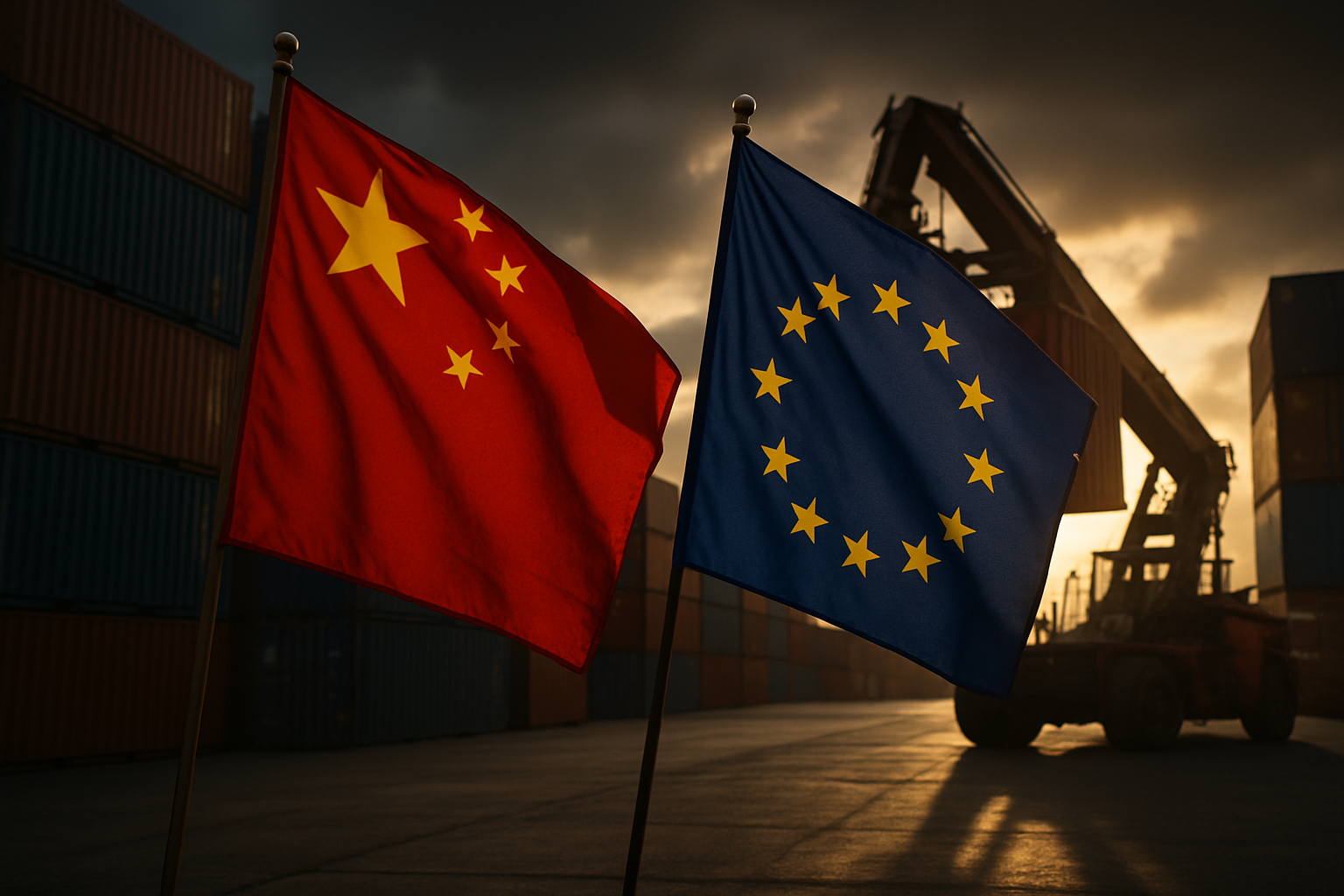
China has issued stark warnings to the European Union over its ambitious "Made in Europe" initiative, threatening countermeasures if Brussels adopts measures that Beijing claims would harm Chinese business interests in strategic sectors.
The escalating diplomatic tension centers on the European Commission's proposed rules requiring companies seeking public funds in critical industries—including automotive, green technology, and steel—to meet local content thresholds. The initiative represents the EU's most significant departure from free-market principles since the bloc's formation, marking a fundamental shift toward strategic trade policy amid intensifying global economic competition.
Beijing's Strategic Response
Chinese officials on Monday criticized the EU's protectionist measures, with Beijing warning it would take countermeasures if the legislation proceeds without considering Chinese interests. The warning comes as tensions over economic dependency and technological sovereignty reach unprecedented levels between the world's second-largest economy and the European bloc.
According to sources from the Cyprus-based publication Polítis, the Commission is advancing legislation requiring companies in strategically important sectors to source "a number or percentage of components" with European "origin." This requirement would fundamentally alter procurement patterns across the 27-member bloc, potentially excluding Chinese suppliers from lucrative European contracts worth hundreds of billions of euros annually.
The confrontation extends beyond economics into questions of technological sovereignty. Recent developments include Chinese sanctions on European firms supporting Taiwan's defense capabilities, creating a complex web of interdependencies and vulnerabilities that both sides are increasingly unwilling to tolerate.
Historical Context: From Partnership to Competition
The current crisis represents the culmination of a dramatic transformation in China-EU relations over the past decade. Historical memory analysis reveals how Brussels has evolved from viewing China as a "lucrative market" to recognizing Beijing as a "competitive threat" in high-tech manufacturing, according to German government assessments.
This shift accelerated following the February 2026 EU competitiveness summit at Alden Biesen castle, where European leaders confronted China's dominance over critical materials production—controlling 60% of global output and 90% of refining capacity. These dependencies create what EU officials have termed "kill switch vulnerabilities" for European infrastructure and strategic industries.
The memory semiconductor crisis, which has driven prices up sixfold, exemplifies these vulnerabilities. European tech companies dependent on Asian suppliers face operational challenges that won't resolve until 2027 when new fabrication facilities come online. Meanwhile, Chinese technological breakthroughs—including circumventing chip restrictions through companies like DeepSeek and scaling robotics production at firms like Unitree—demonstrate Beijing's capacity to work around Western limitations.
The 'Made in Europe' Framework
The contested legislation emerged from extensive deliberations following the March 2026 launch of the EU's comprehensive industrial strategy. Originally encompassing artificial intelligence, semiconductors, quantum computing, biotechnology, and robotics, the policy framework has undergone significant modifications as implementation challenges became apparent.
Austria's Economic Chamber emphasized that "strengthening European industry is the order of the day," supporting accelerated approval procedures and strategic deployment of public procurement preferences. The initiative targets achieving 20% GDP from manufacturing by 2035, reversing decades of deindustrialization while building technological autonomy.
The policy shift from crisis-driven reactions to proactive strategic planning reflects broader European aspirations to establish the continent as a "third pole" in global competition, rather than remaining subordinate to US-China technological dominance. With 89% of Europeans demanding greater EU unity and 86% wanting a stronger global voice according to Eurobarometer polling, democratic mandate exists for ambitious economic integration initiatives.
Implementation Challenges and German Ambivalence
Germany's complex position illustrates the practical challenges facing the "Made in Europe" initiative. Chancellor Friedrich Merz's recent Beijing visit, which secured 120 Airbus aircraft orders worth billions, demonstrates the economic cooperation that complicates strategic competition goals. Berlin acknowledges China's evolution from partner to competitor while maintaining significant commercial relationships that employ hundreds of thousands of Europeans.
The enhanced cooperation mechanism allows groups of nine or more member states to advance policies without unanimous consent—essential for navigating complex economic challenges while preserving European unity. However, balancing competitiveness with cohesion, strategic autonomy with international cooperation, and democratic governance with competitive survival pressures remains an ongoing struggle.
Implementation across 27 diverse economies with varying exposure to Chinese trade creates additional complexity. Estonia's success achieving 88% renewable electricity generation with Europe's largest battery storage capacity demonstrates energy independence possibilities, while other nations face greater adjustment challenges in transitioning supply chains.
Digital Sovereignty Integration
The industrial policy coordinates with broader European digital sovereignty initiatives, including Slovakia's €1.3 billion digital euro pilot program, Spain's criminal executive liability framework for tech platforms, and France's enhanced social media enforcement operations. These measures address what Brussels identifies as US cloud dependency vulnerabilities alongside Chinese digital infrastructure concerns, creating comprehensive sovereignty strategies beyond single sectors.
The approach reflects sophisticated understanding that technological independence requires coordinated action across multiple domains rather than sector-specific interventions. Success depends on developing frameworks protecting European interests without creating self-defeating isolation from global technological progress.
Economic and Geopolitical Stakes
The China-EU confrontation occurs amid broader economic pressures, including Trump administration bilateral trade deals that bypass EU multilateral frameworks. Argentina's elimination of over 1,600 tariffs and India's duty reductions from 50% to 18% demonstrate American preferences for country-by-country negotiations over engagement with Brussels institutions.
Natural gas prices have surged 24% across Europe, while electricity costs undermine EU electrification strategies despite the Clean Industrial Deal framework. These energy vulnerabilities, combined with supply chain disruptions and memory chip shortages, create immediate pressures that could undermine longer-term strategic planning.
The stakes extend beyond immediate economic concerns to questions of democratic governance in the 21st century. The confrontation tests whether democratic societies can maintain economic sovereignty while participating in global technological development—a balance that authoritarian competitors don't face.
Taiwan Dimension and Security Implications
Taiwan's role in the dispute adds significant complexity, with Beijing's sanctions on European firms supporting Taipei's defense capabilities creating cross-cutting pressures. Wellington Koo, Taiwan's defense minister, emphasized that Chinese sanctions won't disrupt arms supplies due to diversified procurement channels, but the situation illustrates how economic and security issues intertwine in contemporary international relations.
The sanctions demonstrate Beijing's willingness to use economic pressure to advance political objectives, validating European concerns about dependency vulnerabilities. Brussels faces the challenge of maintaining support for democratic partners while managing economic relationships with authoritarian competitors.
Global Template and Future Implications
The China-EU confrontation over "Made in Europe" represents a template-setting moment for 21st-century economic governance. Success in establishing European technological and economic leadership could influence similar initiatives worldwide, while failure risks subordination to US-China systems during a critical period of global economic restructuring.
The crisis tests fundamental assumptions about international economic integration developed during the post-Cold War period. Traditional approaches emphasizing market efficiency and comparative advantage clash with contemporary concerns about supply chain resilience, technological sovereignty, and strategic autonomy.
Resolution of the current tensions will likely influence international approaches to managing economic relationships during an era of intensifying great power competition. The precedent established could either strengthen institutional cooperation through innovative frameworks or accelerate fragmentation as nations prioritize bilateral arrangements over multilateral coordination.
Looking Forward: Critical Juncture
The coming months represent a decisive phase in determining whether Europe can achieve strategic autonomy without triggering destructive economic warfare with China. Beijing's countermeasure threats signal determination to prevent what it sees as discriminatory treatment, while Brussels faces pressure from member states demanding protection from unfair Chinese competition.
The March 2027 implementation timeline for comprehensive reforms creates urgency for resolution, requiring coordination across 27 member states while managing hundreds of billions of euros in investment commitments. Success depends on maintaining the delicate balance between protecting European interests and avoiding escalation that could damage both economies during a period of global uncertainty.
As the world watches this confrontation unfold, the stakes extend far beyond immediate trade concerns to questions about the future of international economic governance, the viability of strategic autonomy for democratic societies, and the possibility of managing great power competition without triggering broader fragmentation of global systems that have underpinned prosperity for decades.