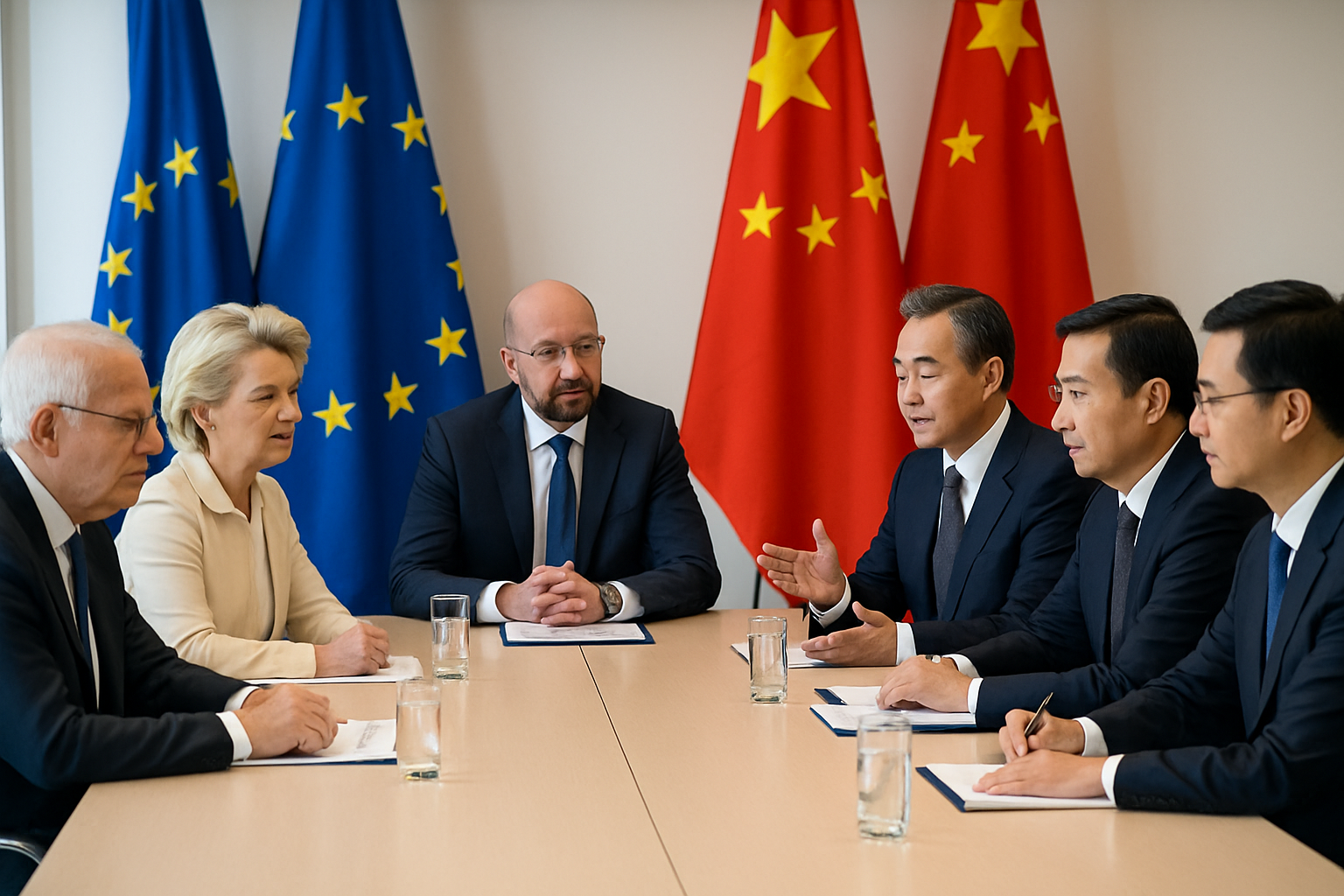
Germany is pursuing a complex dual-track approach toward China, with Chancellor Friedrich Merz advocating for renewed trade cooperation while Defense Minister Boris Pistorius warns of growing regional security threats and calls for sustained U.S. military presence in the Indo-Pacific region.
The apparent contradictions in German policy reflect broader European struggles to balance economic interests with mounting security concerns as China's global influence expands and regional tensions escalate across the Indo-Pacific theater.
Merz Floats EU-China Trade Revival
Speaking to German lawmakers on Wednesday, Chancellor Merz signaled support for a potential European Union-China trade agreement "in the longer term," despite rising tensions between Brussels and Beijing. His comments mark a significant departure from recent EU skepticism toward Chinese trade practices and reflect growing pressure on European leaders to address economic vulnerabilities.
"We now need strategic partnerships around the world in order to strengthen ourselves, especially our exports," Merz told parliament, emphasizing Germany's need for diversified international relationships amid uncertain global economic conditions.
The Chancellor's position comes as the U.S. Supreme Court's recent ruling striking down Trump's global tariff program creates new uncertainties in American trade policy. European officials view this as an opportunity to pursue independent economic strategies with major partners, including China, without facing immediate American pressure.
"The comments highlight an emerging split between European economic pragmatism and Atlantic security coordination."
— European diplomatic sources
Germany's manufacturing sector, heavily dependent on Chinese markets and supply chains, faces mounting pressure to maintain profitable relationships despite broader geopolitical tensions. Chinese firms now compete directly with established European manufacturers in sophisticated technology sectors, fundamentally altering the competitive landscape that has defined German industrial success.
Defense Minister Issues Indo-Pacific Warning
While Merz advocates for trade cooperation, Defense Minister Pistorius delivered stark warnings about Chinese regional behavior during his visit to Australia. The Defense Minister called on the United States to honor its security commitments to the Indo-Pacific and signaled that Berlin would maintain its military presence in the region.
Pistorius expressed particular concern about "dangerous activities" in the South China Sea, where Chinese military operations have intensified significantly over the past year. Intelligence reports indicate Chinese aircraft activity around Taiwan increased by 23% in 2025, with daily deployments designed to "exhaust" the island's population according to Taiwanese Defense Minister Wellington Koo.
The German Defense Minister also sounded alarm bells over Beijing's "close" monitoring of how Washington and its allies manage the ongoing Iran and Ukraine conflicts, suggesting China views these crises as opportunities to test Western resolve and coordination mechanisms.
"To me, one thing is crystal clear," Pistorius stated during his Australia meetings, emphasizing the importance of sustained democratic partnerships in an increasingly contested strategic environment.
Complex Strategic Triangulation
The divergent messages from Berlin's top officials reflect Germany's increasingly complex position as Europe's economic powerhouse seeks to navigate great power competition while maintaining beneficial relationships with multiple partners.
Recent developments in China-Europe relations have created both opportunities and challenges for German policymakers. Chancellor Merz's February visit to Beijing resulted in a major 120-aircraft Airbus deal worth billions of euros, demonstrating the continued strength of German-Chinese economic cooperation despite broader political tensions.
However, China's diplomatic relations with other key European partners have deteriorated sharply. Japan's 2026 diplomatic bluebook downgraded China from a "most important" partner to merely an "important neighbor," citing tensions over Taiwan policy and regional security concerns. China's attempts to rally Southeast Asian nations against Japan's position gained minimal regional support, highlighting limits to Beijing's diplomatic influence.
European officials note that China's zero-tariff policy for 53 African countries, announced for May 2026 implementation, represents the most comprehensive China-Africa trade expansion in history. This initiative positions Beijing as a champion of multilateral economic cooperation while Western nations pursue increasingly bilateral approaches to international trade.
Economic Interdependence vs Security Concerns
The fundamental challenge facing German and European policymakers lies in managing economic interdependence with China while addressing legitimate security concerns about Beijing's regional behavior and technological competition strategies.
Germany's economy remains deeply integrated with Chinese markets, with China serving as Germany's largest trading partner across multiple sectors. However, German businesses increasingly find themselves competing directly with Chinese firms in renewable energy and advanced manufacturing - areas where Germany traditionally held clear technological advantages.
Recent semiconductor industry developments have added complexity to this relationship. SMIC, China's leading chipmaker, faces U.S. scrutiny over alleged provision of chipmaking tools and technical training to Iranian military units, while China continues to dominate 60% of global critical minerals production and 90% of refining capacity.
Memory chip shortages affecting global supply chains have created additional pressure points, with companies like Lenovo reporting 21% profit declines due to structural supply chain challenges.
Indo-Pacific Strategic Stakes
The Indo-Pacific region has emerged as the critical theater for 21st-century great power competition, with European nations increasingly recognizing their stakes in regional stability and security outcomes.
Taiwan remains the most sensitive flashpoint in regional tensions. President Lai Ching-te has warned that Chinese seizure of Taiwan would threaten Japan, the Philippines, and other Indo-Pacific democracies, highlighting the interconnected nature of regional security challenges.
China's military pressure campaign around Taiwan has intensified significantly, with systematic exercises designed to normalize Chinese military presence while testing democratic resolve. Beijing simultaneously pursues engagement with Taiwan's opposition parties, attempting to bypass the current Democratic Progressive Party government through alternative diplomatic channels.
The broader implications extend beyond Taiwan to encompass critical global supply chains, with Taiwan Strait shipping lanes essential for international commerce and technological infrastructure dependencies that affect European economic interests directly.
Alliance Coordination Challenges
Germany's dual-track approach reflects broader challenges facing democratic allies as they attempt to coordinate responses to China's rise while maintaining beneficial economic relationships.
The recent U.S.-EU-Japan Critical Minerals Partnership, involving 55 countries, represents one attempt to diversify supply chains away from Chinese dominance. However, the practical implementation of such alternatives requires years of investment and infrastructure development that may not match immediate economic pressures.
European strategic autonomy discussions have gained urgency as policymakers recognize the need for independent capabilities while maintaining Atlantic alliance structures. The success of these efforts will largely determine Europe's capacity to navigate great power competition while preserving democratic values and economic prosperity.
Looking Forward: Managed Competition
The contrasting positions of Chancellor Merz and Defense Minister Pistorius may actually represent elements of a coherent German strategy for managing complex relationships with China through compartmentalized engagement - pursuing economic cooperation where beneficial while maintaining security partnerships with democratic allies.
Success of this approach will depend on Germany's ability to establish clear red lines for unacceptable Chinese behavior while creating space for continued beneficial cooperation in areas of mutual interest. The economic stakes remain enormous, with bilateral trade relationships affecting millions of jobs and critical supply chain dependencies.
As European leaders prepare for continuing tensions in 2026, the German model of principled but pragmatic engagement with China may provide a template for other democratic nations seeking to balance economic interests with security imperatives in an increasingly complex international environment.
The ultimate test will be whether European nations can maintain unity on core security issues while pursuing diversified economic strategies that reduce strategic vulnerabilities without sacrificing prosperity or democratic principles.