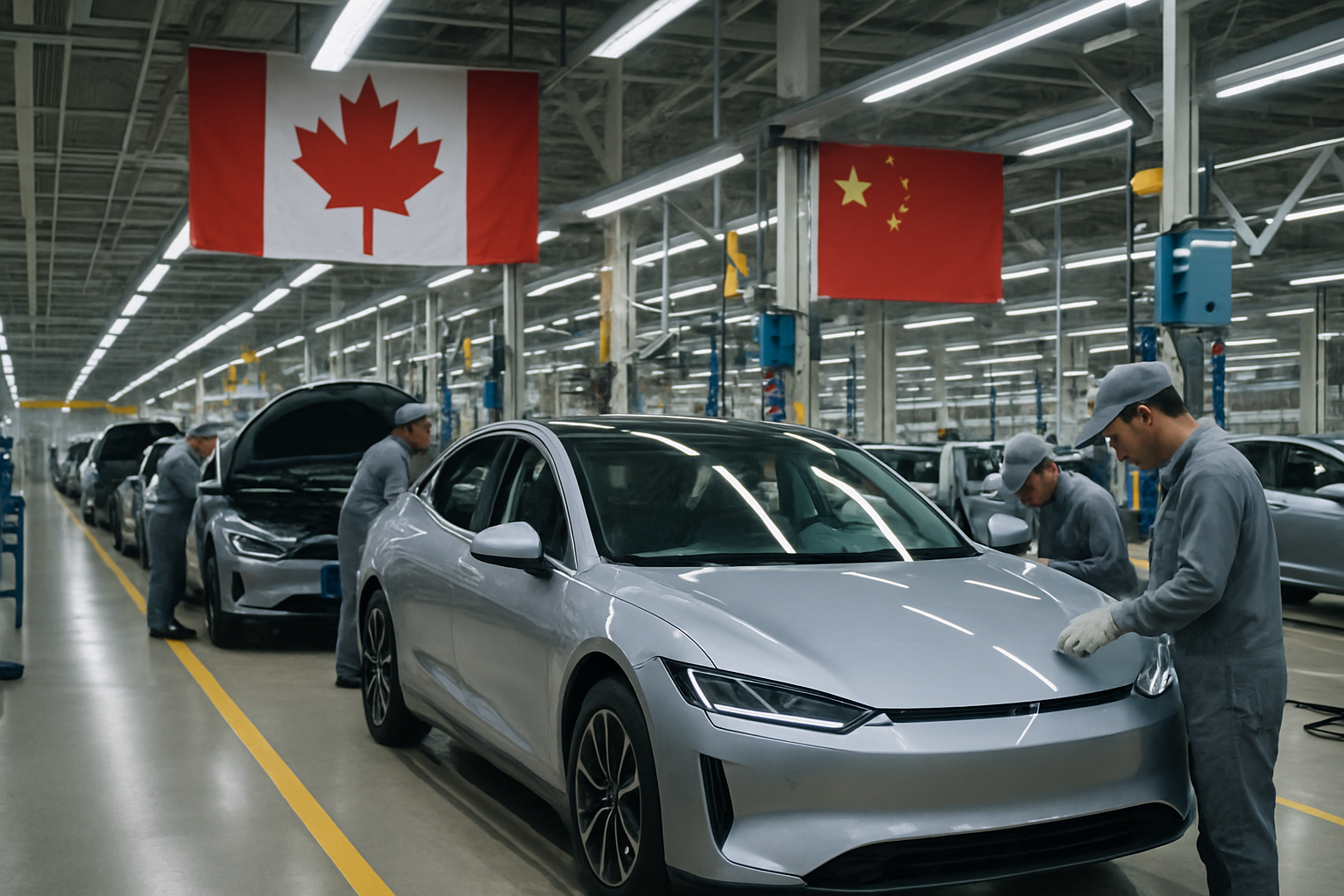
China's electric vehicle industry is charging ahead with unprecedented technological innovations and manufacturing capacity, positioning the nation as the undisputed global leader in the EV revolution while Canada prepares to welcome Chinese electric vehicles into its domestic market.
The Chinese electric vehicle market has reached a watershed moment in 2026, demonstrating technological supremacy through revolutionary charging innovations and massive production capabilities. At the Zeekr intelligent factory in Ningbo, General Manager Xu Naiping oversees operations that exemplify China's industrial approach to electric mobility—combining cutting-edge technology with unprecedented manufacturing scale.
Revolutionary Charging Technology Breakthrough
China's technological leadership was crystallized in March 2026 with BYD's announcement of Megawatt Flash Charging technology, delivering an astonishing 1,360 kW of power that enables vehicles to gain 400 kilometers of range in just five minutes. This breakthrough eliminates the primary barrier to EV adoption—charging time—by achieving refueling speeds that rival traditional gasoline stations.
The advancement was further enhanced by the unveiling of Blade Battery 2.0, which functions effectively in extreme weather conditions down to -30°C, addressing cold climate concerns that have historically limited EV adoption in northern regions. The battery system can charge from 10% to 70% capacity in just five minutes and reach 97% charge in nine minutes, representing the world's fastest charging speed for mass-manufactured battery units.
"This is a historic moment for the entire electric vehicle industry. We're not just matching gasoline vehicle convenience—we're exceeding it."
— Industry analyst commenting on BYD's charging breakthrough
Manufacturing Scale and Global Dominance
China's strategic approach extends beyond individual technological achievements to encompass the entire EV ecosystem. The nation now controls approximately 60% of global critical materials production and 90% of refining capacity for lithium, cobalt, and rare earth elements—the essential components for electric vehicle batteries.
This supply chain dominance has enabled Chinese manufacturers to achieve remarkable production volumes. Contemporary Amperex Technology Ltd (CATL), China's battery giant, reported a 42% profit surge to 72.2 billion yuan (US$10.4 billion) in 2025, with lithium-ion battery sales reaching 661 GWh—a 39% increase that demonstrates the scale of China's battery manufacturing capabilities.
The manufacturing prowess extends to complete vehicle production, with Chinese EV companies "flooding Europe" according to Slovakian officials, forcing European automakers to seek financial support from Brussels to compete with Chinese alternatives. This competitive pressure has fundamentally altered global automotive trade flows, with Germany now importing more vehicles from China than it exports—a complete reversal of traditional automotive trade patterns.
Canada's Strategic Market Positioning
As China accelerates its EV dominance, Canada is preparing to welcome Chinese electric vehicles into its domestic market, recognizing the inevitable shift in global automotive dynamics. Prime Minister Mark Carney has announced the return of electric vehicle consumer incentives as part of a comprehensive $9.7 billion national automotive strategy designed to make EVs "more affordable and reliable for Canadians."
Canada's approach reflects a pragmatic understanding of the global EV landscape, where Chinese manufacturers have achieved technological and cost advantages that traditional Western automakers struggle to match. The Canadian strategy emphasizes consumer accessibility while building domestic EV infrastructure and maintaining competitiveness in the rapidly evolving electric vehicle market.
Technological Innovation Convergence
Recent battery longevity studies have exceeded early industry predictions, with Tesla Model S vehicles from 2012-2014 retaining 85-92% battery capacity after 200,000+ miles, while Nissan Leaf vehicles from 2011-2013 demonstrate 75-85% capacity retention after a decade of operation. These findings suggest practical EV battery lifespans of 15-20 years, far exceeding initial manufacturer warranties and supporting robust used EV markets.
Chinese innovations have also addressed safety concerns, with companies developing water-based battery technology using organic electrodes that are as safe as "tofu brine," eliminating traditional fire risks associated with lithium-ion batteries. Vehicle-to-grid technology has advanced to enable EVs to function as mobile energy storage systems, charging during off-peak renewable generation periods and discharging during high demand to support electrical grid stability.
Global Infrastructure Development
The infrastructure supporting EV adoption continues expanding rapidly worldwide. Austria has doubled its EV charging capacity by adding 1,000 stations, while Estonia leads European renewable electricity adoption with 88% renewable power and the continent's largest battery storage system serving 90,000 households. New Zealand has announced a $50 million investment to double its public charging network through ChargeNet and Meridian Energy partnerships.
This infrastructure development creates the foundation for widespread EV adoption, supporting the technological capabilities that Chinese manufacturers have achieved through strategic industrial planning and massive capital investment.
Climate Urgency and Market Transformation
The acceleration of Chinese EV development occurs against the backdrop of escalating climate urgency, with January 2026 marking the 18th consecutive month of global temperatures exceeding 1.5°C above pre-industrial levels. This climate reality underscores the critical importance of rapid transportation electrification as governments worldwide seek to meet emissions reduction commitments.
The oil crisis of March 2026, with Brent crude reaching $119.50 and WTI $108.15 following Iran's Strait of Hormuz closure affecting 40% of global oil transit, has created economic conditions that make electric vehicles not just environmentally necessary but economically rational. Caribbean EV owners now save $75 per $100 compared to gasoline despite electricity rate increases, demonstrating the fundamental economic shift favoring electric mobility.
Supply Chain Challenges and Opportunities
Despite China's dominance, the global EV industry faces significant supply chain challenges, including memory chip shortages causing sixfold price increases that affect vehicle control systems. These constraints are expected to persist until 2027 when new semiconductor fabrication facilities come online.
International responses include the US-EU-Japan Critical Minerals Partnership involving 55 countries and seven African suppliers, aimed at diversifying supply chains and reducing dependence on Chinese materials processing. However, these alternatives require massive investment and years of development, suggesting continued Chinese advantages in the near term.
Regulatory Evolution and Safety Standards
China's influence extends beyond manufacturing to regulatory standard-setting, as demonstrated by the country's decision to ban hidden door handles in vehicles effective January 2027. This regulation prioritizes functional safety over aesthetic design and affects major manufacturers including Tesla, BYD, NIO, and XPeng, illustrating China's growing role as a global automotive standards-setter.
Urban-rural adoption disparities continue to present challenges, with homeowners and rural residents enjoying charging advantages while urban apartment dwellers face infrastructure barriers. However, advancing workplace charging solutions and vehicle-to-grid technology are creating new opportunities for EV adoption across diverse living situations.
Future Implications for Global Markets
The convergence of Chinese technological innovation, manufacturing scale, and global market preparation represents a fundamental transformation of the automotive industry. Commercial vehicle electrification is accelerating with Tesla's large-scale Semi truck production and BMW's electric 3 Series production beginning in Munich in August 2026, indicating the expansion of electrification beyond passenger vehicles.
As Canada and other nations prepare their markets for Chinese EV entry, the success of this transition will depend on coordinated development across energy systems, charging infrastructure, supply chain security, and regulatory frameworks. The automotive industry's most significant transformation in over a century requires sustained international cooperation while recognizing the new competitive realities established by Chinese technological and manufacturing leadership.
The March 2026 developments represent a watershed moment where crisis-driven demand converges with technological readiness, creating conditions for mass EV adoption acceleration. China's strategic industrial policy has created lasting competitive advantages in emerging technology sectors, fundamentally altering global automotive dynamics through technological innovation, manufacturing scale, supply chain control, and coordinated government support.