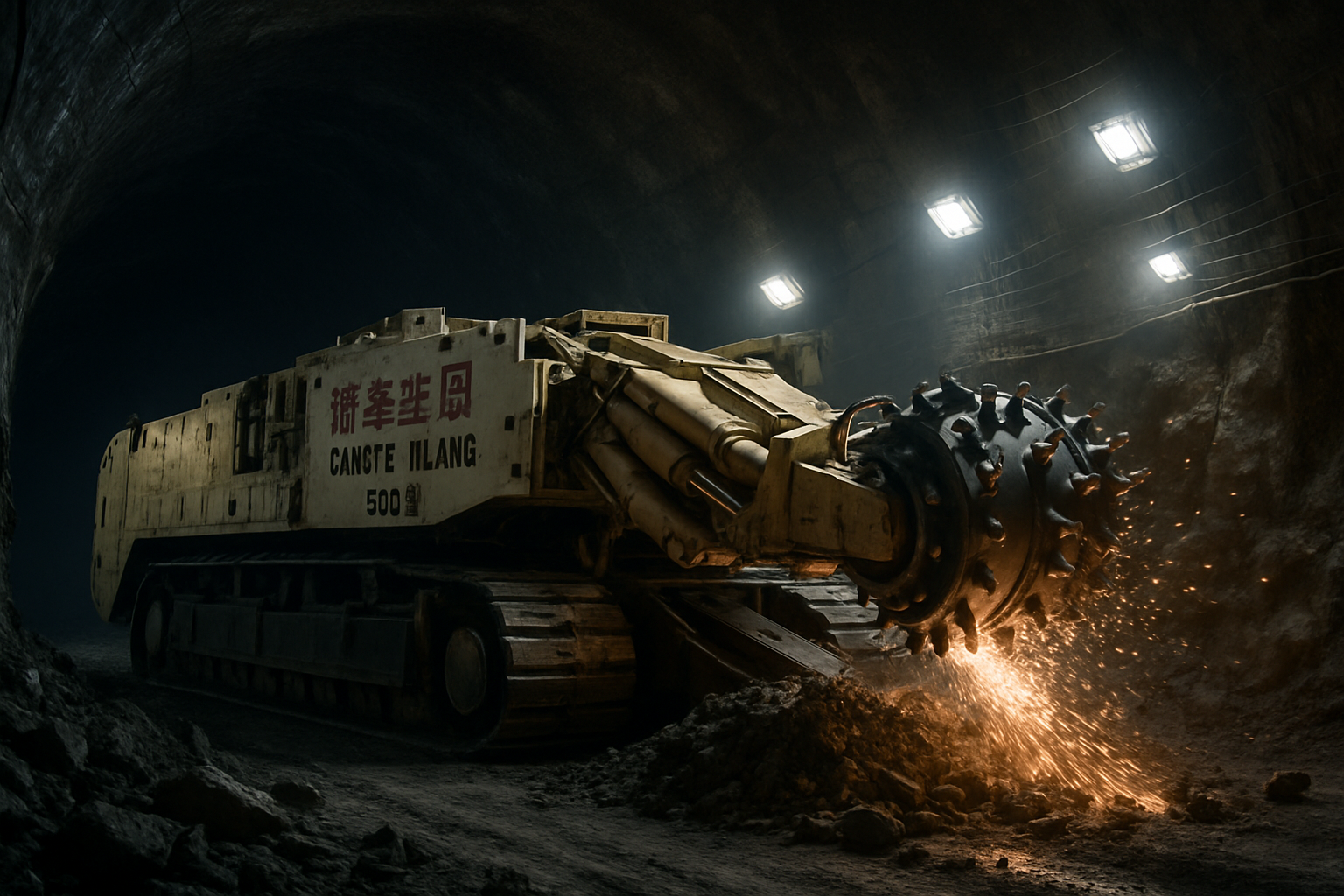
China has unveiled the "Gangtie Jiliang" (Steel Backbone), a fearsome 500-tonne underground mining carrier that represents the world's first boring machine capable of excavating full-face shafts to depths exceeding 1,000 meters in hard rock formations, marking a revolutionary advance in global mining technology.
The massive machine, measuring 8.1 meters wide and weighing approximately 500 tonnes, is designed to accomplish what no previous mining equipment has achieved: delving straight down, kilometer after kilometer, into the Earth's crust to extract valuable ore deposits from unprecedented depths. The breakthrough comes at a critical time when global demand for critical minerals has reached new heights.
Unprecedented Engineering Achievement
Unlike traditional mining equipment, the Gangtie Jiliang has been specifically engineered for vertical excavation in the world's hardest rock formations. The machine's imposing appearance reflects its formidable capabilities—looking more like an industrial fortress than conventional mining equipment, yet designed with precision to navigate the extreme challenges of deep underground operations.
The technology represents a quantum leap in mining efficiency, potentially reducing extraction timelines from years to months for deep ore deposits. This capability positions China at the forefront of the global race to secure critical mineral resources, particularly as supply chain vulnerabilities have become a strategic concern worldwide.
Strategic Context of Global Mining Revolution
The unveiling of Gangtie Jiliang occurs within the broader context of an unprecedented global mining investment surge. According to the African Finance Corporation, $29.5 trillion in mineral reserves exist globally, with $8.6 trillion remaining untapped. Recent major investments include Ivory Coast's $1.2 billion gold projects and South Africa's R325 million Zandkopsdrift rare earth commitment.
China's technological advancement comes as the nation maintains dominance in critical materials, controlling 60% of global production and 90% of refining capacity for lithium, cobalt, and rare earth elements. The US-EU-Japan Critical Minerals Partnership, involving 55 countries and seven African suppliers, represents international efforts to diversify supply chains away from Chinese dominance.
"This breakthrough represents a paradigm shift in how we approach deep mineral extraction, potentially unlocking resources previously considered economically unfeasible."
— Industry Mining Expert
Technology Integration and Environmental Considerations
Modern mining operations, including the Gangtie Jiliang project, incorporate sophisticated environmental compliance measures as prerequisites rather than optional additions. The machine integrates digital monitoring systems, automated controls, and advanced waste management protocols designed to minimize environmental impact during deep excavation operations.
The development aligns with China's systematic approach to industrial innovation, combining massive infrastructure investment with talent development and strategic market positioning. Recent Chinese technological achievements include mind-controlled robot dog systems and breakthrough AI applications in scientific research, demonstrating the country's comprehensive approach to emerging technologies.
Global Mining Safety and Regulatory Evolution
The introduction of advanced mining technology comes amid heightened focus on industry safety and environmental governance. Recent incidents, including radiation contamination alerts at Congo's Kamoto Copper Company and mining disasters in Nigeria, have underscored the critical importance of enhanced safety protocols and regulatory oversight.
The Gangtie Jiliang's sophisticated design incorporates lessons learned from global mining challenges, featuring advanced safety systems and environmental monitoring capabilities that represent the evolution toward comprehensive development strategies balancing economic growth with environmental protection and community engagement.
Economic and Strategic Implications
The technological breakthrough has significant implications for global mineral markets and supply chain security. As memory chip shortages have driven semiconductor prices sixfold higher, affecting industries worldwide until 2027, advanced mining capabilities like those demonstrated by Gangtie Jiliang become increasingly strategic assets.
The machine's ability to access previously unreachable deposits could fundamentally alter global resource availability, particularly for rare earth elements essential to renewable energy infrastructure, electric vehicle batteries, and advanced electronics manufacturing. This capability strengthens China's position in negotiations over critical materials while potentially reducing global supply chain vulnerabilities.
International Response and Competition
The revelation of China's underground mining capabilities is likely to accelerate international efforts to develop comparable technologies. Recent developments include Japan's deep-sea mining breakthrough at Minamitorishima, achieving 20 times terrestrial mineral concentrations at 6,000-meter depths, and various African nations enhancing their mining capabilities through international partnerships.
Peru's recent mining investment boom, with $398 million in January 2026 representing an 8.9% year-over-year increase driven by infrastructure and exploration growth, demonstrates the global appetite for advanced mining capabilities. The success of Gangtie Jiliang could influence similar technological development programs worldwide.
Future Implications for Global Mining
The successful deployment of kilometer-deep mining technology represents more than a technical achievement—it signals a fundamental transformation in how humanity accesses Earth's mineral resources. As climate change and geopolitical tensions reshape global supply chains, the ability to extract materials from previously inaccessible depths becomes a critical strategic capability.
The technology's potential applications extend beyond traditional mining to include geothermal energy development, scientific research, and infrastructure projects requiring deep underground access. Success with Gangtie Jiliang could catalyze additional innovations in underground engineering and resource extraction.
As global demand for critical minerals continues accelerating due to renewable energy transitions and technological advancement, China's breakthrough in deep underground mining positions the nation as a leader in next-generation resource extraction technologies. The international mining industry will likely need to develop comparable capabilities to remain competitive in an increasingly resource-constrained world.