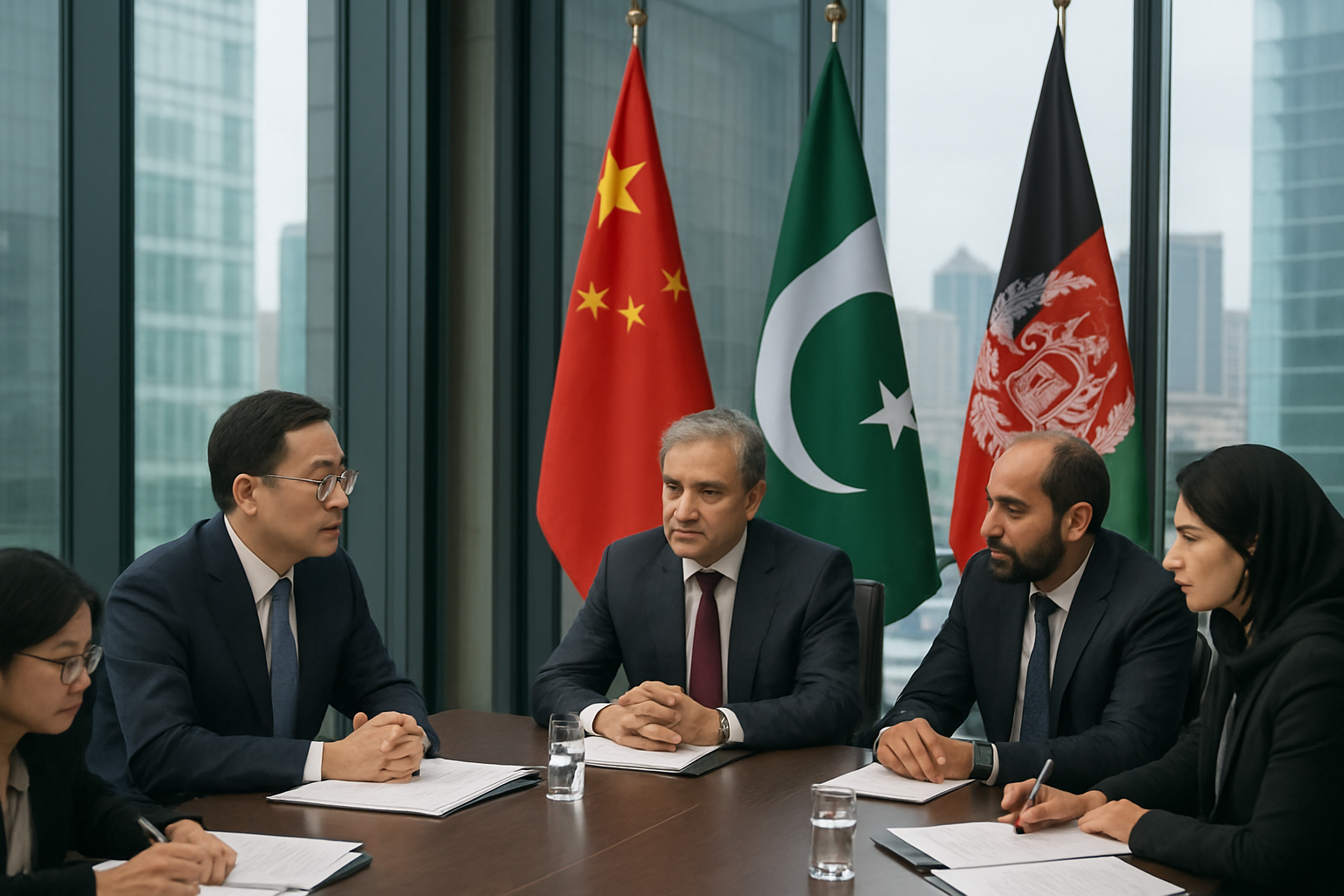
Senior officials from Pakistan, Afghanistan, and China convened in Urumqi on Wednesday under Beijing's trilateral mechanism, marking the most significant diplomatic intervention since Pakistan declared "open war" against the Taliban government in February, triggering the worst cross-border crisis in decades.
The high-level meeting represents China's most direct involvement in resolving the escalating Pakistan-Afghanistan conflict that has claimed hundreds of civilian lives and displaced over 16,000 families since February. Mohibullah Wasiq, chief of staff to Afghanistan's foreign minister, leads the Taliban delegation, while Pakistan's Special Representative for Afghanistan Mohammad Sadiq heads the Pakistani side.
Month-Long Crisis Demands Urgent Intervention
The trilateral talks come after more than six weeks of sustained military confrontation that began with a February 16 Tehrik-e-Taliban Pakistan (TTP) attack in Bajaur that killed 11 Pakistani soldiers. Pakistani Defense Minister Khawaja Asif's subsequent declaration of "open war" on February 27 marked an unprecedented escalation, with Operation Ghazab lil-Haq targeting Taliban positions across multiple provinces.
The conflict has devastated bilateral relations between the nuclear-armed neighbors. Pakistani airstrikes have targeted strategic installations including Bagram Airfield and facilities in Kabul, while Taliban forces have conducted retaliatory drone strikes on Pakistani territory, including attacks on military installations in Islamabad, Nowshera, and Abbottabad.
"The meeting is focused on sharing perspectives on the latest escalation. No major outcomes are expected, though China is pushing for confidence-building measures, such as reopening trade routes."
— Senior Pakistani Foreign Ministry Official
Humanitarian Crisis Deepens
The human cost of the confrontation has been severe. According to the UN Assistance Mission in Afghanistan (UNAMA), at least 185 civilians have been killed or wounded since February 26, with women and children comprising the majority of casualties. The UN Office for the Coordination of Humanitarian Affairs (OCHA) reports that 16,370 families have been newly displaced across 10 Afghan provinces.
Most critically, the World Health Organization has been forced to deliver emergency medical oxygen to only 23 hospitals, while hundreds of health centers have closed due to the conflict. The crisis compounds Afghanistan's existing humanitarian emergency, where 88% of female-headed households cannot meet minimum living requirements.
Economic warfare has accompanied the military confrontation. Bilateral trade has collapsed by 59%, with Pakistani exports to Afghanistan plummeting from $550 million to $228 million over seven months. Traditional trade routes through Chaman-Spin Boldak and Torkham have faced repeated closures, affecting border communities dependent on cross-border commerce.
The Durand Line Dispute
At the heart of the conflict lies the disputed 2,640-kilometer Durand Line, the colonial-era border established in 1893 that Afghanistan has never recognized. Pakistan maintains that TTP operates "with impunity from Afghan soil," using the porous mountainous terrain as sanctuary for attacks against Pakistani forces. The Taliban categorically denies providing militant sanctuaries or allowing territory to be used against neighboring countries.
This fundamental disagreement over territorial sovereignty versus cross-border terrorism management has proven impossible to resolve through previous diplomatic channels. The disputed incidents include Pakistan's alleged March 16 strike on Omid Addiction Treatment Hospital in Kabul, which Taliban claims killed over 400 people, though Pakistan maintains it targeted military installations.
China's Strategic Mediation Role
China's intervention through the Urumqi trilateral mechanism reflects Beijing's growing concern about regional stability, particularly given its significant investments in Pakistan through the China-Pakistan Economic Corridor (CPEC). Chinese Foreign Minister Wang Yi has been actively mediating between the two sides, with special envoys shuttling between Kabul and Islamabad.
The Chinese approach represents a departure from Western-led mediation efforts, utilizing Beijing's established relationships with both governments. However, Chinese UN warnings about the presence of ISIS-K, al-Qaeda, and East Turkestan Islamic Movement (ETIM) in Afghanistan contradict Taliban claims of having defeated terrorism, adding complexity to the negotiations.
According to Pakistani officials familiar with the talks, the meeting is "not a mediation effort per se" but rather an opportunity for all parties to share perspectives on the crisis. China is reportedly pushing for practical confidence-building measures, particularly the reopening of crucial trade routes that have been disrupted by the fighting.
International Mediation Failures
The Urumqi talks follow a series of failed international mediation attempts. Saudi Arabia had achieved a modest breakthrough in February 2026 with a prisoner exchange that saw three Pakistani soldiers released from Taliban custody. However, this confidence-building measure proved insufficient to prevent the subsequent military escalation.
Turkish Foreign Minister Hakan Fidan launched comprehensive mediation initiatives, contacting counterparts in Qatar and Saudi Arabia, while Iran offered mediation services warning of broader regional destabilization. Even religious diplomacy achieved temporary success with a historic Eid al-Fitr ceasefire (March 18-23) brokered by Saudi Arabia, Qatar, and Turkey, but this was immediately violated.
The failure of traditional diplomatic frameworks has highlighted the need for innovative approaches to managing the intersection of territorial sovereignty and transnational terrorism in the 21st century.
Nuclear Dimensions and Regional Implications
The involvement of nuclear-armed Pakistan adds a dangerous dimension to the crisis, requiring careful international monitoring to prevent escalation beyond conventional military operations. The confrontation represents the most serious test of the post-2021 South Asian security architecture since the Taliban's return to power.
Pakistan has acknowledged its diminished influence over Afghanistan compared to wealthier regional powers including Turkey, the UAE, Qatar, Saudi Arabia, and China. This shift in regional dynamics has forced Islamabad to rely increasingly on military solutions rather than diplomatic leverage.
The crisis serves as a template for managing territorial sovereignty versus transnational terrorism challenges globally. Success or failure of the diplomatic containment effort will influence how similar regional security challenges are addressed in the future.
Prospects for Resolution
Despite the unprecedented military escalation, both sides have maintained that diplomatic channels remain open. Taliban leadership consistently states that "the path of talks remains open" and seeks "mutual understanding and respect." Pakistan, while indicating "no rush" to end the military campaign, has not ruled out negotiations if concrete anti-militant measures are implemented.
The Afghan delegation to Urumqi includes senior officials from the ministries of defense, interior, and the General Directorate of Intelligence, suggesting a comprehensive approach to addressing Pakistan's security concerns. This broad representation indicates the Taliban's recognition that military solutions alone cannot resolve the underlying issues.
However, the fundamental disagreement over the Durand Line's legitimacy and the presence of militant groups in Afghanistan remains unresolved. Any sustainable solution will require addressing these core issues while balancing sovereignty principles with practical security cooperation.
Looking Forward
The Urumqi trilateral talks represent a critical juncture in one of South Asia's most dangerous conflicts. While immediate major breakthroughs are not expected, the meeting provides a platform for de-escalation and the establishment of mechanisms to prevent further civilian casualties.
The international community faces pressure to develop effective conflict prevention mechanisms before the crisis expands into a broader regional confrontation. The stakes extend far beyond bilateral relations, affecting global security architecture and the development of frameworks for managing nuclear-armed neighbor disputes.
As the talks continue, the focus will be on practical measures to reduce tensions, including the reopening of trade routes, establishment of communication channels, and implementation of cease-fire monitoring mechanisms. The success of China's mediation efforts could provide a template for regional conflict resolution in an increasingly multipolar world order.