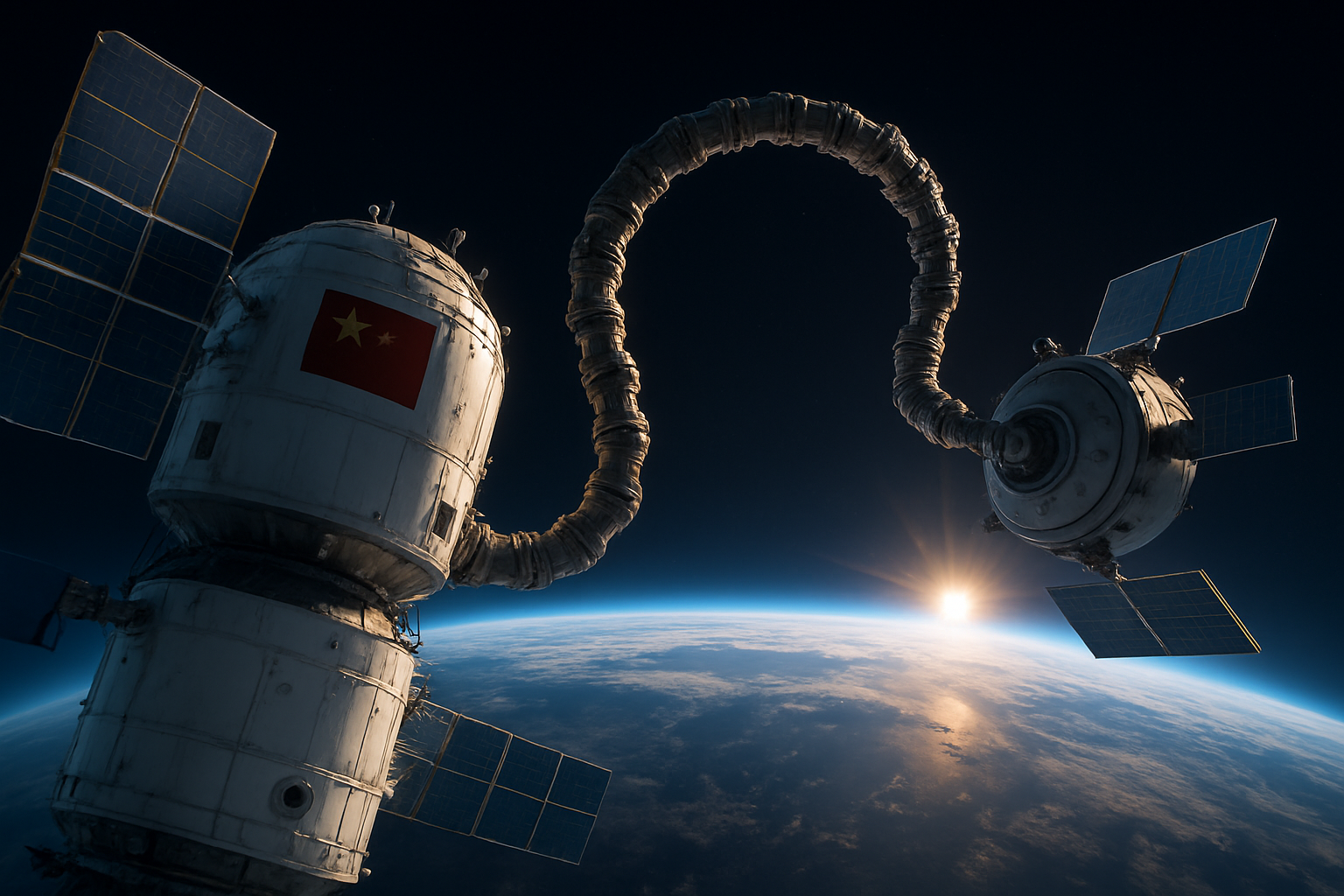
China has launched Hukeda-2, the nation's first commercial test satellite equipped with revolutionary flexible robotic arm technology designed to capture other spacecraft for orbital refueling operations, marking a significant advance in the emerging space economy as nations race to develop sustainable orbital infrastructure.
The satellite lifted off from the Jiuquan Satellite Launch Centre in the Gobi Desert on Monday, carrying what researchers describe as "octopus tentacle" technology that could transform how spacecraft operate in low Earth orbit. This mission represents China's second major orbital servicing experiment, following last year's secretive high-orbit satellite-to-satellite refueling test that demonstrated the country's growing capabilities in advanced space operations.
Revolutionary Robotic Technology
Hukeda-2's flexible robotic arm represents a breakthrough in orbital manipulation technology, designed to safely capture and service other spacecraft without the rigid constraints of traditional robotic systems. The "octopus tentacle" design allows for more natural, adaptive movements that can accommodate the unpredictable dynamics of orbital mechanics and varying spacecraft configurations.
The technology addresses two critical challenges facing the modern space industry: the need for orbital refueling capabilities to extend satellite lifespans, and the urgent requirement for debris removal systems as space becomes increasingly congested. According to the European Space Agency's Holger Krag, over 34,000 tracked objects larger than 10 centimeters currently orbit Earth, with millions of smaller untrackable debris pieces posing collision risks at orbital speeds of 17,500 mph.
Commercial Space Economy Expansion
The Hukeda-2 mission occurs during what industry analysts describe as the transition from the "AI revolution to the space economy golden age," with space-based infrastructure evolving from experimental to essential for modern civilization. SpaceX is preparing for a potential trillion-dollar IPO in June 2026, while the global space economy is projected to exceed $1 trillion by 2030.
China's investment in orbital servicing technology positions the nation as a key player in this expanding market. The ability to refuel satellites in orbit could dramatically extend their operational lifespans from the current average of 10-15 years to potentially decades, representing billions of dollars in extended value for satellite operators worldwide.
"This technology could fundamentally change how we think about satellite operations and space sustainability."
— Space Industry Analyst
Addressing the Space Debris Crisis
Beyond refueling capabilities, Hukeda-2's mission includes testing rapid satellite disposal methods at the end of their operational lives. This addresses growing concerns about the "cascade effect" where collisions generate additional debris causing chain reactions that could render orbital regions unusable.
Recent Austrian research documented atmospheric pollution from rocket debris, showing lithium concentrations elevated tenfold above normal levels from Falcon-9 rocket stage reentry. As the space industry scales up with proposed million-satellite constellations, sustainable disposal methods become critical for long-term space access.
ESA is developing "space janitor" spacecraft with robotic arms and nets for debris removal, but these systems would be overwhelmed by the scale of proposed future satellite deployments. China's commercial approach to orbital servicing could provide scalable solutions to this growing challenge.
International Competition and Cooperation
The Hukeda-2 mission demonstrates China's advancing capabilities in a field where international cooperation and competition intersect. While NASA has developed the DAGGER AI system for 30-minute geomagnetic storm prediction to protect satellites, and maintains leadership through the Artemis lunar program, China's focus on practical orbital infrastructure addresses immediate commercial needs.
The mission occurs alongside other major space developments, including NASA's Artemis II lunar flyby mission scheduled for April 1, 2026, Pakistan's upcoming astronaut mission to China's Tiangong space station, and ongoing International Space Station operations with record-setting research missions.
Thailand's leadership of UN space governance initiatives reflects the need for international frameworks to manage increasing commercial space activity. The success or failure of missions like Hukeda-2 will influence how these governance structures develop to balance innovation with sustainability.
Technical Challenges and Innovation
Orbital refueling and servicing operations require unprecedented precision, as demonstrated by recent technical challenges faced by other space programs. NASA's Artemis II mission has faced multiple delays due to hydrogen leak and helium system failures, highlighting the complexity of space operations even for established programs.
China's approach with Hukeda-2 focuses on incremental testing and validation, building on the country's previous orbital servicing experiments. The flexible robotic arm technology represents years of development in materials science, control systems, and orbital mechanics that could have applications beyond satellite servicing.
The mission will test automated capture and release sequences, fuel transfer protocols, and disposal procedures that could become standard operations for the commercial space industry. Success would position China alongside leading space nations in developing critical infrastructure for the space economy.
Future Implications
The Hukeda-2 mission represents more than a technical demonstration—it's a preview of how space operations may evolve as orbital activities become routine rather than exceptional. The ability to service, refuel, and safely dispose of satellites in orbit could enable entirely new business models and mission profiles.
For commercial satellite operators, orbital servicing could transform economics by extending asset lifespans and reducing the need for replacement launches. For space sustainability, effective debris removal and end-of-life disposal could prevent the cascade scenario that threatens humanity's long-term access to space.
As the space economy enters its golden age, missions like Hukeda-2 will determine whether orbital space becomes a sustainable frontier for human activity or a debris-filled barrier that limits our cosmic aspirations. The success of China's "octopus tentacle" technology could influence the entire industry's approach to sustainable space operations.
The mission continues through 2026, with results expected to inform both China's space strategy and international standards for orbital servicing operations. In an era where space infrastructure is becoming as critical as terrestrial systems, the technologies tested by Hukeda-2 may prove essential for maintaining humanity's growing presence beyond Earth.