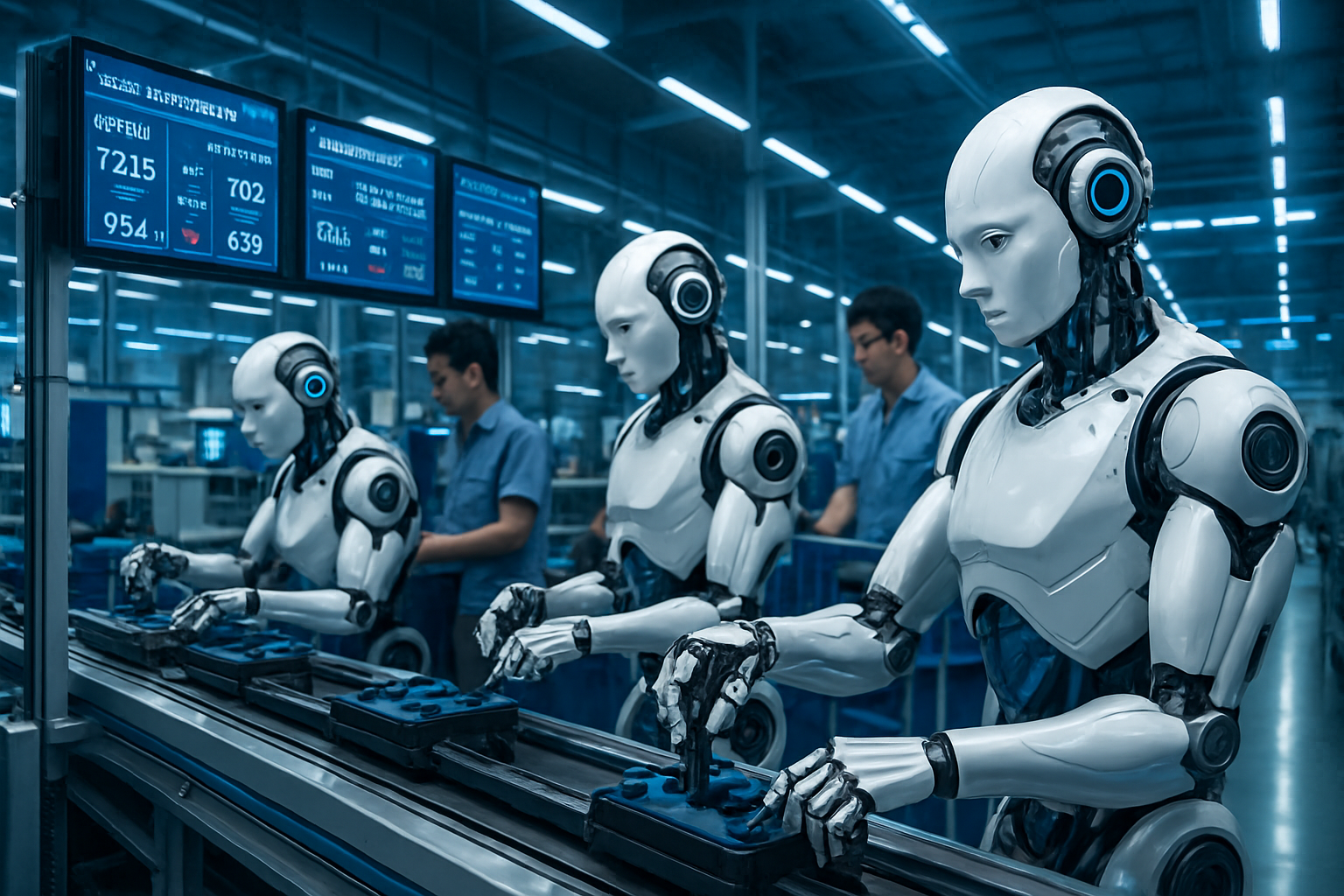
China's humanoid robotics industry has emerged as a critical battleground in the global technology race, with Chinese companies scaling production from laboratory prototypes to mass manufacturing as they target a trillion-dollar market opportunity by the end of the decade.
The transformation has been remarkable. What began as mechanical performers dancing at Beijing's 2026 Spring Festival Gala has evolved into a sophisticated industrial ecosystem. Unitree Robotics, one of China's leading humanoid robot manufacturers, exemplifies this trajectory by scaling production from 5,500 units in 2025 to an ambitious target of 10,000-20,000 units in 2026, marking the industry's transition from experimental showcase to commercial reality.
From Spring Festival Spectacle to Industrial Revolution
The dramatic shift became evident during China's 2026 Spring Festival celebrations, where four Chinese companies—Unitree, Galbot, Noetix, and MagicLab—showcased humanoid robots performing kung fu routines and lion dances before a global audience of over 600 million viewers. This public demonstration represented more than entertainment; it signaled China's strategic commitment to dominating the humanoid robotics sector.
"The dream of embodied intelligence is finally ready to step off the stage and into everyday life," industry analysts noted, observing the transition from novelty performances to practical applications. This evolution reflects broader technological maturation, with Chinese companies developing proprietary vision-language-action models and advanced AI integration systems.
Strategic Response to Demographic Pressures
China's aggressive expansion in humanoid robotics stems partly from urgent demographic realities. The country faces what experts call the "4-2-1 problem," where single children must support four aging parents and grandparents—a consequence of decades of population control policies creating an inverted population pyramid.
Bank of America Global Research analysis reveals that China's artificial intelligence and robotics development represents a strategic response to the world's most rapidly aging population. The demographic pressure is accelerating investment in AI and robotics across rapidly aging yet technologically advanced countries, particularly China, South Korea, and Japan, to offset labor shortages and sustain productivity despite population shrinkage.
"China's systematic AI implementation is driving productivity gains that could potentially offset demographic headwinds."
— Bank of America Global Research
Industrial Applications and Manufacturing Integration
The practical implementation of humanoid robotics extends beyond demographic solutions. Xiaomi Corporation has deployed humanoid robots in electric vehicle manufacturing facilities, marking the first large-scale integration of humanoid robotics in EV production. These robots perform complex assembly operations, quality control, and material handling while collaborating with human workers and navigating factory floors autonomously.
This integration represents a fundamental shift in manufacturing philosophy. Rather than replacing human workers entirely, Chinese companies are developing human-AI collaboration models that enhance rather than eliminate human capabilities. The approach contrasts with Western implementations that often focus on workforce replacement, demonstrating China's "human-centered" approach to technological integration.
Global Competition and Market Dynamics
China's advancement occurs amid intensifying global competition and significant infrastructure challenges. The global semiconductor crisis has driven memory chip prices up sixfold, affecting major manufacturers including Samsung, SK Hynix, and Micron. Consumer electronics costs have increased 20-30% over the past year, with shortages expected to persist until new fabrication facilities come online in 2027.
Despite these constraints, Chinese companies continue aggressive expansion. The nation achieved a logistics automation efficiency record with a 13.9% GDP ratio, demonstrating the measurable economic benefits of systematic AI implementation. Meanwhile, China controls 60% of global critical mineral production and 90% of refining capacity, providing strategic leverage in the technology supply chain.
International Implications and Technological Sovereignty
China's humanoid robotics surge has broader geopolitical implications. The country's 15th Five-Year Plan elevates "AI Plus" as a top national priority, emphasizing "safe and orderly development" while maintaining competitive advantage in the global technology race. This strategic positioning occurs as European and American companies scramble to develop competitive responses.
BMW's recent deployment of two AI-powered humanoid robots named "Aeon" at German manufacturing facilities represents Europe's attempt to counter Chinese dominance. However, the pilot program's limited scope—involving Swedish-developed robots—highlights the gap between Chinese mass production and Western experimental approaches.
Infrastructure Challenges and Innovation Drivers
The global memory crisis has paradoxically accelerated innovation in China's robotics sector. Companies are developing memory-efficient algorithms and alternative processing architectures to maximize AI capabilities while minimizing hardware requirements. This constraint-driven innovation provides advantages during global semiconductor shortages and positions Chinese companies favorably when supply constraints ease.
World Bank projections indicate that AI water demand will reach 4.2-6.6 billion cubic meters by 2027 for data center cooling—equivalent to 4-6 times Denmark's total water withdrawal. Despite these environmental and infrastructure challenges, massive corporate investments continue, with Chinese companies maintaining ambitious expansion plans.
Regulatory Framework and International Cooperation
China's approach to humanoid robotics development emphasizes regulatory balance. The country has implemented comprehensive AI content-labeling regulations requiring identification of artificially generated media, demonstrating commitment to responsible development. This regulatory framework contrasts with the fragmented international approach, where only one-third of countries have agreed to AI warfare governance declarations while the US and China abstain from comprehensive commitments.
The United Nations has established an Independent Scientific Panel with 40 global experts as the first fully independent AI assessment body. However, coordination challenges persist due to national security and economic competitiveness concerns, complicating unified international approaches to humanoid robotics governance.
Economic Impact and Employment Transformation
The humanoid robotics revolution carries significant employment implications. Microsoft's Mustafa Suleyman predicts AI could replace the majority of office workers within two years, with lawyers and auditors following within 18 months. However, China's approach differs from Western models, emphasizing worker transition programs rather than mass layoffs.
The "SaaSpocalypse" phenomenon—where AI systems eliminate hundreds of billions in traditional software market capitalization—demonstrates the sector's disruptive potential. Chinese companies like Unitree are creating employment opportunities through robotics production scaling, offering an alternative model to Western workforce reduction strategies.
Successful Integration Models and Human-Centered Approaches
China's robotics development benefits from examining successful AI integration models globally. Malaysia operates the world's first AI-integrated Islamic school, combining artificial intelligence with traditional learning. Canadian universities implement AI teaching assistants while maintaining critical thinking standards, and Singapore's WonderBot 2.0 demonstrates successful heritage education AI applications.
These models emphasize AI as sophisticated amplification tools for human capabilities rather than replacement systems. China's humanoid robotics industry appears to be adopting similar philosophical approaches, viewing robots as collaborative partners rather than human substitutes.
Future Trajectory and Global Implications
March 2026 represents what experts describe as a "critical inflection point" in AI development globally. China's demographic-driven approach to robotics could reshape global assumptions about the relationship between demographics and economic development. Success in maintaining productivity growth despite population decline would provide templates for other aging societies worldwide.
The ability of China's humanoid robotics industry to achieve its trillion-dollar market ambitions will depend on resolving infrastructure constraints, maintaining international cooperation frameworks, and developing sustainable business models that prioritize human welfare alongside technological advancement.
"Success or failure of China's AI-demographic strategy carries implications beyond national borders as the world's second-largest economy and largest manufacturing base."
— Industry Analysis Report
As China's humanoid robotics industry evolves from Spring Festival entertainment to trillion-dollar market opportunity, it represents more than technological advancement. The sector embodies a comprehensive strategy for managing 21st-century challenges through innovative human-AI collaboration, potentially reshaping global economic and social structures in the process.
The window for effective international coordination is narrowing as technological change accelerates. How the global community responds to China's humanoid robotics revolution will likely determine whether artificial intelligence serves broad human flourishing or exacerbates international tensions and inequality in the decades ahead.