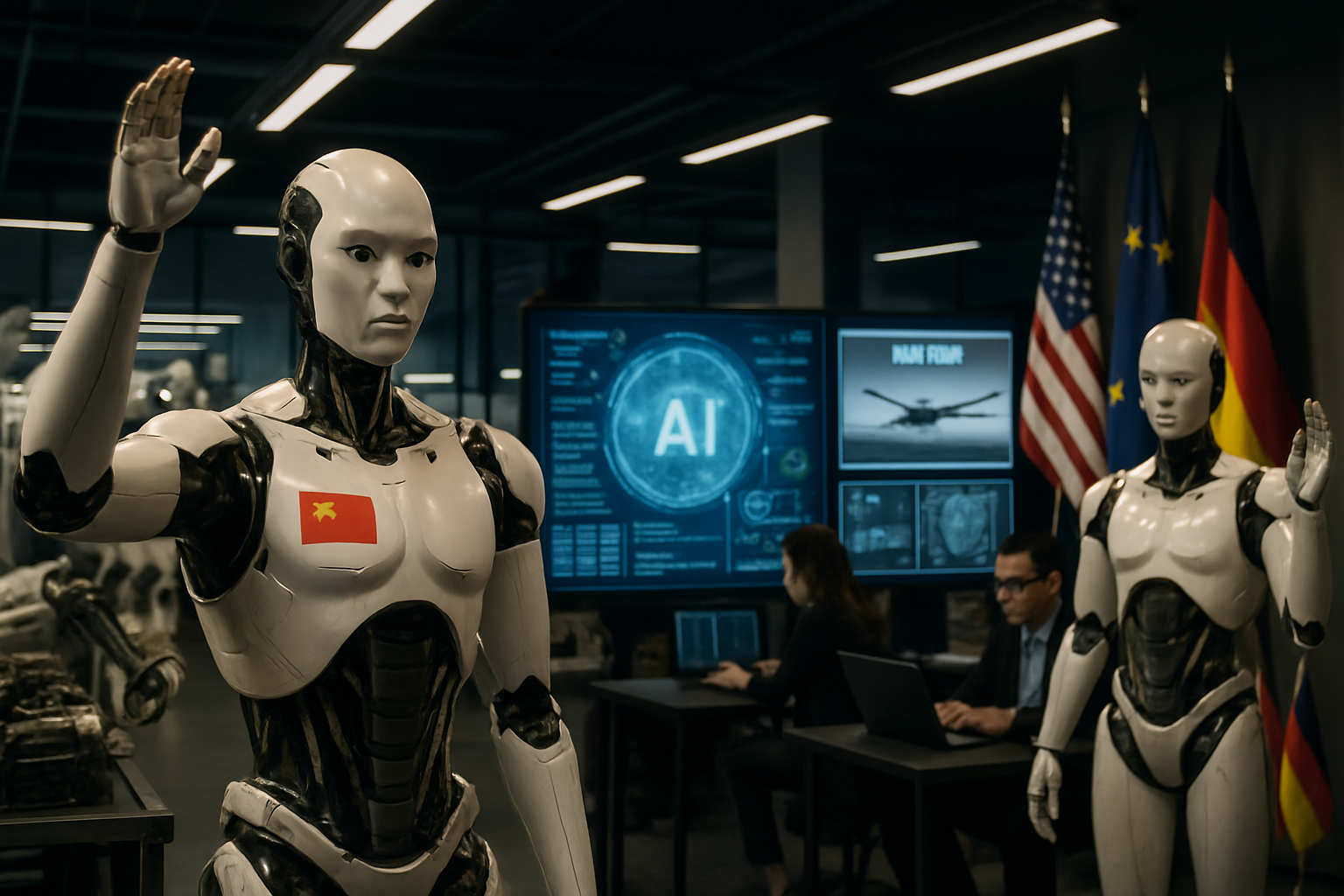
China's ambitious humanoid robotics revolution stands at a critical crossroads, as experts warn that the industry's "ChatGPT moment" remains years away despite unprecedented production scaling and massive investment, while technology startups fundamentally transform the nature of modern warfare.
At the Boao Forum for Asia in Hainan, leading experts delivered sobering assessments of China's humanoid robotics progress, revealing persistent challenges in task adaptation and training efficiency that continue to hold back widespread deployment despite rapid advances in recent years. The findings come as the industry experiences its most significant expansion in history, with companies like Unitree Robotics scaling production from 5,500 to over 20,000 humanoid units in 2026.
The Reality Behind China's Robotics Ambitions
Despite the impressive Spring Festival Gala demonstrations that showcased four major Chinese companies—Unitree, Galbot, Noetix, and MagicLab—performing sophisticated kung fu and lion dance routines to over 600 million global viewers, industry panelists emphasized that humanoid robots remain far from large-scale commercial deployment.
The challenge lies not in the spectacular demonstrations but in the fundamental adaptability required for real-world applications. Current humanoid systems excel at predetermined tasks but struggle with the dynamic problem-solving and environmental adaptation that would make them truly revolutionary in workplace settings.
"Despite rapid advances in recent years, humanoid robots were still far from large-scale deployment, with both hardware and software limitations yet to be fully resolved."
— Expert Panel, Boao Forum for Asia
This assessment comes amid China's strategic push to address its "4-2-1 demographic problem," where single children must support four aging parents and grandparents—a consequence of decades of population control policies. Bank of America analysis reveals that China's AI and robotics development serves as a crucial strategic response to the world's most rapidly aging population, aimed at offsetting labor shortages and sustaining productivity despite demographic pressures.
Tech Startups Reshape Military Landscape
While humanoid robots await their breakthrough, technology startups are already transforming warfare in unprecedented ways. For the first time in modern military history, traditional defense contractors like Lockheed Martin and Boeing are being joined by rising technology giants including Palantir, Anthropic, and Anduril in major military operations.
The transformation represents a fundamental shift in how conflicts are conducted, with artificial intelligence, data analytics, and autonomous systems becoming integral to military strategy. The recent US-Israeli operations against Iran showcase how AI-enhanced decision-making, real-time threat assessment, and precision targeting capabilities are revolutionizing military effectiveness at superhuman speeds.
This evolution has created new tensions around the militarization of civilian AI technologies. Pentagon integration of ChatGPT into military systems, serving over 800 million weekly users, has sparked debates about the appropriate boundaries between civilian and military AI applications. Meanwhile, companies like Anthropic face "supply chain risk" designations for refusing to remove military restrictions on their Claude AI system.
The Philippine Perspective on Human-Machine Partnership
Adding crucial context to the global AI transformation, the Philippines hosted the 2026 Philippine CEO Outlook forum, which examined "Embracing the New Futures of the Human-Machine Partnership." The discussions revealed that the fundamental challenge extends beyond technology itself to questions about what kind of intelligence should shape economic and social systems.
As one forum participant noted, the deeper issue was not technological capability but ensuring that artificial intelligence development serves social good rather than purely commercial interests. This perspective aligns with successful AI integration models emerging globally, where technology serves as an amplification tool for human capabilities rather than a replacement mechanism.
Infrastructure Constraints Drive Innovation
The global semiconductor crisis continues to shape AI and robotics development, with memory chip prices surging sixfold due to unprecedented demand from companies like Samsung, SK Hynix, and Micron operating at full capacity. Consumer electronics costs have increased 20-30%, with shortages expected to persist until 2027 when new fabrication facilities come online.
Paradoxically, these constraints are spurring innovation in memory-efficient algorithms, hybrid processing approaches, and sustainable deployment strategies that could ultimately democratize AI access. The crisis has forced companies to develop more efficient approaches that maximize AI capabilities while minimizing hardware requirements.
Despite these challenges, massive investments continue. Alphabet has committed $185 billion to AI infrastructure in 2026—the largest single-year corporate technology investment in history—while Amazon plans over $1 trillion in AI development through the decade.
Global Governance Frameworks Emerge
The rapid advancement of AI and robotics technologies has prompted unprecedented international coordination efforts. The United Nations has established an Independent Scientific Panel of 40 experts under Secretary-General António Guterres, representing the first fully independent global AI assessment body.
European nations are leading regulatory innovation, with Spain implementing the world's first criminal executive liability framework for technology platforms and France conducting AI company cybercrime raids. These initiatives represent the most sophisticated global technology governance effort since the commercialization of the internet.
However, significant gaps remain in AI warfare governance, with only one-third of countries agreeing to comprehensive frameworks while the US and China abstain from binding commitments. The unauthorized use of Anthropic's Claude AI system in military operations, despite company policies prohibiting violence and surveillance applications, highlights the enforcement challenges in regulating dual-use technologies.
Successful Human-AI Collaboration Models
Amid the challenges and controversies, successful integration models are emerging that demonstrate the potential for human-AI collaboration. Malaysia operates the world's first AI-integrated Islamic school, combining artificial intelligence with traditional naqli (religious) and aqli (academic) learning. Canadian universities have implemented AI teaching assistants that maintain critical thinking standards, while Singapore's WonderBot 2.0 has achieved remarkable success in heritage education.
These examples share common characteristics: they treat AI as amplification tools serving human goals, maintain sustained commitment to human development, ensure comprehensive stakeholder engagement, and demonstrate cultural sensitivity in implementation.
The March 2026 Inflection Point
Industry experts characterize March 2026 as a critical "civilizational choice point" that will determine whether AI serves human flourishing or becomes a tool for exploitation and control. The convergence of infrastructure constraints, regulatory intensification, massive investments, and international cooperation requirements creates unprecedented coordination challenges.
The decisions made in this period will establish decades-long patterns for human-AI relationships. Success requires resolving infrastructure constraints while maintaining innovation momentum, developing sustainable business models that prioritize human welfare, and creating international cooperation frameworks that balance competitiveness with stability.
"What kind of intelligence do we want shaping our economy? The deeper issue was not technology itself."
— 2026 Philippine CEO Outlook Forum
The emergence of a multipolar AI landscape—with Chinese demographic-driven advancement, European regulatory innovation, American corporate investment, and Global South participation—offers hope for preventing single-entity dominance while enabling culturally sensitive development approaches.
Looking Ahead: Technology Serving Humanity
As China's humanoid robots await their breakthrough moment and technology startups reshape warfare, the most promising path forward involves sophisticated human-AI collaboration that amplifies human capabilities while preserving creativity, cultural understanding, and ethical reasoning that define human potential.
The window for effective coordinated action is narrowing as development accelerates. The choices made in 2026 will determine whether AI fulfills its transformative promise or creates systemic disruptions requiring dramatic corrections. The future lies not in replacing human judgment and creativity, but in developing AI systems that serve humanity's highest aspirations through democratic governance and human-centered values.
Success will ultimately be measured not by technological prowess alone, but by whether these powerful tools enhance human dignity, preserve cultural diversity, and contribute to global stability and prosperity. The humanoid robots may still be waiting for their moment, but the choices we make about AI's role in society cannot wait much longer.