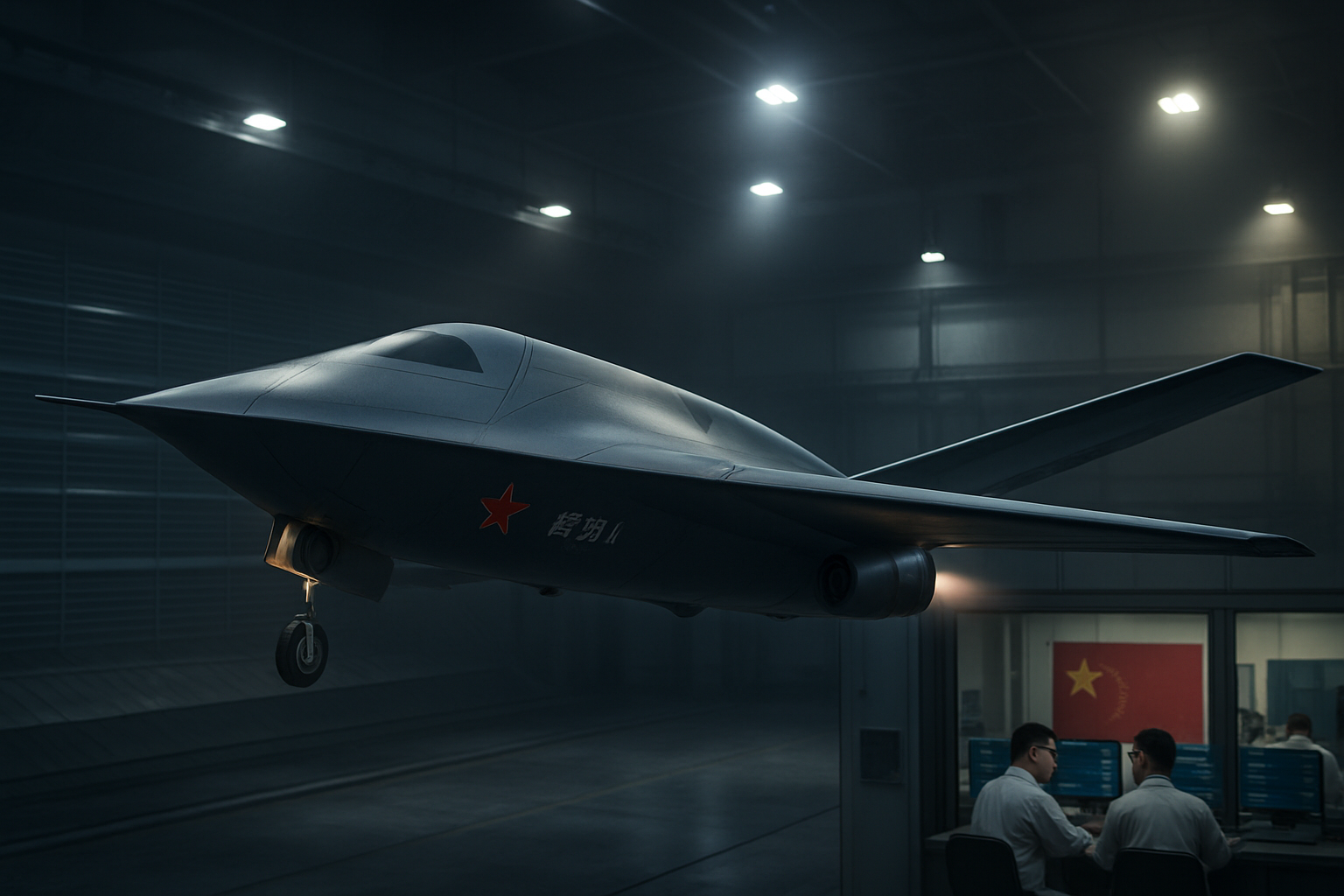
China has successfully tested a revolutionary hybrid propulsion system for small battlefield drones that promises to make them significantly quieter, more stealthy, and capable of longer-range operations, according to Chinese state media reports.
The breakthrough technology, announced Friday on CCTV-7, China's military television channel, represents a significant advancement in unmanned aerial vehicle capabilities that could reshape the dynamics of modern warfare. The hybrid system combines fuel-powered electricity generation with electric motors, merging the advantages of both propulsion methods to create what military analysts describe as a game-changing capability.
Revolutionary Propulsion Technology
The new hybrid system addresses a fundamental challenge in drone design that has long forced military engineers to choose between two distinct propulsion paths. Traditional fuel-powered systems, typically used in larger unmanned aircraft, offer strong performance and extended range but generate significant noise signatures that compromise stealth operations. Electric systems, while quieter and more suitable for stealth missions, have been limited by battery capacity and operational endurance.
China's solution elegantly bridges this gap by using fuel-powered electricity generation to drive electric motors, creating what researchers describe as "the best of both worlds." The system maintains the operational endurance of fuel-based propulsion while achieving the noise reduction and stealth characteristics of electric power.
According to the CCTV-7 report, the hybrid propulsion system has successfully passed comprehensive flight tests, demonstrating its readiness for potential deployment in battlefield scenarios. The development comes at a critical time when drone warfare has fundamentally altered military strategies worldwide.
Strategic Context of Drone Innovation
The timing of this announcement is particularly significant given the evolving landscape of global military technology and ongoing conflicts that have highlighted the strategic importance of unmanned systems. Recent intelligence assessments indicate that Russia is expanding its unmanned forces to 101,000 troops by April 2026, representing the largest dedicated drone force in modern warfare.
This technological arms race has intensified following the widespread use of drones in the Ukraine conflict, where both sides have deployed thousands of unmanned systems monthly. The conflict has demonstrated how drone technology can level playing fields between asymmetric forces and provide cost-effective solutions for military objectives that would traditionally require expensive manned aircraft or ground operations.
China's hybrid propulsion breakthrough occurs against the backdrop of increasing global focus on AI-enhanced military capabilities. Ukrainian forces have already deployed AI-enhanced drone systems with improved low-light vision capabilities, while the Pentagon has integrated ChatGPT into military systems serving over 800 million weekly users. However, only one-third of countries have agreed to AI warfare governance frameworks, with both the US and China abstaining from comprehensive commitments.
Technical Advantages and Implications
The hybrid propulsion system offers several critical advantages that could prove decisive in military applications. The reduced acoustic signature makes detection significantly more difficult, particularly during reconnaissance missions or surprise attacks. The extended range capabilities allow for operations deep behind enemy lines without the need for forward staging areas or refueling stations.
Perhaps most importantly, the system's ability to operate quietly while maintaining long endurance could revolutionize surveillance and intelligence gathering operations. Traditional surveillance aircraft or satellites can be tracked and countered, but small, quiet drones with extended operational periods could provide persistent monitoring capabilities that are extremely difficult to detect or defeat.
Military technology experts note that this development represents part of China's systematic approach to modernizing its defense capabilities. The country has increased defense spending by 7% to 1.91 trillion yuan despite targeting GDP growth of only 4.5-5%, demonstrating the priority placed on military technology advancement.
Broader Military Technology Context
China's drone innovation comes as military AI applications face increasing scrutiny globally. Recent developments have highlighted the complex intersection of artificial intelligence and military technology, with the Pentagon actively encouraging AI companies to expand tools into classified networks while facing resistance from some technology firms concerned about safety and ethical implications.
The advancement also occurs during what experts describe as a critical inflection point in AI and military technology integration. March 2026 has been identified as a "civilizational choice point" where AI transitions from experimental to essential infrastructure across military and civilian sectors worldwide.
Over 300 quantum physicists recently signed a manifesto denouncing the militarization of quantum research, representing unprecedented scientific ethical resistance to weaponization of breakthrough technologies. This resistance parallels concerns about rapid military adoption of AI and autonomous systems without adequate governance frameworks.
Global Implications and Future Prospects
The successful development of hybrid propulsion for military drones has implications extending far beyond China's immediate military capabilities. As drone technology becomes increasingly sophisticated and accessible, the advantages of quiet, long-range unmanned systems could influence military planning and procurement decisions worldwide.
Intelligence assessments suggest that this technology could be particularly valuable in potential conflict scenarios around Taiwan, where China's military activity has increased by 23% in 2025. The ability to deploy large numbers of quiet, persistent drones could provide significant advantages in surveillance, reconnaissance, and potential combat operations.
The development also highlights the ongoing technological competition between major military powers, with each seeking advantages in unmanned systems, artificial intelligence, and hybrid propulsion technologies. This competition is occurring alongside broader tensions over technology transfer, export controls, and military modernization programs.
Industry and Manufacturing Scale
The successful testing of hybrid propulsion systems suggests that China is moving from research and development into potential production phases. The country has demonstrated remarkable scaling capabilities in other technology sectors, with companies like Unitree Robotics expanding production from 5,500 to over 20,000 units in 2026, showing how quickly laboratory innovations can transition to mass production.
This manufacturing capability, combined with China's systematic investment in military technology, suggests that hybrid-powered drones could potentially be deployed at significant scale if the technology proves operationally effective. The implications for regional security and military balance could be substantial, particularly given the cost-effectiveness of drone systems compared to traditional military platforms.
As military technology continues evolving rapidly, China's hybrid drone breakthrough represents another significant milestone in the ongoing transformation of warfare. The success of this technology in actual operational conditions will likely determine whether it becomes a widely adopted innovation or remains a specialized capability with limited applications.