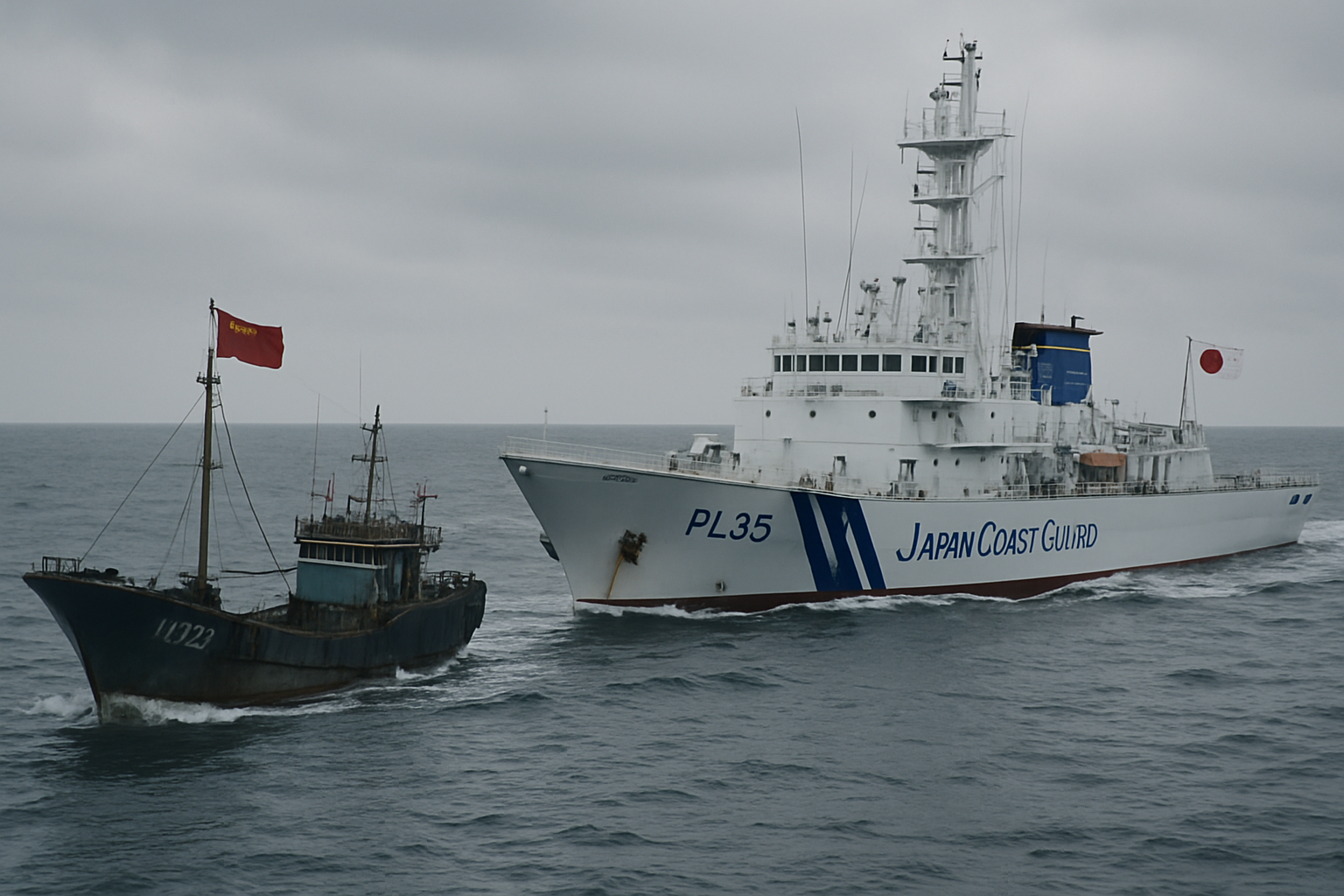
Maritime tensions between China and Japan reached a dangerous new threshold this week as Tokyo seized a Chinese fishing vessel and arrested its captain, while Beijing simultaneously threatened decisive action against US intelligence operations targeting Chinese military personnel.
Japanese authorities announced Friday that they had detained a Chinese fishing boat and arrested its 47-year-old captain after the vessel allegedly attempted to flee inspection in Japan's exclusive economic zone (EEZ) off Nagasaki Prefecture. The incident occurred Thursday approximately 165 kilometers south-southwest of Meshima Island, involving what officials described as a "tiger net fishing boat" with high capacity and 11 crew members aboard.
Maritime Confrontation Details
According to Japan's Fisheries Agency, the Chinese vessel's captain was ordered to stop for an onboard inspection by fisheries inspectors but "failed to comply and fled." The captain now faces charges for allegedly resisting the mandatory inspection, a move that Japanese media reports could significantly inflame ongoing diplomatic tensions between the two regional powers.
Beijing responded swiftly to the detention, with Chinese Foreign Ministry spokesman Lin Jian urging Tokyo to "protect its crew members' rights" and ensure fair treatment by Japanese authorities. The Chinese government emphasized that it has "consistently required the country's fishermen to operate" within international maritime law frameworks, though disputes over fishing rights in overlapping territorial claims have been a persistent source of friction.
The maritime incident represents the latest flashpoint in increasingly complex China-Japan relations, occurring amid broader regional tensions that have seen Chinese military aircraft activity increase 23% in 2025 with daily deployments around Taiwan designed to systematically pressure the island's population.
Intelligence Warfare Escalation
Simultaneously, China announced Friday it would take "all necessary measures" to counter foreign espionage activities after the CIA released an unprecedented Mandarin-language video specifically designed to recruit Chinese military officers. This marked a significant escalation in intelligence warfare between the world's two largest economies, which regularly accuse each other of espionage activities.
The timing of the CIA recruitment campaign proves particularly provocative, coming just weeks after the dramatic removal of China's top general amid corruption investigations. The video targets potentially disillusioned mid-level officers during a period when President Xi Jinping has consolidated complete control over the People's Liberation Army, eliminating remaining internal opposition that might complicate potential Taiwan military action.
Romanian sources indicated that the CIA campaign represents part of broader intelligence operations exploiting opportunities created by high-level PLA purges, including ongoing corruption investigations into General Zhang Youxia, the 75-year-old vice-chairman of China's Central Military Commission. This intelligence warfare intensification reflects the unprecedented public nature of recruitment efforts versus traditional covert operations.
Historical Context and Regional Implications
These developments build upon mounting regional tensions that have characterized East Asian geopolitics throughout 2025 and into 2026. China's unsuccessful attempt in late 2025 to rally Southeast Asian ambassadors against Japan following Prime Minister Sanae Takaichi's controversial Taiwan remarks demonstrated the limits of Beijing's diplomatic influence, even among countries where China serves as the largest trading partner.
The fishing vessel seizure occurs within the broader framework of China's dual-track regional strategy, combining military pressure campaigns with selective diplomatic engagement. While Beijing maintains regular military exercises and surveillance activities, it simultaneously pursues economic partnerships and attempts to engage opposition parties in neighboring countries to circumvent current government positions.
Taiwan President Lai Ching-te's recent warning that "if China seizes Taiwan, the next countries under threat would be Japan, the Philippines, and others in the Indo-Pacific region" has resonated with regional security analysts who view these maritime incidents as part of broader Chinese territorial expansion strategies.
International Response and Strategic Calculations
The maritime detention coincides with President Trump's unprecedented endorsement of Japan's Prime Minister Takaichi and announced plans for a March 19 summit, signaling strengthened US-Japan ties that complicate China's regional objectives. This represents a break from conventional diplomatic practice, with Washington offering "total endorsement" of an allied leader ahead of domestic electoral processes.
Japan's successful deep-sea rare earth mining breakthrough at Minamitorishima in early February, extracting materials from 6,000-meter depths with concentrations 20 times higher than terrestrial mines, adds another strategic dimension to regional competition. This technological achievement directly addresses Japan's goal of reducing dependence on China, which controls 60% of global rare earth production and 85% of processing capacity.
The fishing incident also reflects broader patterns in China's approach to territorial disputes, where Beijing employs systematic pressure campaigns while testing international responses. Chinese attempts to challenge Japanese administrative control over contested waters through fishing vessel operations represent a calculated strategy of incremental territorial assertion without triggering major military confrontation.
Economic and Strategic Stakes
Maritime security in East Asian waters carries enormous economic implications, as regional shipping lanes handle crucial portions of global trade flows. The Taiwan Strait alone affects international supply chains spanning everything from semiconductors to consumer goods, while fishing rights disputes impact food security and livelihood questions for millions of people across the region.
China's response to the vessel seizure will likely influence broader regional dynamics, particularly as Beijing continues expanding its nuclear arsenal and military capabilities while facing increasing international coordination through partnerships like the US-EU-Japan Critical Minerals Alliance announced in February 2026.
The simultaneous intelligence operations controversy adds complexity to economic relationships, as technological competition intensifies between China and Western allies. The CIA recruitment video campaign targets potential defectors during a period when China faces domestic challenges, including over 42,000 protest arrests and severe economic pressures from international sanctions related to various regional disputes.
Looking Ahead: Diplomatic and Security Challenges
These incidents occur against the backdrop of multiple global crises requiring international cooperation, including ongoing Middle East tensions, Ukraine conflict resolution efforts, and climate change mitigation strategies. The intersection of maritime territorial disputes with intelligence warfare demonstrates how regional conflicts can quickly escalate across multiple domains.
Regional allies including South Korea, Philippines, and ASEAN nations are closely monitoring developments for potential impacts on trade, security partnerships, and diplomatic relationships. The challenge for all parties involves balancing economic interdependence with security concerns, particularly as China remains the largest trading partner for most regional economies while simultaneously presenting security challenges.
Success in managing these tensions requires pragmatic solutions that address legitimate security concerns while respecting democratic principles and regional stability. The international community's response to these maritime and intelligence incidents will likely influence broader patterns of conflict management in an era of renewed great power competition.
As regional tensions continue evolving, the coming weeks will prove critical for determining whether diplomatic channels can prevent escalation or whether these incidents represent steps toward more sustained confrontation between major powers in one of the world's most economically vital regions.