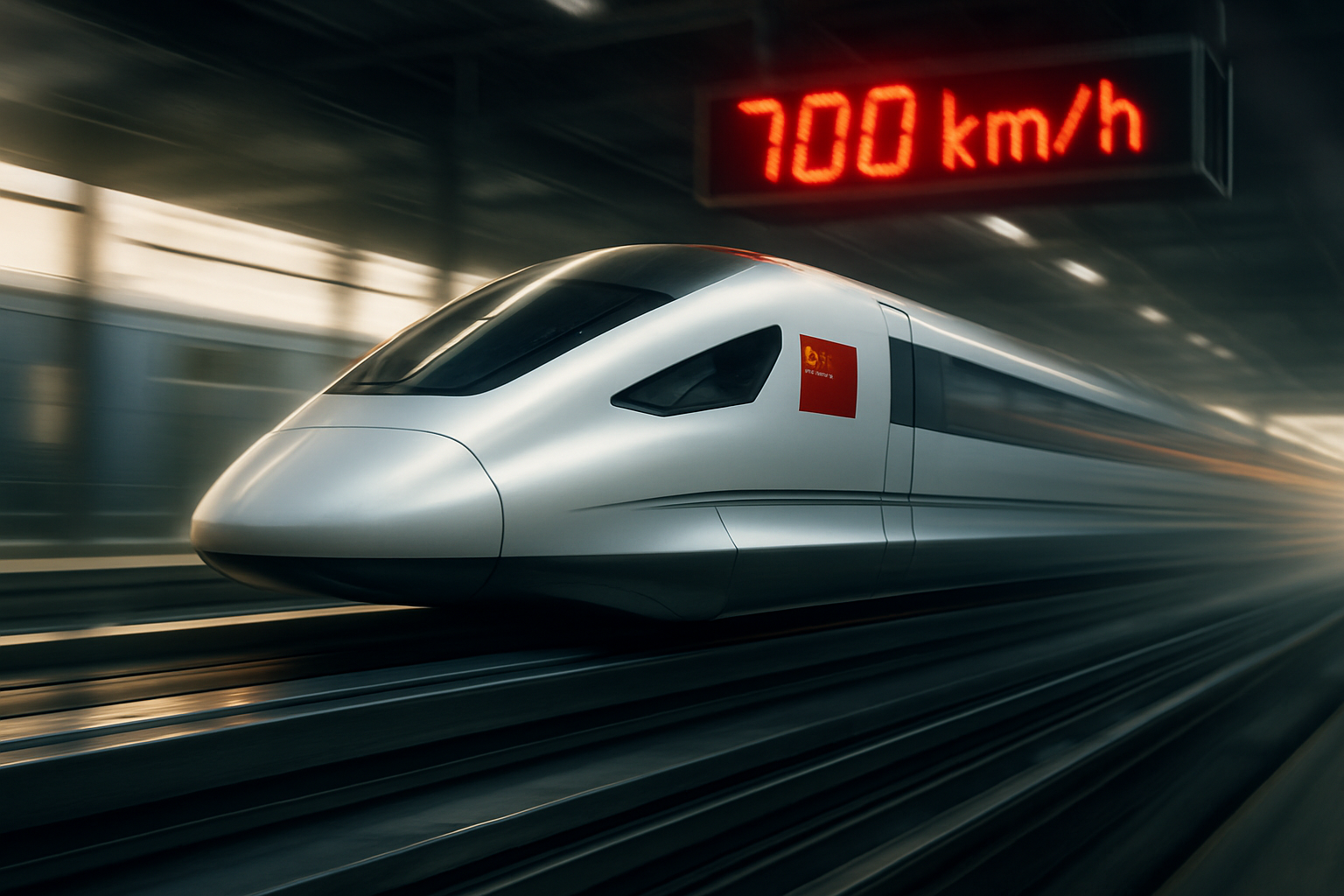
China has set a new world record with its fastest magnetic levitation train, achieving an extraordinary speed of 700 km/h in just two seconds—so fast that the vehicle virtually disappears from view during acceleration, marking a revolutionary milestone in global transportation technology.
The groundbreaking test was conducted on a 400-meter maglev track where the vehicle reached its maximum velocity before safely and controllably coming to a stop, demonstrating not just raw speed but sophisticated control systems capable of managing extreme acceleration forces.
Technological Breakthrough in Electromagnetic Propulsion
The research was conducted by a team from the National University of Defense Technology (NUDT), which has been developing this technology for over a decade. According to the researchers, this represents the most intensive recorded acceleration for a maglev system of this mass, establishing a new technological standard in the field of electromagnetic propulsion.
The key to this achievement lies in advanced electromagnetic systems that have been refined through years of meticulous engineering and testing. The technology represents a significant leap forward from previous maglev implementations, combining unprecedented power with precise control mechanisms.
"This achievement represents the culmination of over a decade of dedicated research and development in electromagnetic propulsion technology."
— National University of Defense Technology Research Team
Global Context of High-Speed Rail Development
This record comes amid an unprecedented global infrastructure surge exceeding $570 billion, with nations worldwide investing heavily in advanced transportation systems. China's achievement builds on a remarkable period of international high-speed rail development, including Vietnam's planned Hanoi-Ha Long Bay bullet train utilizing Japanese Shinkansen technology and the historic Saudi Arabia-Qatar 785-kilometer high-speed electric rail agreement.
The Chinese breakthrough occurs within a broader context of transportation modernization that has seen nations racing to develop faster, more efficient rail networks. European high-speed rail networks continue expanding, with projects like the Austria Franz-Josefs-Bahn modernization and Denmark's Copenhagen-Stockholm rail revival demonstrating continued investment in sustainable transportation infrastructure.
Engineering Challenges and Solutions
Achieving 700 km/h acceleration in just two seconds required overcoming extraordinary technical challenges. The engineering team had to address extreme electromagnetic forces, thermal management issues at high speeds, and the precise control systems needed to manage such rapid acceleration and deceleration safely.
The 400-meter test track itself represents a marvel of engineering precision, equipped with sophisticated monitoring systems to capture every millisecond of the record-breaking run. The controlled environment allowed researchers to validate not just the speed achievement but the entire safety and operational envelope of the technology.
China's Transportation Technology Leadership
This achievement solidifies China's position at the forefront of global transportation innovation. The country has systematically built expertise in high-speed rail technology over the past two decades, progressing from technology adoption to becoming a global leader in transportation system exports and innovation.
China's dominance extends beyond just maglev technology to encompass the entire high-speed rail ecosystem, including the critical materials supply chain where the nation controls 60% of global production and 90% of refining capacity for lithium, cobalt, and rare earth elements essential for advanced transportation systems.
Implications for Future Transportation
The 700 km/h achievement opens new possibilities for ultra-high-speed transportation that could revolutionize intercity travel. At such speeds, connections between major urban centers could be accomplished in unprecedented timeframes, potentially reshaping economic geography and urban planning.
This technological breakthrough also has significant implications for international cooperation and competition in advanced transportation. As nations increasingly view transportation infrastructure as strategic assets for economic competitiveness and climate adaptation, China's technological leadership positions it advantageously in global infrastructure partnerships.
Integration with Global Infrastructure Development
The timing of this achievement coincides with massive international infrastructure development projects worldwide. Countries are increasingly recognizing advanced transportation networks as foundations for economic competitiveness, regional integration, and climate adaptation strategies.
Modern infrastructure projects universally incorporate sophisticated technology integration from the design phase, including AI-powered monitoring systems, predictive maintenance capabilities, and climate adaptation features. China's maglev breakthrough represents the cutting edge of this technological convergence.
Economic and Strategic Significance
Beyond the technical achievement, this record demonstrates China's continued commitment to transportation innovation despite global economic uncertainties. The development represents significant research investment and positions Chinese technology companies as leaders in next-generation transportation systems.
The economic implications extend beyond domestic transportation to include export potential for Chinese maglev technology. Countries worldwide seeking to modernize their transportation infrastructure may look to Chinese expertise, particularly given the demonstrated performance capabilities.
Future Development Trajectory
This breakthrough likely represents just the beginning of ultra-high-speed transportation development. The successful demonstration of 700 km/h capability suggests that even higher speeds may be achievable with continued refinement of the underlying technology.
The research team's focus on the "most intensive acceleration" indicates that future development may emphasize not just maximum speed but rapid acceleration and deceleration capabilities that could make ultra-high-speed transportation practical for shorter distance applications.
As global transportation networks continue evolving toward greater speed, efficiency, and sustainability, China's maglev achievement sets new benchmarks for what is technically possible. The success establishes precedents that will likely influence transportation development strategies worldwide, contributing to an era of unprecedented innovation in how people and goods move across vast distances.