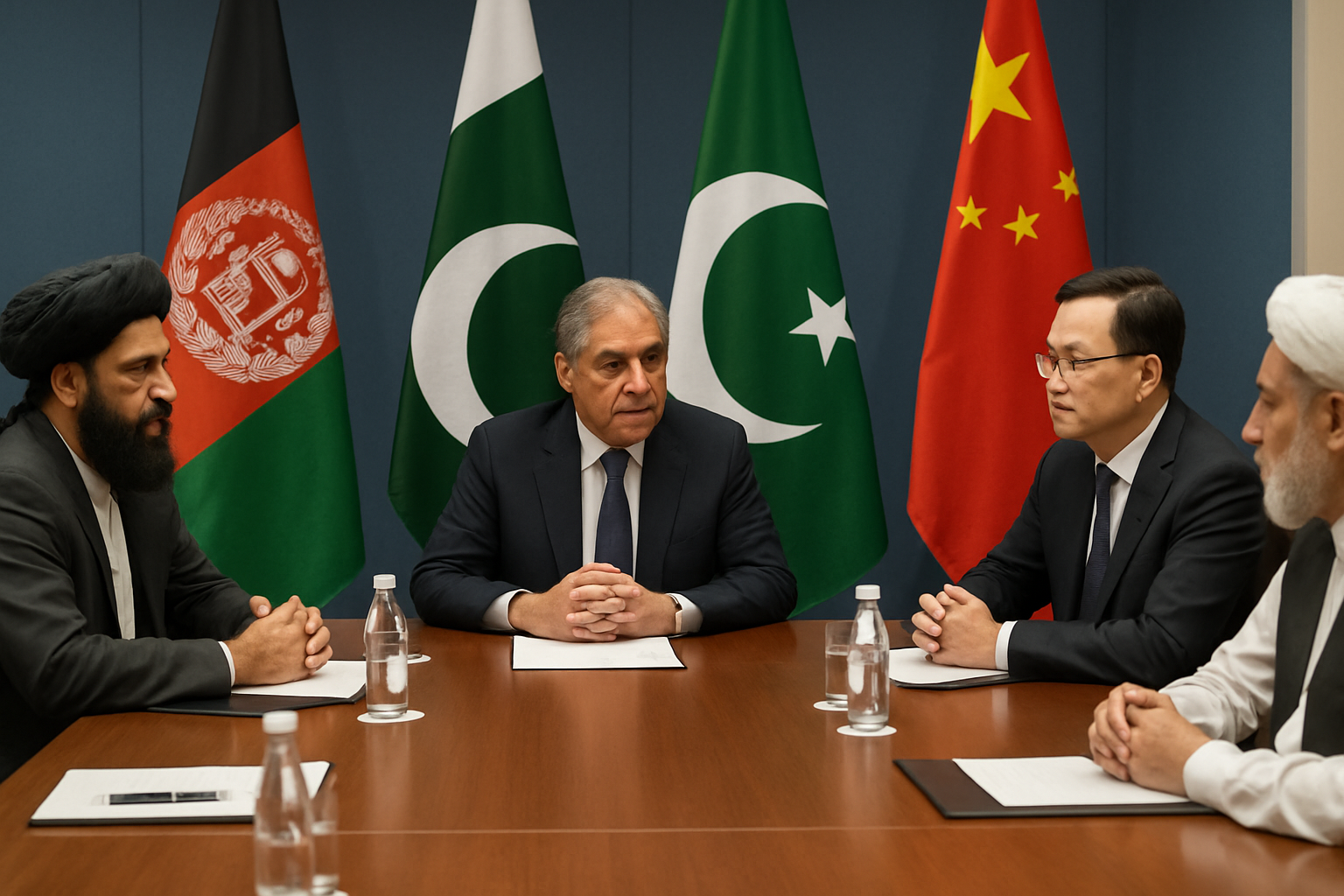
Officials from Afghanistan and Pakistan concluded a pivotal round of China-mediated talks in Urumqi, with both sides describing the discussions as constructive and agreeing to work toward a comprehensive resolution of their disputes that have claimed hundreds of civilian lives and displaced tens of thousands.
The trilateral talks, held from April 1-7 in the western Chinese city of Urumqi, represent the first high-level diplomatic engagement between the neighboring nations since Pakistan's Defense Minister Khawaja Mohammad Asif declared "open war" against Afghanistan's Taliban government on February 27, 2026.
Diplomatic Breakthrough After Months of Warfare
Abdul Qahar Balkhi, spokesperson for the Islamic Emirate's Ministry of Foreign Affairs, confirmed the talks covered a wide range of issues including bilateral relations, security concerns, and broader regional stability. The discussions were held in what he described as a "constructive atmosphere," with both sides engaging in comprehensive exchanges on the crisis that has escalated into the most serious military confrontation since the Taliban's 2021 return to power.
The Afghan delegation was led by Mohibullah Wasiq, chief of staff to the Foreign Minister, while Pakistan was represented by Special Representative Mohammad Sadiq. Chinese Foreign Ministry spokeswoman Mao Ning emphasized that the delegations "engaged in frank and pragmatic discussions in a positive atmosphere."
"Afghanistan and Pakistan stated their commitment to resolving their differences as soon as possible and realising a return to normalcy in bilateral relations, agreeing not to take any actions that would escalate or complicate the situation."
— Mao Ning, Chinese Foreign Ministry Spokesperson
Crisis Timeline and Humanitarian Catastrophe
The current crisis began on February 16, 2026, when a Tehreek-e-Taliban Pakistan (TTP) attack in Bajaur killed 11 Pakistani soldiers using a vehicle-borne improvised explosive device. This prompted Pakistani airstrikes on February 22 targeting seven alleged terrorist camps in Afghanistan, which Pakistan claimed killed over 80 militants but resulted in civilian casualties including eight schoolchildren.
The humanitarian toll has been devastating. According to the UN Assistance Mission in Afghanistan (UNAMA), 289 civilians have been killed or injured, with 76 fatalities and 213 wounded. The UN Office for the Coordination of Humanitarian Affairs (OCHA) reports that 16,370 families have been displaced across 10 provinces.
The World Health Organization (WHO) has been forced to deliver emergency oxygen to only 23 hospitals, with hundreds of health centers closed due to security concerns and funding shortages. The economic impact has been equally severe, with bilateral trade collapsing by 59% - Pakistani exports to Afghanistan fell from $550 million to $228 million over seven months.
The Durand Line Dispute at the Heart of the Crisis
Central to the ongoing tensions is the disputed 2,640-kilometer Durand Line, the colonial-era border established in 1893 that has never been recognized by any Afghan government. Afghanistan views the boundary as an artificial division of Pashtun tribal areas, while Pakistan maintains that TTP militants operate "with impunity from Afghan soil," using the porous mountainous terrain as sanctuary for cross-border attacks.
The Taliban categorically denies providing sanctuary to militant groups or allowing Afghan territory to be used for attacks against neighbors. However, Pakistan has acknowledged its diminished influence in Afghanistan compared to wealthier regional powers such as Turkey, UAE, Qatar, Saudi Arabia, and China, leading to increased reliance on military solutions.
Previous Mediation Efforts and Nuclear Implications
Multiple international mediation efforts have attempted to resolve the crisis with limited success. Saudi Arabia facilitated a prisoner exchange in February 2026, securing the release of three Pakistani soldiers. Turkey, Iran, and Russia all offered mediation services, while 22 prominent Islamic scholars from both countries issued joint appeals for peace.
Most notably, Saudi Arabia, Qatar, and Turkey achieved a temporary ceasefire during Eid al-Fitr (March 18-23) through faith-based diplomacy, but this was immediately violated with continued artillery exchanges and civilian casualties.
The nuclear dimension adds particular urgency to the crisis. As the most serious confrontation involving nuclear-armed Pakistan since the Taliban's return, the conflict requires careful international monitoring to prevent escalation beyond conventional operations. The situation tests the post-2021 South Asian security architecture and serves as a template for managing territorial sovereignty versus transnational terrorism challenges in the 21st century.
China's Strategic Mediation Role
China's direct involvement in mediating the crisis reflects Beijing's strategic interests in regional stability and protection of its China-Pakistan Economic Corridor (CPEC) investments. Foreign Minister Wang Yi has deployed special envoys shuttling between Kabul and Islamabad, representing China's most comprehensive diplomatic intervention in the region.
The Chinese approach focuses on confidence-building measures, including the reopening of traditional trade routes such as Chaman-Spin Boldak and Torkham crossings that have been repeatedly closed during the conflict. Beijing has warned the UN about the presence of ISIS-K, al-Qaeda, and ETIM militants in Afghanistan, which contradicts Taliban claims of having defeated terrorism.
"China hopes both sides maintain calm, conduct face-to-face talks as soon as possible, establish a ceasefire, and resolve disputes through dialogue."
— Wang Yi, Chinese Foreign Minister
International Response and Regional Implications
The crisis has drawn international condemnation and intervention attempts. India's Ministry of External Affairs condemned Pakistan's cross-border operations as "aggressive actions" causing civilian casualties. The European Union has called for urgent de-escalation and respect for international law, while emphasizing that Afghan soil must not be used to threaten other countries.
The Afghanistan diaspora has organized protests in major cities including London, Oslo, and Sacramento, calling for international accountability for those responsible for civilian casualties. The Norwegian Refugee Council has appealed for urgent aid for families displaced by the fighting.
Economic Warfare and Border Communities
The conflict's economic dimension has particularly affected border communities dependent on cross-border trade. The repeated closure of traditional trade routes has created supply shortages of essential goods and medical supplies, especially in remote mountainous regions like Nuristan province.
Residents of Afghanistan's Kamdesh and Barg-e-Matal districts have made urgent appeals to Taliban officials for intervention to reopen blocked roads. The economic warfare compounds an existing humanitarian crisis where 88% of Afghan female-headed households are unable to meet minimum living requirements.
Path Forward and Diplomatic Prospects
Despite the diplomatic breakthrough in Urumqi, significant challenges remain. The Taliban maintains that the "path of talks remains open" and seeks "mutual understanding and respect," while Pakistan has indicated there is "no rush" to end its military campaign without concrete anti-militant measures being implemented.
The success or failure of the Chinese-mediated framework will influence global approaches to managing the intersection of territorial sovereignty and transnational terrorism. The crisis serves as a critical test for innovative diplomatic frameworks that must balance security concerns with territorial integrity, civilian protection, and international law compliance.
Taliban spokesman Hamdullah Fitrat has reported that 761 civilians have been killed and 626 wounded in Pakistani attacks since February 22, highlighting the urgent need for sustained diplomatic engagement. Pakistan's acknowledgment of its policy limitations and the Taliban's commitment to dialogue provide hope that the Chinese mediation framework can achieve what previous efforts could not.
Template for 21st Century Conflict Resolution
The Afghanistan-Pakistan crisis represents a template for contemporary challenges where state sovereignty intersects with transnational terrorism concerns. The involvement of nuclear-armed neighbors, complex tribal dynamics, colonial-era border disputes, and competing regional power interests creates a multifaceted challenge requiring innovative diplomatic solutions.
The Chinese trilateral mechanism represents Beijing's most significant diplomatic intervention in South Asian affairs, demonstrating China's growing role as a regional mediator. The framework's success could provide a model for managing similar territorial disputes globally, while failure risks prolonged regional warfare with devastating humanitarian consequences.
As the talks concluded on April 7, 2026, both sides expressed appreciation for China's hospitality and mediation efforts. The international community continues to monitor the situation closely, with the stakes extending far beyond bilateral relations to affect regional stability and global security architecture in an era where traditional diplomatic mechanisms face unprecedented tests.