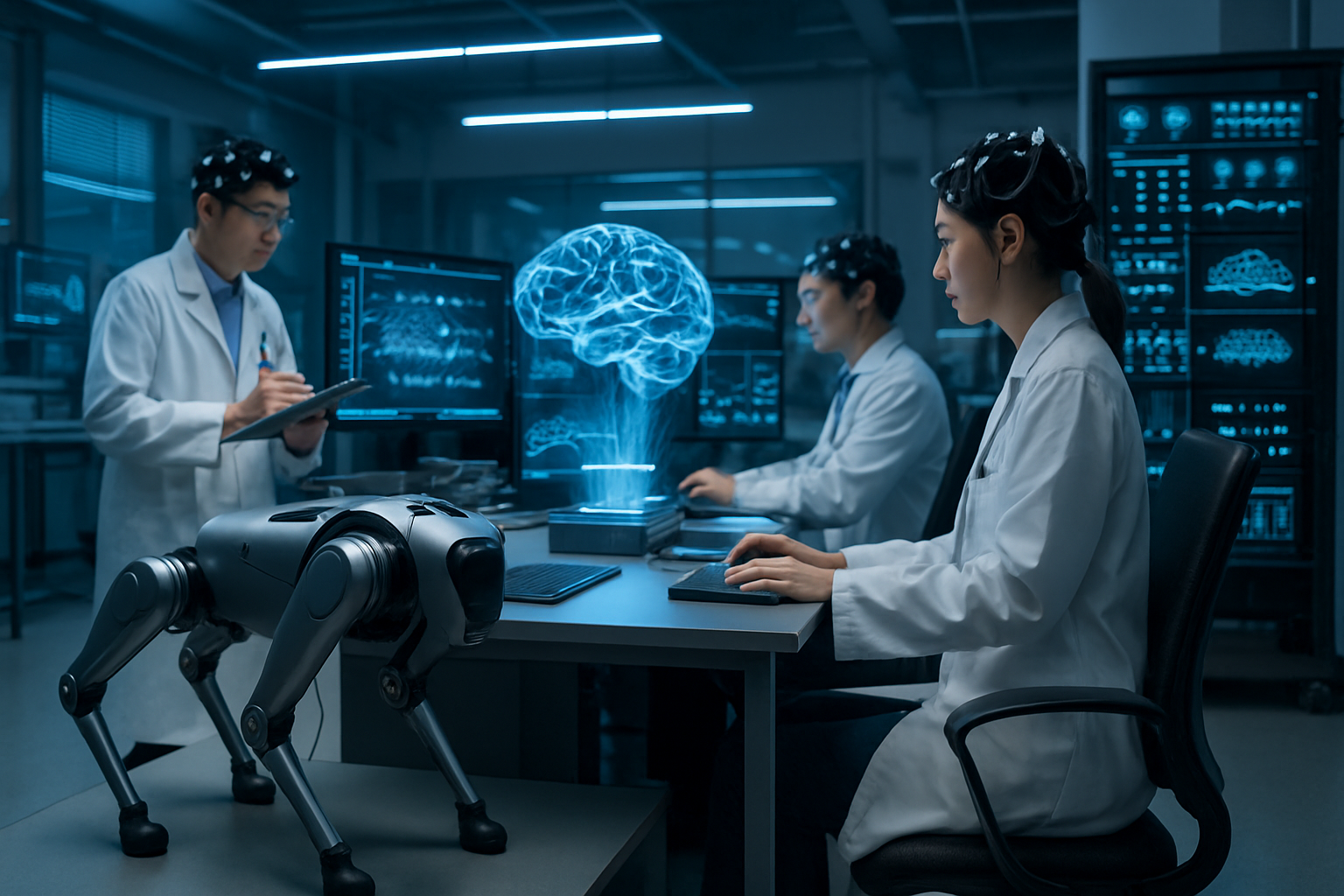
Chinese researchers at Xi'an Jiaotong University have achieved a groundbreaking technological milestone by developing the world's first mind-controlled robot dog system, allowing operators to command the autonomous machine through thought alone, without the need for joysticks, buttons, or any physical controls.
The revolutionary breakthrough, announced on March 30, 2026, combines cutting-edge brain-signal reading technology with autonomous navigation systems, representing a significant leap forward in brain-computer interface (BCI) applications. According to project leader Xu, the system enables users to control the robot dog's movements and actions simply by thinking about the desired commands.
Revolutionary Brain-Computer Interface Technology
This breakthrough positions China at the forefront of a rapidly expanding global brain-computer interface revolution that has seen unprecedented momentum throughout 2026. The mind-controlled robot dog system builds upon China's recent strategic victories in neurotechnology, including Neuracle Medical Technology's historic achievement of securing the world's first commercial approval for a coin-sized neural implant designed to restore motor function in spinal cord injury patients.
The Xi'an Jiaotong University research team has successfully overcome the complex challenges of translating neural signals into precise mechanical commands. The system employs advanced algorithms to interpret brainwave patterns and convert them into actionable instructions for the robot dog, enabling seamless human-machine collaboration without traditional input devices.
"This represents a fundamental shift in how humans can interact with robotic systems. We're moving beyond physical interfaces to direct neural communication."
— Professor Xu, Xi'an Jiaotong University Project Leader
Context of China's Neurotechnology Leadership
The mind-controlled robot dog achievement occurs within China's broader strategic push toward neurotechnology dominance, driven by what experts term the "doctrine of the mean" approach to brain-computer interfaces. Unlike Western companies that have pursued high-risk, fully invasive neural implant strategies, Chinese researchers have focused on semi-invasive and non-invasive methods that balance effectiveness with safety and regulatory feasibility.
This pragmatic philosophy has enabled China to achieve faster commercial approval and practical patient solutions while American competitors like Neuralink remain mired in theoretical development and regulatory obstacles. China's systematic approach to neurotechnology investment, combined with its "middle-path" innovation model, has created sustainable competitive advantages in the global brain-computer interface race.
The breakthrough also aligns with China's comprehensive artificial intelligence strategy, particularly its response to demographic challenges including the "4-2-1 problem" where single children must support four aging parents and grandparents. Advanced human-robot collaboration systems like the mind-controlled robot dog represent technological solutions to China's rapidly aging population and associated labor shortages.
Technical Innovation and Applications
The Xi'an Jiaotong University system represents a sophisticated integration of multiple advanced technologies. The brain-signal reading component employs non-invasive electroencephalography (EEG) sensors to capture neural activity, while machine learning algorithms process and interpret the complex patterns of brainwaves associated with specific intentions.
The autonomous navigation aspect of the system allows the robot dog to execute high-level commands while handling low-level movement coordination independently. This hybrid approach reduces cognitive load on operators while maintaining precise control over the robot's behavior and objectives.
Potential applications for this technology extend far beyond demonstration purposes. The system could revolutionize assistance for individuals with mobility impairments, enhance search and rescue operations, improve military and security applications, and create new paradigms for human-robot collaboration in industrial settings.
Global Brain-Computer Interface Revolution
The Chinese breakthrough occurs during what researchers have termed the "Therapeutic Revolution of 2026," a global paradigm shift toward prevention-first healthcare and advanced neurotechnology solutions. This period has witnessed remarkable achievements including Austrian scientists enabling 200,000 human brain cells to learn and play video games, and Finnish researchers demonstrating measurable brain structure changes from choir singing.
The convergence of digital brain mapping breakthroughs, including the successful copying of a complete living fly brain into a computer, demonstrates the accelerating pace of neuroscience advancement. These achievements collectively point toward a future where brain-computer interfaces become integral to medical treatment, human augmentation, and technological interaction.

Infrastructure and Investment Context
China's neurotechnology success occurs despite ongoing global infrastructure constraints, including a severe semiconductor shortage that has driven memory chip prices sixfold higher, affecting companies like Samsung, SK Hynix, and Micron through 2027. However, these constraints have paradoxically spurred innovation in memory-efficient algorithms and hybrid processing approaches that democratize access to advanced AI and BCI technologies.
Massive corporate investments continue to flow into the sector, with Alphabet committing $185 billion to AI infrastructure in 2026 (the largest single-year corporate tech investment in history) and Amazon planning over $1 trillion in AI development spending. These investments underscore the strategic importance of brain-computer interface technologies in the broader artificial intelligence ecosystem.
China's approach has emphasized practical, near-term applications over moonshot projects, enabling faster progress toward commercial viability. This strategy has proven particularly effective in the current environment where infrastructure constraints favor efficiency-focused development over raw computational power approaches.
International Competition and Collaboration
The mind-controlled robot dog breakthrough intensifies global competition in neurotechnology, with implications extending far beyond scientific achievement. The United Nations has established an Independent Scientific Panel of 40 experts to provide the first fully independent international assessment of AI technologies, recognizing the need for coordinated governance frameworks.
European nations have responded with increased regulatory oversight, including Spain's implementation of the world's first criminal executive liability framework for technology platforms and France's cybercrime raids on AI companies. These regulatory approaches contrast with China's more permissive development environment, creating different pathways for neurotechnology advancement.
Successful integration models from other nations provide templates for responsible development. Malaysia has launched the world's first AI-integrated Islamic school, Canadian universities employ AI teaching assistants while maintaining critical thinking standards, and Singapore's WonderBot 2.0 demonstrates successful heritage education applications. These examples show how advanced technologies can enhance rather than replace human capabilities when implemented thoughtfully.
Ethical Considerations and Future Implications
The development of mind-controlled robotics raises fundamental questions about consciousness, digital rights, and human identity that require careful consideration. As brain-computer interfaces become more sophisticated, society must grapple with issues of mental privacy, cognitive enhancement, and the potential for neural surveillance or manipulation.
The Chinese research team's emphasis on non-invasive approaches addresses some safety concerns while still achieving practical functionality. This balanced approach may provide a model for responsible development that maximizes benefits while minimizing risks to human subjects.
Industry experts characterize March 2026 as a "civilizational choice point" that will determine whether AI and neurotechnology serve human flourishing or become tools of exploitation. The success of projects like the mind-controlled robot dog depends on establishing governance frameworks that balance innovation with human welfare, commercial interests with ethical considerations, and national competitiveness with international cooperation.
Path Forward
The Xi'an Jiaotong University breakthrough represents a critical step toward practical brain-computer interfaces that could transform how humans interact with technology. As the system undergoes further development and testing, its success could accelerate adoption of similar technologies across multiple sectors.
The most promising path forward involves sophisticated human-machine collaboration that amplifies human capabilities while preserving the creativity, cultural understanding, and ethical reasoning that define human potential. Organizations that treat brain-computer interfaces as tools for human empowerment rather than replacement consistently achieve superior outcomes in terms of functionality, user satisfaction, and long-term sustainability.
The window for coordinated international action on neurotechnology governance is narrowing as development accelerates. The decisions made in 2026 regarding research priorities, safety standards, and ethical frameworks will establish the trajectory of human-machine interface development for the remainder of the century.