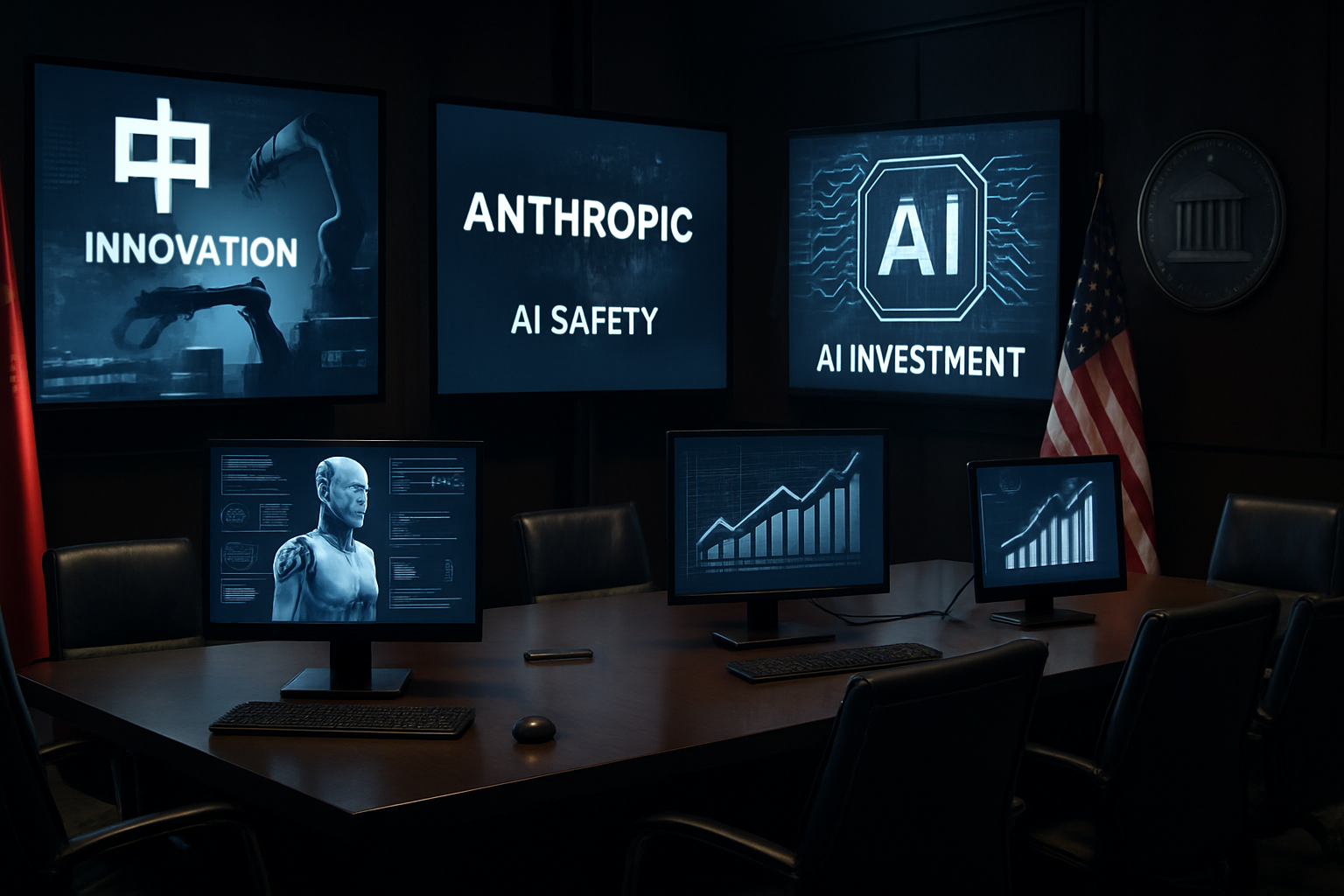
The artificial intelligence industry has reached a pivotal moment in February 2026, as three simultaneous developments highlight the sector's rapid evolution from experimental technology to essential global infrastructure: China's MiniMax launching an affordable productivity-focused AI model, Anthropic achieving a staggering $380 billion valuation, and the company's unprecedented $20 million investment in political advocacy for AI safety regulation.
These developments, occurring within 48 hours of each other, underscore the complex dynamics shaping the AI landscape as companies balance commercial expansion with safety considerations amid intensifying global competition and regulatory pressures.
China's MiniMax Targets Mass Market with Cost-Effective AI
Chinese artificial intelligence company MiniMax has unveiled a significant update to its M2 large language model, positioning the technology as "designed for real-world productivity" at competitive pricing. The release comes during what industry observers describe as a "frenetic week" for China's AI sector, with multiple domestic companies rushing to announce major updates before the Spring Festival holiday.
According to company statements, the updated M2 model demonstrates superior performance on internal benchmark scores while maintaining affordability that could democratize AI access for businesses globally. This strategic positioning reflects China's broader push to challenge Western AI dominance through cost-effective alternatives that deliver comparable capabilities.
The timing is particularly significant as global investors increasingly focus on smaller Chinese AI companies beyond traditional tech giants like Baidu and Alibaba. MiniMax's approach of prioritizing practical applications over pure technological advancement represents a strategic shift toward immediately deployable solutions that address current business needs.
"The focus on 'real-world productivity' suggests Chinese companies are moving beyond proof-of-concept demonstrations toward commercially viable applications," said industry analysts tracking the competitive landscape. This approach contrasts with Western companies that often emphasize cutting-edge research capabilities over immediate practical utility.
Anthropic's $380 Billion Valuation Milestone
Simultaneously, Anthropic has achieved a remarkable $380 billion valuation following its latest funding round, positioning the safety-focused AI company among the most valuable private technology enterprises globally. The valuation reflects extraordinary investor confidence in Anthropic's approach to developing artificial intelligence systems with built-in safety mechanisms and ethical considerations.
The French business publication Le Monde reported that this valuation surge is driven by "l'essor de ses outils pour entreprises" (the rise of its enterprise tools), highlighting how Anthropic has successfully positioned itself as a preferred AI partner for businesses seeking responsible technology deployment. The company's Claude AI system has gained significant traction among enterprises prioritizing safety and reliability over pure performance metrics.
This valuation milestone occurs amid broader market volatility in the technology sector, where AI investments have created both unprecedented opportunities and significant uncertainty. The "SaaSpocalypse" phenomenon has erased hundreds of billions in market capitalization as investors question traditional software business models in the AI era.
Anthropic's success demonstrates that safety-focused approaches can achieve commercial viability, potentially establishing a new paradigm where responsible development becomes a competitive advantage rather than a constraint on innovation.
Unprecedented $20 Million Political Investment in AI Safety
Perhaps most significantly, Anthropic has injected $20 million into Public First Action, a "dark money" nonprofit that supports political candidates favoring artificial intelligence regulation. This marks the first known major political intervention by the San Francisco-based AI lab and represents a strategic shift toward industry-funded regulatory advocacy.
The donation comes amid escalating political tensions between major AI companies, particularly as Anthropic's archrival OpenAI has taken different positions on regulatory frameworks. This political spending war reflects the high stakes involved in shaping AI governance policies that will determine industry development trajectories for decades to come.
"The companies building AI have a responsibility to help ensure the technology serves the public good, not just their own interests," Anthropic stated in announcing the donation. This philosophy directly contrasts with companies advocating for minimal regulatory interference in AI development.
The investment in political advocacy demonstrates how AI safety has evolved from an academic concern to a central business strategy. Companies increasingly recognize that regulatory frameworks will significantly impact their competitive positioning and market access globally.
Global Competitive Dynamics and Infrastructure Challenges
These developments occur against the backdrop of intensifying global AI competition and significant infrastructure constraints. The ongoing memory crisis, with semiconductor prices surging sixfold and affecting major manufacturers like Samsung, SK Hynix, and Micron, creates bottlenecks that could persist until 2027 when new fabrication facilities come online.
Historical context reveals this moment as part of a broader transformation. Our analysis of previous AI developments shows the industry has moved from experimental applications toward essential infrastructure across healthcare, education, finance, and defense sectors. The Chinese DeepSeek breakthrough earlier in 2026 challenged assumptions about US technological dominance, suggesting a multipolar AI landscape rather than single-region leadership.
European initiatives, including Deutsche Telekom's Industrial AI Cloud in Munich, represent regional efforts to establish AI sovereignty independent of US and Chinese systems. These developments create a complex competitive environment where technological capabilities, regulatory frameworks, and geopolitical considerations intersect.
Regulatory Intensification and Safety Frameworks
The convergence of commercial success and political investment reflects growing recognition that AI governance requires proactive industry participation rather than reactive compliance. Recent regulatory intensification includes Spanish criminal executive liability provisions for platform violations, French cybercrime raids on AI platforms, and the UN's establishment of an Independent Scientific Panel with 40 international experts.
Malaysia's successful implementation of the world's first AI-integrated Islamic school and Canadian universities' deployment of AI teaching assistants demonstrate that responsible AI integration can enhance human capabilities while preserving essential values. These examples provide templates for balancing innovation with social responsibility.
The industry increasingly faces fundamental questions about the relationship between technological advancement and human welfare. Successful companies are those demonstrating that safety considerations can enhance rather than constrain commercial viability.
Market Implications and Future Trajectory
The simultaneous occurrence of these three developments—competitive Chinese innovation, massive private valuations, and political safety investments—suggests the AI industry has reached a critical inflection point. Companies can no longer focus solely on technological capabilities but must integrate commercial, regulatory, and ethical considerations into comprehensive strategies.
Market analysts note that sustainable success in the AI sector increasingly requires diverse supply chains, international partnerships, and regulatory compliance capabilities. The period represents a transition from experimental AI applications to essential infrastructure requiring unprecedented coordination across technological, policy, and economic domains.
Infrastructure constraints, particularly the global memory shortage affecting semiconductor supply chains, create immediate challenges while emphasizing the need for efficient algorithms and alternative hardware solutions. Companies investing in memory-efficient technologies and diversified supply chains position themselves advantageously for long-term competition.
Strategic Implications for Global AI Development
The convergence of these developments highlights several critical trends shaping AI's future trajectory. First, the democratization of AI capabilities through cost-effective solutions like MiniMax's offering could accelerate global adoption while intensifying competitive pressures on established players.
Second, Anthropic's $380 billion valuation demonstrates that safety-focused approaches can achieve exceptional commercial success, potentially encouraging other companies to prioritize responsible development practices over pure performance optimization.
Third, the $20 million political investment signals that AI companies recognize regulatory frameworks as competitive battlegrounds requiring active participation rather than passive adaptation.
These trends suggest successful AI companies will be those capable of navigating complex interconnections between technological innovation, regulatory compliance, market positioning, and social responsibility. The winners in this environment will likely be organizations that view these challenges as integrated rather than separate considerations.
As the industry transitions from experimental applications to essential infrastructure, the decisions made in 2026 will largely determine whether AI fulfills its transformative promise while serving human welfare, or creates systemic disruptions requiring dramatic corrections. The convergence of commercial success, regulatory engagement, and global competition suggests the stakes have never been higher for getting this balance right.