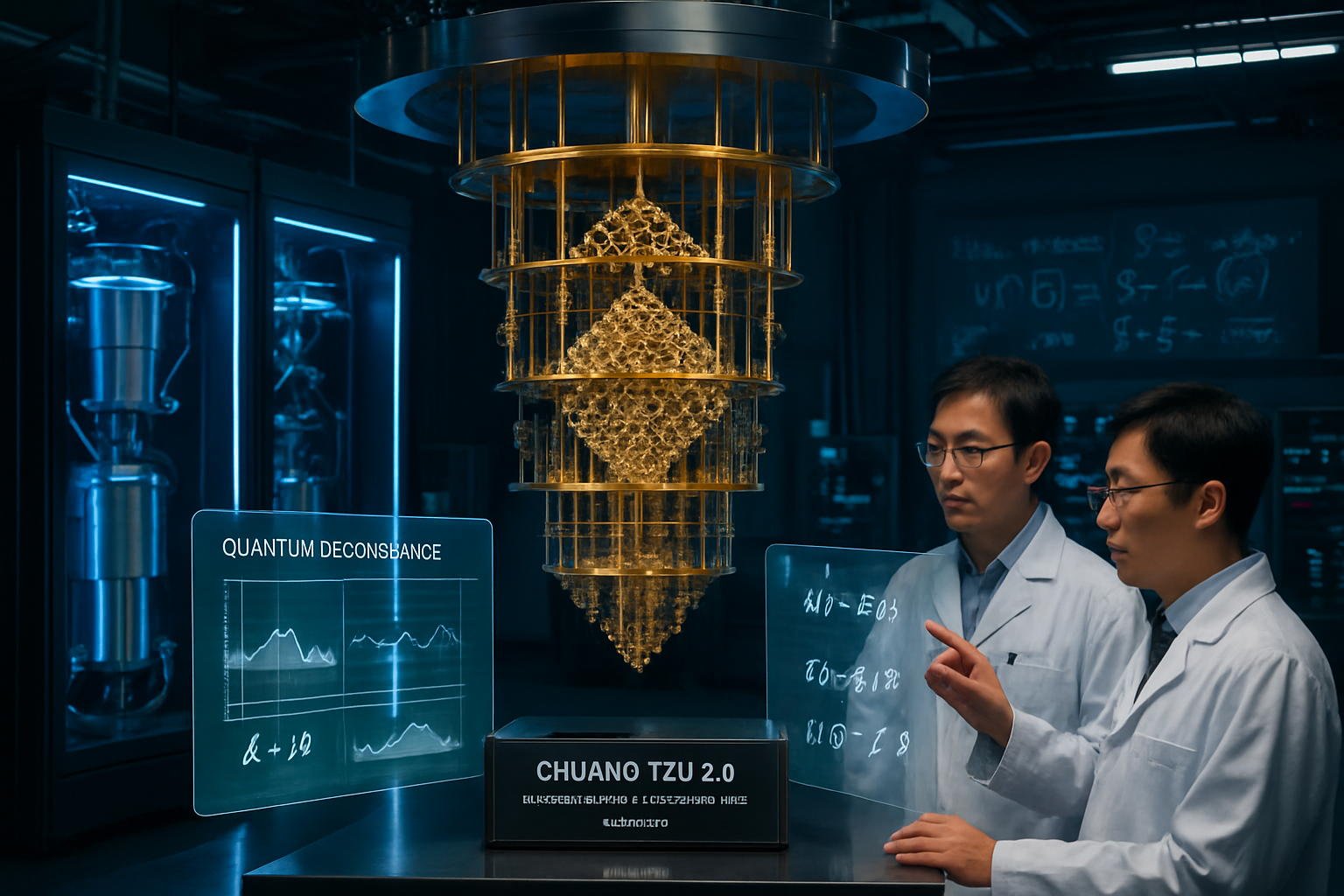
In a landmark achievement that could revolutionize quantum computing, Chinese scientists have successfully observed and manipulated prethermalisation—a critical transitional state in quantum systems—using the advanced 78-qubit "Chuang-tzu 2.0" superconducting processor, effectively putting quantum chaos in "slow motion" for detailed scientific study.
The breakthrough, announced by researchers from leading Chinese quantum physics institutes, represents a significant advance in humanity's ability to understand and control quantum decoherence, a fundamental challenge that has long plagued quantum computing development. By gaining the ability to "tune" the speed of quantum decoherence, scientists now possess a vital tool for managing complex quantum environments that could accelerate practical quantum computing applications.
Understanding Quantum Prethermalisation
When a quantum system is disturbed, it naturally returns to a balanced state through a process where energy and information spread throughout the system until they reach equilibrium. However, prethermalisation represents a crucial intermediate phase—a temporary quasi-stable state that occurs before the system reaches its final thermal equilibrium.
This transitional state has been theoretically predicted for decades, but directly observing and manipulating it has remained beyond scientific reach until now. The Chinese team's success in controlling this process opens unprecedented possibilities for quantum error correction and stability enhancement in future quantum computers.
"The ability to directly observe prethermalisation gives us a window into the fundamental processes that govern quantum systems," explains the research team. "By slowing down quantum chaos, we can study these processes in detail and potentially harness them for practical applications."
The Chuang-tzu 2.0 Advantage
Named after the ancient Chinese philosopher Zhuangzi (also known as Chuang-tzu), the superconducting quantum processor represents one of China's most advanced quantum computing platforms. With 78 qubits operating at near absolute zero temperatures, the system provides sufficient complexity to observe emergent quantum phenomena while maintaining precise control over individual quantum states.
The processor's architecture allows researchers to manipulate quantum coherence with unprecedented precision, essentially creating a "quantum laboratory" where fundamental physics can be studied under controlled conditions. This level of control has enabled the team to slow down quantum decoherence processes that typically occur on timescales far too fast for detailed observation.
Global Quantum Computing Context
This breakthrough occurs within the broader context of an intensifying global quantum technology race. Recent developments include significant quantum advances across multiple nations, with China emerging as a major player alongside traditional leaders like the United States and European Union.
The achievement builds upon China's previous quantum successes, including breakthrough quantum encryption research using rubidium atoms that demonstrated tamper-proof communication over 100+ kilometers. These advances position China at the forefront of practical quantum technology applications, from secure communications to advanced computing.
Kazakhstan recently established the Kazakh-Singaporean Center for Quantum Technologies in Almaty, while various international collaborations continue advancing quantum research despite growing geopolitical tensions. The field remains characterized by both cooperation and competition as nations recognize quantum technology's strategic importance.
Technical Implications
The ability to control prethermalisation could address one of quantum computing's most persistent challenges: maintaining quantum coherence long enough to perform meaningful calculations. Quantum decoherence—the process by which quantum systems lose their quantum properties and behave classically—has been the primary obstacle preventing quantum computers from achieving their theoretical potential.
By manipulating the speed and characteristics of decoherence, researchers may develop new quantum error correction protocols, extend quantum coherence times, and create more stable quantum computing platforms. This could accelerate the development of fault-tolerant quantum computers capable of solving complex problems beyond the reach of classical computers.
The research methodology could also be applied to other quantum systems, potentially advancing quantum sensing, quantum communications, and quantum simulation technologies. The techniques developed for controlling prethermalisation may prove universally applicable across quantum technologies.
Future Applications and Challenges
While the scientific achievement is significant, translating laboratory breakthroughs into practical quantum computing applications remains challenging. The current research demonstrates proof-of-concept capabilities that must be scaled and refined for commercial applications.
Potential applications include more stable quantum computers, enhanced quantum sensors for medical imaging and geological exploration, and improved quantum communication networks. The ability to control quantum decoherence could also enable new types of quantum simulations for drug discovery, materials science, and fundamental physics research.
However, significant engineering challenges remain, including scaling these techniques to larger quantum systems, maintaining control precision at room temperature operations, and integrating decoherence management into practical quantum computing architectures. The semiconductor memory crisis affecting global technology development may also impact quantum computing hardware advancement.
Strategic Implications
China's quantum breakthrough occurs amid broader technological competition and cooperation dynamics. While the research contributes to global scientific knowledge, it also enhances China's position in the strategic quantum technology landscape that could determine future technological and economic advantages.
The success demonstrates the effectiveness of sustained government investment in fundamental research combined with advanced technological infrastructure. China's approach to quantum research emphasizes both theoretical understanding and practical applications, reflected in projects ranging from quantum communication networks to quantum computing platforms.
International collaboration remains essential for advancing quantum science, as these technologies require global cooperation to address shared challenges while managing competitive dynamics. The Chinese breakthrough provides valuable insights that could benefit worldwide quantum research efforts.
Looking Forward
The successful manipulation of quantum prethermalisation represents a crucial step toward practical quantum computing, but substantial work remains before these capabilities transform into commercial applications. Researchers must demonstrate scalability, develop engineering solutions for real-world deployment, and address the numerous technical challenges associated with quantum technology commercialization.
The breakthrough also highlights the importance of continued investment in fundamental quantum research, as unexpected discoveries in basic science often provide the foundation for technological revolutions. As quantum technologies mature from laboratory curiosities to practical tools, controlling quantum decoherence may prove essential for realizing their full potential.
With quantum technology positioned as a key component of future technological infrastructure—from secure communications to advanced computing and precision sensing—breakthroughs like China's prethermalisation control could help determine which nations lead the next phase of technological development.