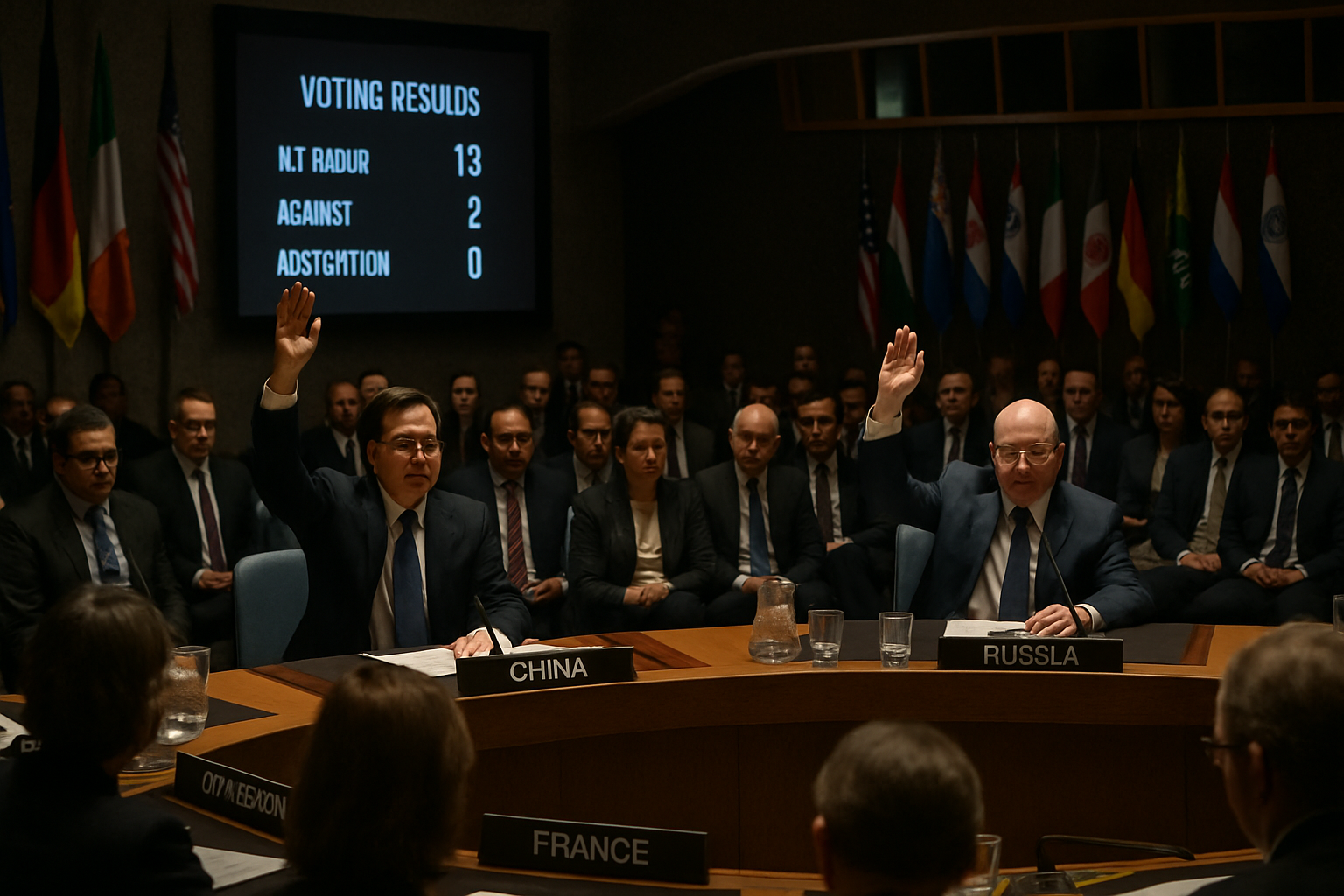
The UN Security Council on Tuesday failed to adopt a draft resolution aimed at reopening the Strait of Hormuz after China and Russia exercised their veto power, dealing a significant blow to international efforts to resolve the maritime crisis that has severely disrupted global shipping and energy markets.
The resolution, drafted by Bahrain on behalf of Gulf states, received 11 votes in favor from Bahrain, the Democratic Republic of the Congo, Denmark, France, Greece, Latvia, Liberia, Panama, Somalia, the United Kingdom, and the United States. However, China and Russia voted against the measure, while Pakistan and Colombia abstained, preventing its adoption under UN Security Council rules.
Resolution Details and Diplomatic Efforts
The Bahrain-drafted resolution underwent six revisions during negotiations in an attempt to bridge differences among council members. The proposal called on states to coordinate "defensive" measures to safeguard maritime security in the Strait of Hormuz, including escorting commercial vessels and deterring attempts to disrupt navigation through the strategic waterway.
The draft emphasized that such efforts should remain defensive in nature and fully comply with international humanitarian law, while respecting the rights and freedoms of navigation of third-party states. It specifically stressed the need to ensure unimpeded passage through the strait amid rising regional tensions stemming from the ongoing Middle East conflict.
Following the vote, Bahrain's Foreign Minister Abdullatif bin Rashid Al Zayani expressed regret over the outcome, stating that "the Council failed to shoulder its responsibility in reopening this vital shipping lane that affects global energy security."
Strategic Importance of the Strait of Hormuz
The Strait of Hormuz, a narrow 21-mile waterway between Iran and the Arabian Peninsula, handles approximately 40% of global seaborne oil transit and is considered one of the world's most critical energy chokepoints. Iran's Revolutionary Guard declared the strait "unsafe for shipping" in March 2026 following the escalation of US-Israeli military operations known as "Operation Epic Fury."
The closure has created the most severe global energy crisis since the 1970s oil shocks, with oil prices surging to historic levels - Brent crude peaked at $119.50 and WTI reached $108.15, representing an 18.98% single-day jump. Over 150 oil and LNG tankers worth billions in cargo remain stranded in the Persian Gulf, while major shipping companies Maersk and MSC have suspended operations indefinitely.
Global Economic Impact
The Strait of Hormuz crisis has triggered unprecedented disruptions across multiple sectors. The International Energy Agency deployed its largest strategic petroleum reserve release in 50-year history - 400 million barrels from 32 countries - in an attempt to stabilize global markets. Japan alone is releasing 80 million barrels, marking its first such deployment since the 2011 Fukushima disaster.
Natural gas prices have surged 24% in Europe and 78% in the United States, reaching €47.32/MWh, the highest level since February 2025. Qatar, which supplies approximately 20% of global LNG exports, has halted production at its Ras Laffan and Mesaid facilities due to Iranian attacks, prompting Energy Minister Saad Al Kaabi to warn that Gulf states may declare force majeure "within weeks" if oil approaches $150 per barrel.
The aviation industry has also been severely impacted, with over 18,000 flights cancelled worldwide - the most extensive disruption since the COVID-19 pandemic. Eight Middle Eastern countries have closed their airspace simultaneously, including Iran, Iraq, Israel, UAE, Qatar, Syria, Kuwait, and Bahrain, effectively severing critical Europe-Asia air corridors.
Regional Coalition Under Strain
The maritime crisis has placed unprecedented strain on regional diplomatic relationships. An extraordinary coalition of Saudi Arabia, UAE, Qatar, and Egypt had been backing diplomatic efforts to resolve the crisis, but this consensus has been severely tested by Iranian retaliatory attacks targeting member territories.
Iranian operations have resulted in casualties across the region: one civilian was killed in Abu Dhabi, 32 foreign nationals were injured in Kuwait airport strikes, and eight people were wounded in Qatar despite Patriot missile systems intercepting 65 missiles and 12 drones. Egyptian President Abdel Fattah el-Sisi condemned the attacks on "sisterly Arab countries," warning of potential "comprehensive chaos" in the region.
Nuclear Diplomacy Collapse
The current crisis stems from the complete breakdown of US-Iran nuclear negotiations, despite achieving what negotiators described as "broad agreement on guiding principles" in Geneva talks - representing the most significant diplomatic progress since the JCPOA collapse in 2018.
However, fundamental disagreements over scope proved insurmountable. Iran maintained that ballistic missiles and regional proxies were "red lines" that should be excluded from nuclear-only discussions, while the United States insisted on comprehensive agreements addressing missiles, armed groups, and human rights issues.
The diplomatic failure led to "Operation Epic Fury," the largest US-Israeli coordinated military operation since 2003, which in turn triggered Iran's massive retaliation campaign "Operation True Promise 4," including the Strait of Hormuz closure.
International Response and Criticism
The veto has drawn sharp criticism from Western allies and Gulf states who view the Strait of Hormuz as a critical global commons that should remain open to international navigation. The failure to achieve Security Council consensus highlights the limitations of multilateral institutions in addressing complex geopolitical crises involving major power rivalries.
UN Secretary-General António Guterres has described the situation as "the greatest test of multilateral cooperation in the modern era," noting that nuclear risks are at their "highest level in decades" following the expiration of the New START treaty between the US and Russia in February 2026.
Alternative Diplomatic Initiatives
Despite the UN setback, alternative diplomatic initiatives are emerging. Pakistan has hosted crucial ministerial talks with Saudi Arabia, Turkey, and Egypt as part of a quadrilateral framework aimed at regional de-escalation. Prime Minister Shehbaz Sharif has formally offered Pakistan as a venue for "meaningful conclusive talks" on comprehensive regional settlement.
European nations have also responded with unprecedented naval deployments, forming a coalition including HMS Dragon, Spanish frigates, and vessels from Italy, France, the Netherlands, and Greece to protect European interests and potentially escort civilian shipping once a diplomatic resolution is achieved.
Economic Warfare and Energy Architecture
The crisis has exposed dangerous vulnerabilities in global energy architecture, with the 21-mile Strait of Hormuz representing a single-point failure for modern logistics systems. Experts warn that over-dependence on strategic chokepoints requires fundamental restructuring to reduce geopolitical volatility.
Iran has deployed an estimated 2,000-6,000 naval mines in the waterway, while US forces have destroyed 28 Iranian mine-laying vessels. The Persian Gulf serves as a critical trade hub beyond energy, affecting consumer goods and industrial materials worldwide, with manufacturing sectors including automotive, electronics, and textiles experiencing severe supply chain disruptions.
Looking Ahead
The failure of the UN resolution represents a significant setback for diplomatic efforts to resolve the crisis peacefully. With China and Russia maintaining their opposition to Western-led initiatives and Iran continuing to assert control over the strategic waterway, the international community faces limited multilateral options.
Financial markets remain extremely volatile, with Pakistan's KSE-100 suffering its largest single-day decline in history (-8.97%) and South Korea's KOSPI triggering circuit breakers with a 12% drop. Central banks from the ECB to the Bank of Japan are coordinating emergency liquidity measures, though traditional monetary policy tools have limited effectiveness against structural geopolitical disruptions.
Energy security experts warn that the current crisis may require years or decades to fully resolve through supply diversification and renewable energy transitions, while strategic petroleum reserves provide only temporary relief during sustained disruptions.
As the crisis enters its seventh week with no clear diplomatic resolution in sight, the international community must grapple with the reality that traditional multilateral mechanisms may be insufficient to address the complex intersection of nuclear proliferation, regional security, and global energy dependencies that define 21st-century geopolitical challenges.