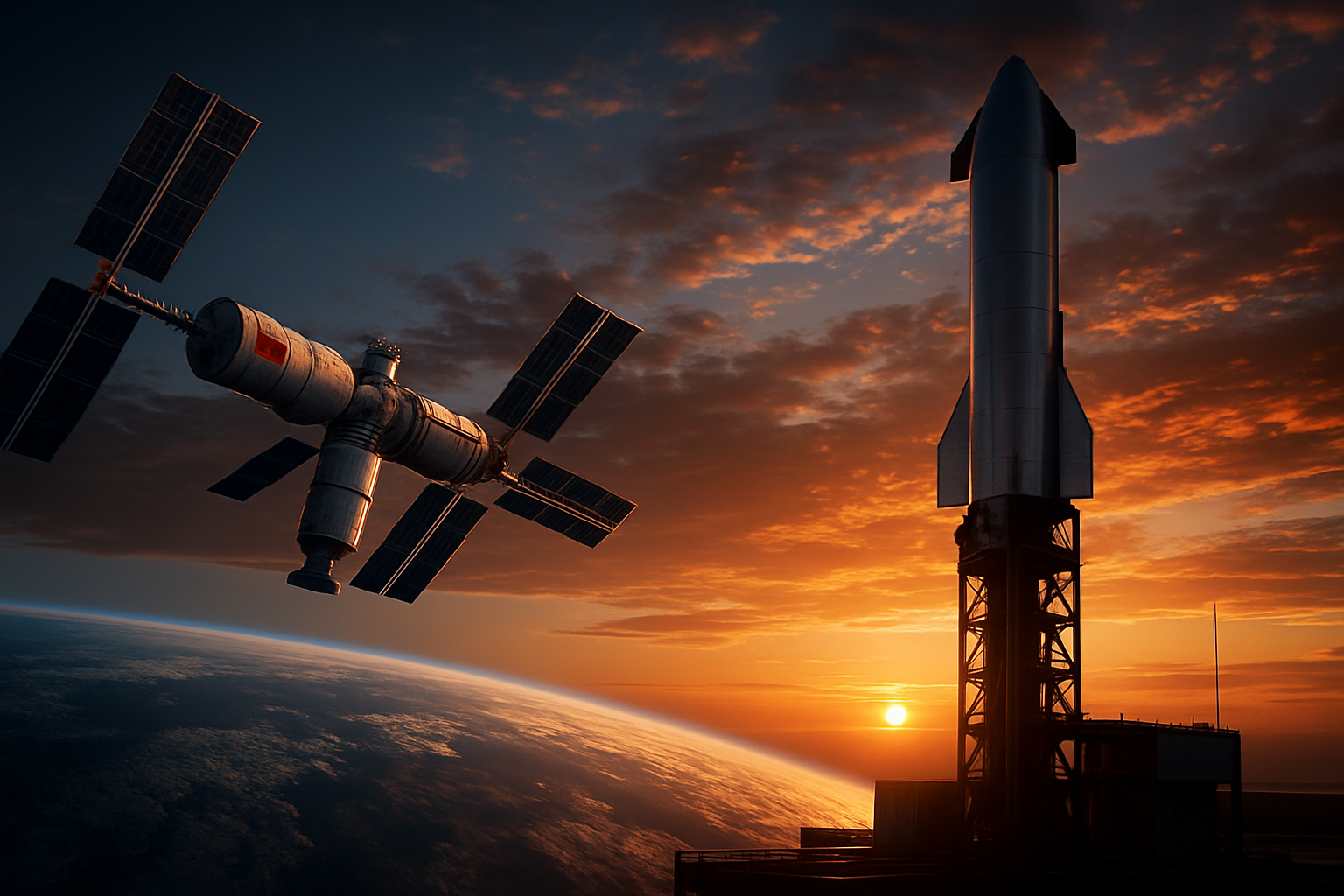
While SpaceX faces mounting delays with its next-generation Starship rocket and prepares for a potentially trillion-dollar initial public offering, China's space program continues its methodical advancement through international cooperation and sustained technological development, highlighting the evolving dynamics of the global space race.
SpaceX CEO Elon Musk announced Friday that the company's next Starship test flight has been postponed from April to May 2026, marking another setback for the ambitious program that aims to revolutionize space transportation. The delay affects the debut of Starship's V3 vehicle iteration, which has been extensively redesigned to meet NASA's requirements for the Artemis lunar program.
SpaceX Faces Technical and Financial Pressures
The latest postponement represents just one challenge facing SpaceX as the company navigates the complex transition from experimental spacecraft to operational lunar lander. NASA's Inspector General confirmed that Starship has accumulated at least two years of development delays since its selection as the Artemis lunar lander in 2021, threatening the timeline for returning astronauts to the Moon.
The technical hurdles are substantial. Starship's mission profile requires complex fuel transfer operations involving multiple tanker vehicles for orbital refueling—a process never before attempted at the required scale. These engineering challenges have forced NASA to restructure its entire Artemis program, moving the actual Moon landing from Artemis III to Artemis IV while adding additional test missions to build "launch muscle memory."
"SpaceX has the elements the IPO market has sought to end a years-long drought in mega-deals—an over trillion-dollar valuation, a CEO with a cult-like retail following, and exposure to a high-growth industry."
— Market Analyst, on SpaceX's upcoming IPO
Simultaneously, SpaceX is preparing for what could become the largest IPO in history, with valuations potentially exceeding $1 trillion. The company's unique position in the space economy, combined with Musk's celebrity status, has generated significant investor interest. However, analysts question whether the IPO market has sufficient appetite for a deal of this magnitude, especially given Starship's ongoing technical challenges.
China's Steady Space Program Progression
While SpaceX grapples with delays and market pressures, China's space program continues its systematic expansion through a different strategic approach. The Chinese National Space Administration (CNSA) has maintained steady progress across multiple fronts, from lunar exploration to international partnerships.
China's recent achievements include the successful fourth launch of the Shenlong reusable spacecraft, demonstrating cost-effective orbital access capabilities that rival SpaceX's Falcon 9 program. More significantly, Chinese scientists from the Shanghai Institute of Technical Physics achieved a historic breakthrough by using artificial intelligence to determine the chemical composition of the Moon's far side through Chang'e-6 samples—the first detailed mapping of the permanently hidden lunar regions.
This AI-powered analysis represents a convergence of space exploration with cutting-edge artificial intelligence capabilities, providing valuable data for future mission planning and resource distribution understanding. The research offers insights essential for both Chinese lunar ambitions and international space exploration efforts, including NASA's Artemis program.
International Cooperation and Competition
Perhaps most notably, China continues expanding its international space partnerships through the Tiangong space station program. Pakistan recently selected astronaut candidates for missions to the Chinese space station scheduled for October-November 2026, demonstrating space capability democratization beyond traditional space powers.
This international cooperation strategy contrasts with the increasingly competitive commercial space environment. While SpaceX faces pressure to deliver on ambitious timelines and investor expectations, China's government-led approach allows for longer-term strategic planning without quarterly earnings pressures.

NASA's Artemis Program Challenges
The delays in both American space programs—government and commercial—underscore the technical complexity of returning humans to deep space. NASA's Artemis II mission, which successfully launched April 1, 2026, after resolving critical helium system failures and hydrogen leak problems, represents the first crewed mission beyond Earth orbit since Apollo 17 in December 1972.
The 54-year gap in human deep space exploration highlights how ambitious these current programs truly are. NASA Administrator Jared Isaacman has emphasized a safety-first approach, stating "we will only launch when we believe we are ready," reflecting institutional learning from historical tragedies.
NASA has committed $20 billion toward establishing a permanent lunar surface base by 2030, canceling the Lunar Gateway orbiting station project to focus resources on surface operations. This strategic pivot responds directly to China's announced plans for lunar crews by 2030 and the need to maintain American leadership in space exploration.
The Broader Space Economy Context
These developments occur during what industry analysts call the transition from the "AI revolution" to the "space economy golden age." The global space economy is projected to exceed $1 trillion by 2030, with both government programs and commercial ventures competing for market leadership.
China's methodical approach includes not only lunar exploration but also advanced orbital servicing capabilities. The recent Hukeda-2 satellite mission tested flexible robotic arm technology for orbital refueling and debris disposal operations, addressing critical space sustainability challenges that affect all spacefaring nations.
Meanwhile, SpaceX has strategically pivoted from Mars colonization to lunar settlement development, targeting self-sustaining Moon cities within 10 years. This shift reflects a more pragmatic approach, leveraging the Moon's three-day travel time, frequent launch windows, and real-time communication advantages over Mars' 26-month cycles.
Technology Integration and Innovation
Both Chinese and American space programs are increasingly integrating artificial intelligence and autonomous systems. NASA achieved fully AI-planned Mars rover missions in December 2025, enabling autonomous navigation and real-time decision-making across cosmic distances. Similarly, China's AI-powered lunar sample analysis demonstrates sophisticated integration of space exploration with advanced computing capabilities.
The memory crisis affecting semiconductor manufacturers—with sixfold price increases at Samsung, SK Hynix, and Micron—is driving interest in space-based data centers. Both nations are exploring orbital computing solutions that could offer unlimited expansion potential with continuous solar power and no atmospheric interference.
Strategic Implications and Future Outlook
The contrasting approaches of China's steady government-led progression versus SpaceX's ambitious commercial timeline highlight fundamental questions about optimal space development strategies. China's model allows for sustained investment and long-term planning without market volatility, while SpaceX's commercial approach drives rapid innovation under competitive pressure.
As the space race evolves, success will likely depend on each program's ability to balance ambitious goals with rigorous engineering standards and comprehensive safety protocols. The coming months will be crucial in determining whether commercial innovation momentum and international cooperation can overcome the technical hurdles plaguing both government and private space exploration programs.
"The space race is no longer just between superpowers—it's between different philosophies of space development, and the winner will likely define humanity's cosmic future."
— Space Policy Expert
The success of these competing approaches will ultimately determine the trajectory of humanity's expansion into space, affecting everything from lunar resource access to Mars exploration capabilities. As both nations work toward permanent extraterrestrial settlements, the methodical Chinese approach and the dynamic American commercial sector represent different paths toward the same goal: establishing humanity as a truly spacefaring civilization.