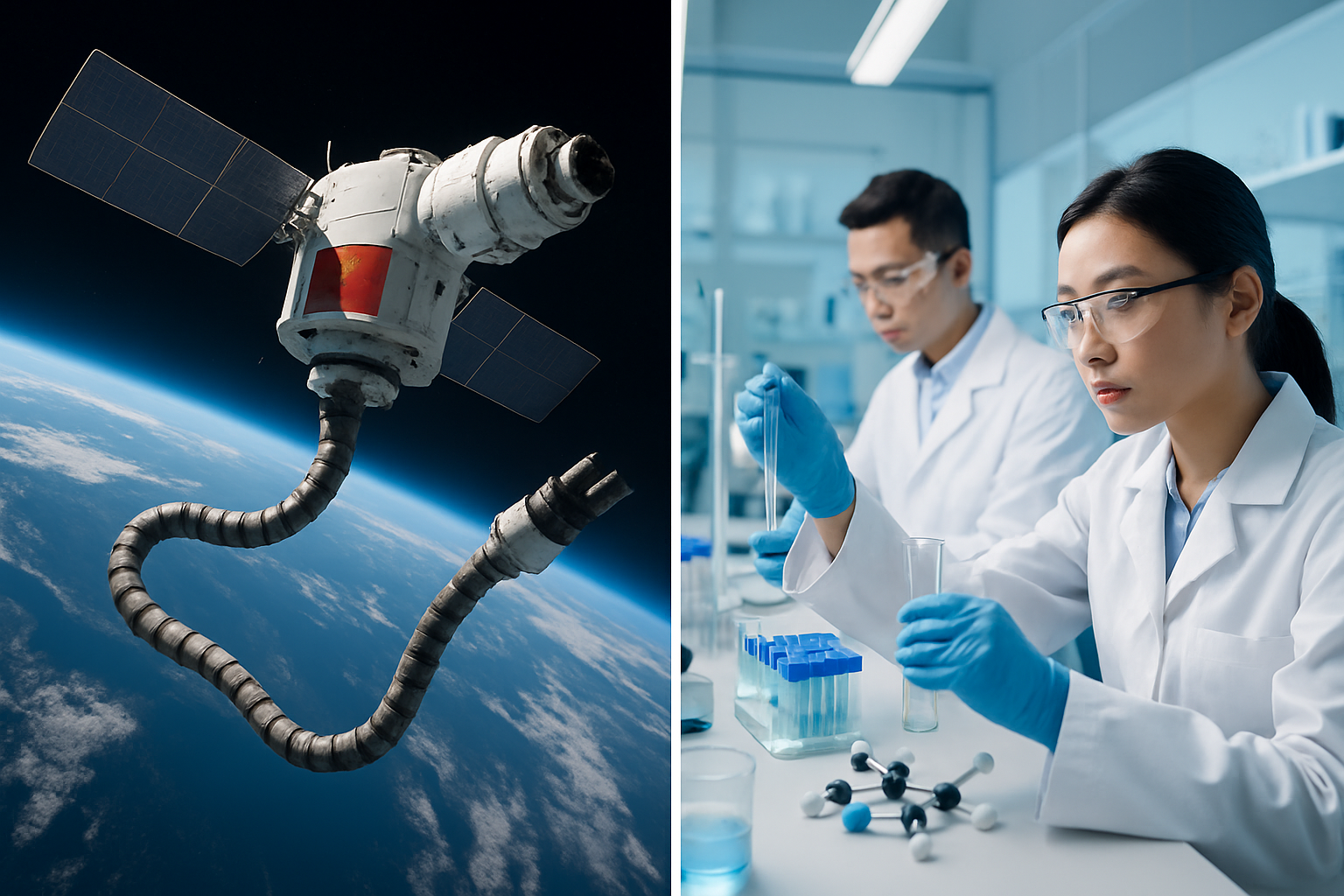
China has achieved a landmark space technology breakthrough with its Hukeda-2 satellite successfully completing orbital refueling tests using an innovative "octopus tentacle" robotic arm, while simultaneously positioning itself as a major challenger to Western pharmaceutical dominance as critical drug patents expire in the Chinese market.
The dual technological advances underscore China's expanding capabilities across multiple strategic sectors, from space exploration to healthcare innovation, marking a pivotal moment in the country's scientific and economic development trajectory during what experts characterize as the "space economy golden age" of 2026.
Revolutionary Space Refueling Technology
The Hukeda-2 demonstration satellite, also designated Yuxing-3 06, launched from the Jiuquan Satellite Launch Center in Gansu province and successfully performed compliance control and refueling tests in low Earth orbit. The mission's centerpiece is a flexible robotic arm that can curl, twist, and adapt to varying spacecraft configurations—a significant advancement over rigid traditional systems.
State broadcaster CCTV reported the successful completion of automated capture and release sequences, fuel transfer protocols, and disposal procedures that could become industry standards for the rapidly expanding commercial space sector. The flexible arm design allows adaptive movements that accommodate unpredictable orbital mechanics, addressing a critical challenge in satellite servicing operations.
"This represents China's second major orbital servicing experiment following our secretive high-orbit satellite-to-satellite refueling test last year. The technology could extend satellite operational lifespans from the current 10-15 years to potentially decades."
— Chinese Space Industry Analyst
The breakthrough comes at a critical juncture for space infrastructure development. ESA's Space Safety Programme head Holger Krag has warned that space is becoming dangerously overcrowded, with over 34,000 tracked objects larger than 10 centimeters orbiting Earth, plus millions of smaller untrackable debris pieces capable of catastrophic damage at 17,500 mph orbital speeds.
Strategic Space Economy Positioning
China's orbital servicing capabilities arrive during what industry analysts describe as the transition from "AI revolution to space economy golden age." With SpaceX preparing a potential trillion-dollar IPO in June 2026 and the global space economy projected to exceed $1 trillion by 2030, China's commercial approach provides scalable solutions for addressing proposed million-satellite constellation deployment challenges.
The mission preview routine space operations evolution, enabling new business models through extended satellite lifespans and reduced replacement launches. This is critical for space sustainability, preventing cascade scenarios that could threaten long-term space access for communications, navigation, and weather systems now essential to modern civilization.
International space cooperation continues through ISS operations, while competitive dynamics intensify with China's Shenlong program advancement, Pakistan's astronaut candidates selected for China's Tiangong station missions in October-November 2026, and European space independence initiatives.
Pharmaceutical Market Disruption
Simultaneously, China's pharmaceutical sector is experiencing a transformative moment as Novo Nordisk's blockbuster semaglutide lost patent protection on March 20, clearing the way for domestic competitors. The drug, which generated approximately $35 billion in global revenue last year, represents a massive market opportunity for Chinese manufacturers.
At least 10 weight-loss injections and oral pills are lining up for regulatory approval in China, targeting a market projected to reach $14 billion by 2030. This surge comes as China's drug regulator accelerates approvals of innovative therapies, helped by a surge in out-licensing deals with global pharmaceutical companies.
The pharmaceutical industry transformation reflects broader patterns in China's innovation strategy. Chinese biotech companies are evolving from manufacturers to innovation leaders, as demonstrated by Harbour BioMed's historic $1.2 billion partnership with Solstice Oncology for exclusive antibody development and commercialization outside China.
Technology Integration and Innovation
Both space and pharmaceutical breakthroughs showcase China's sophisticated approach to technology integration. The Hukeda-2 mission demonstrates how China combines advanced robotics, artificial intelligence, and precision engineering to solve complex orbital challenges, while pharmaceutical advances reflect systematic investment in biotechnology infrastructure and talent development.
Chinese scientists have achieved multiple biotechnology breakthroughs in 2026, including gene-edited tomatoes emitting buttered popcorn aroma using CRISPR/Cas9 tools, demonstrating mastery of advanced gene-editing techniques with applications across agriculture, pharmaceuticals, and industrial biotechnology.
International Implications
These developments occur within broader Chinese systematic investment creating a multipolar technological landscape that challenges traditional Western dominance. China's approach combines government support with international collaboration, offering an alternative model to purely market-driven development.
The space achievements complement China's expanding international presence through programs like Zhiyuan academic initiative for AI research, attracting global talent to Beijing. Meanwhile, pharmaceutical advances position China as a crucial partner in addressing global challenges from antibiotic resistance to metabolic diseases.
"China offers unique advantages: large patient populations for clinical trials, government innovation support, streamlined regulatory processes, and increasing international recognition of research quality."
— Biotechnology Industry Observer
Economic and Strategic Context
The convergence of space and pharmaceutical breakthroughs reflects China's strategic positioning during a period of global technological transformation. The country's space capabilities support both national security objectives and commercial opportunities in satellite services, while pharmaceutical innovations address domestic health needs and global market expansion.
China's flexible robotic arm technology could revolutionize satellite maintenance economics, potentially generating billions in extended operational value across the global satellite fleet. Similarly, the pharmaceutical patent cliff represents opportunities for Chinese companies to capture significant market share in treatments for diabetes, obesity, and other metabolic disorders affecting millions worldwide.
The timing is particularly significant as global memory crisis drives semiconductor prices sixfold higher, affecting companies like Samsung, SK Hynix, and Micron. China's space-based solutions and pharmaceutical alternatives provide strategic advantages during supply chain constraints affecting traditional technology and healthcare sectors.
Future Implications
Both achievements position China for sustained technological leadership across critical sectors defining the next phase of human development. The orbital servicing technology establishes foundations for expanded space infrastructure supporting everything from communications to climate monitoring, while pharmaceutical capabilities address health challenges affecting global populations.
As the world transitions toward a spacefaring civilization requiring integrated Earth-space technological systems, China's dual advances in orbital operations and healthcare innovation demonstrate the country's preparation for leadership roles in emerging trillion-dollar markets.
The success of these parallel technological developments could influence international cooperation frameworks, commercial space standards, and pharmaceutical market dynamics for decades to come. China's systematic investment combining government support with international collaboration provides a template for sustaining technological advancement during periods of rapid global change.
March 2026 thus represents a watershed moment where China's coordinated investment in space technology and pharmaceutical innovation begins yielding transformative capabilities, positioning the country as both partner and competitor in shaping humanity's technological future across multiple critical domains.