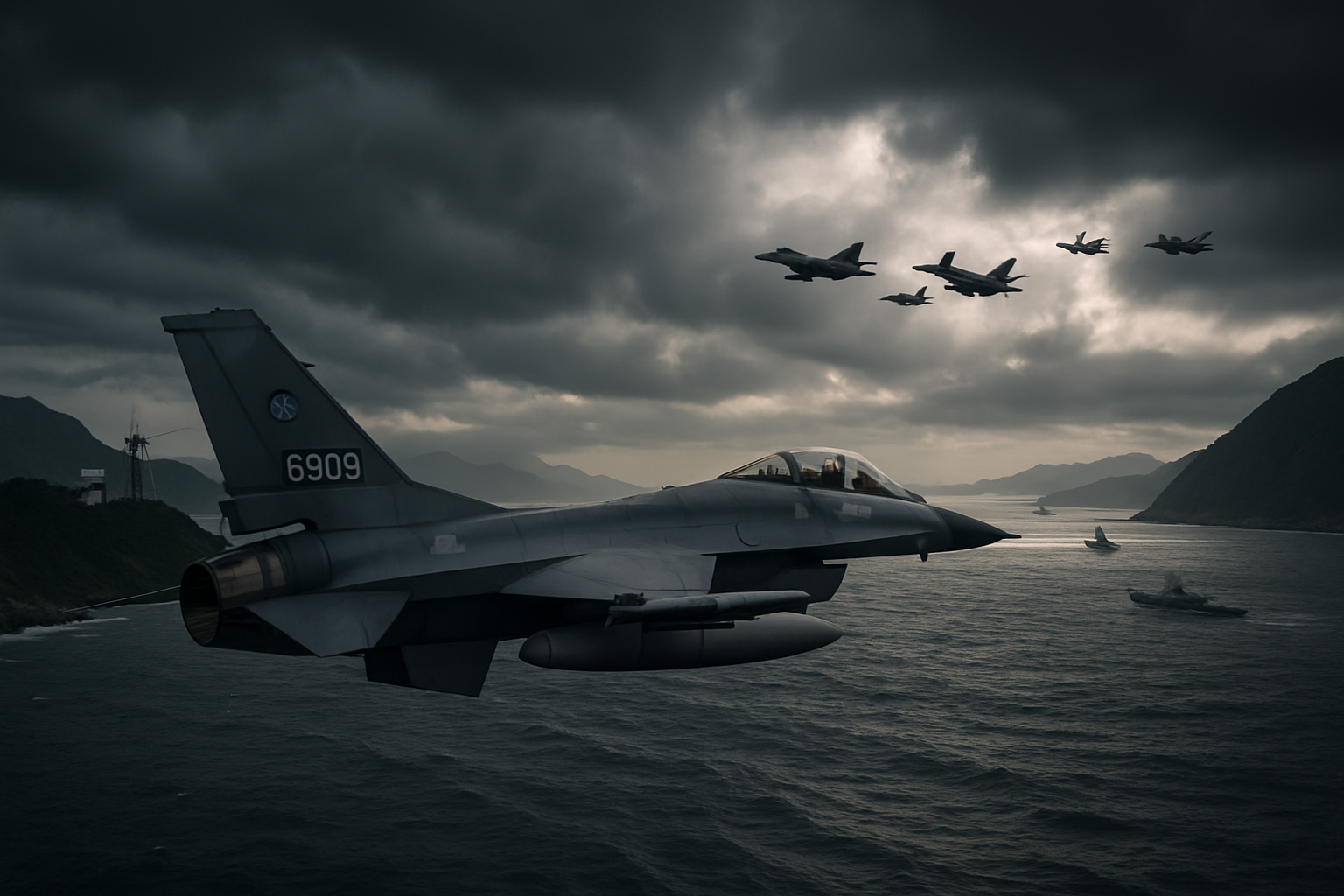
Taiwan completed its acquisition of advanced US M1A2T Abrams tanks as China simultaneously demonstrated hypersonic missile capabilities in the South China Sea, marking a significant escalation in military tensions across the Taiwan Strait that experts warn could reshape regional security dynamics.
The final shipment of 28 M1A2T Abrams tanks arrived at the Port of Taipei over the weekend under heavy security escort, completing a long-delayed modernization program aimed at strengthening Taiwan's defensive capabilities against mounting pressure from Beijing. The tanks, considered among the world's most powerful armored vehicles, were immediately transferred under police and military escort to the army's Armour Training Command in Hsinchu County.
Strategic Military Escalation
The completion of Taiwan's tank acquisition coincided with China's People's Liberation Army releasing footage of YJ-20 hypersonic anti-ship missile launches, conducted as joint US-Philippines-Japan military drills heightened regional tensions. The China Military Bugle social media account posted video of PLA Navy strike tests at sea, including multiple YJ-20 launches, though specific timing and locations were not disclosed.
The hypersonic missile demonstration represents a significant advancement in China's anti-access capabilities, designed to counter foreign military intervention in any potential Taiwan conflict. Military analysts note that the YJ-20's hypersonic speed and maneuverability make it extremely difficult to intercept, fundamentally altering the strategic calculus for any military engagement in the Taiwan Strait.
European Sanctions Add Complexity
Adding another layer to the escalating tensions, China imposed sanctions on seven European companies over arms sales to Taiwan, marking a rare case of Europe-targeted, Taiwan-related economic retaliation. Taiwan's Defense Minister downplayed the impact of these sanctions, stating it was "not the first time China had taken such action" and would not affect Taipei's ability to source weapons.
"Taiwan gets most of its weapons from the United States, and Europe has not sold any big-ticket items like fighter jets to Taipei for around three decades, fearful of raising Beijing's ire."
— Defense Analysis Report
The European sanctions demonstrate Beijing's expanding use of economic coercion to pressure international support for Taiwan, even as the island's primary military partnerships remain centered on its relationship with Washington.
Historical Context of Mounting Pressure
Recent intelligence assessments reveal that Chinese military aircraft activity around Taiwan increased by 23% in 2025, with daily warplane and naval vessel deployments representing the most sustained pressure campaign to date. Defense Minister Wellington Koo has previously warned of China's systematic campaign designed to "exhaust" and "fatigue" Taiwan's population through constant military demonstrations.
Beijing has been employing what analysts describe as "complex and precise" tactics combining military pressure, cyber attacks, and psychological warfare as part of what Chinese leadership calls the "great rejuvenation of the Chinese nation." This dual-track approach includes regular military exercises while simultaneously engaging with Taiwan's opposition parties to circumvent the current Democratic Progressive Party government.
Regional Alliance Responses
The escalation occurs amid broader regional tensions, with the Philippines establishing a monitoring station at Tubbataha Reefs Natural Park in the South China Sea, and Japan strengthening its defense posture under Prime Minister Sanae Takaichi's administration. The interconnected nature of these territorial disputes highlights how Taiwan Strait tensions affect broader Asia-Pacific security calculations.
Taiwan maintains confidence in its "rock solid" relationship with the United States, despite the evolving diplomatic landscape. Recent completion of a historic US-Taiwan trade agreement eliminated 26% of agricultural tariffs and secured $85 billion in Taiwanese purchases, demonstrating continued economic and security cooperation despite Chinese pressure.
Military Modernization Race
The delivery of advanced US tanks represents just one component of Taiwan's broader defensive modernization program. The M1A2T variant includes specific modifications for Taiwan's operational environment and potential conflict scenarios, featuring enhanced armor protection and advanced fire control systems.
China's response has included not only the hypersonic missile demonstrations but also continued large-scale military exercises. The latest exercises conducted in late 2025 showcased what Beijing describes as "advanced combat capabilities," serving both as training for PLA forces and as deterrent messaging to Taiwan and its international supporters.
International Implications
The current escalation unfolds against the backdrop of broader global security challenges, including the expiration of the New START treaty between the US and Russia in February 2026 - the first time in over 50 years without nuclear arms control constraints between superpowers. This has created what UN Secretary-General António Guterres describes as nuclear risks at their "highest level in decades."
Regional allies including Japan, South Korea, and ASEAN nations are closely monitoring developments for potential impacts on trade and security partnerships. The Taiwan Strait serves as a crucial shipping lane for global supply chains, with any conflict potentially disrupting worldwide economic flows.
Future Trajectory
Military experts warn that the current trajectory of military demonstrations and counter-demonstrations creates risks of miscalculation that could trigger broader conflict. Taiwan's successful completion of its tank acquisition program strengthens its defensive capabilities but also provides Beijing with justification for its own military preparations.
The challenge for regional stability lies in managing what analysts describe as a "great power competition" that requires careful diplomatic management to prevent regional conflict escalation. Success in maintaining peace across the Taiwan Strait will depend on pragmatic solutions that address legitimate security concerns while respecting democratic principles and regional stability frameworks.
As tensions continue to mount, the international community faces the critical task of developing innovative diplomatic approaches that can address the complex intersection of territorial sovereignty, military modernization, and economic interdependence that defines contemporary China-Taiwan relations. The stakes extend far beyond the immediate region, affecting global supply chains, international law precedents, and the broader framework for managing great power competition in the 21st century.