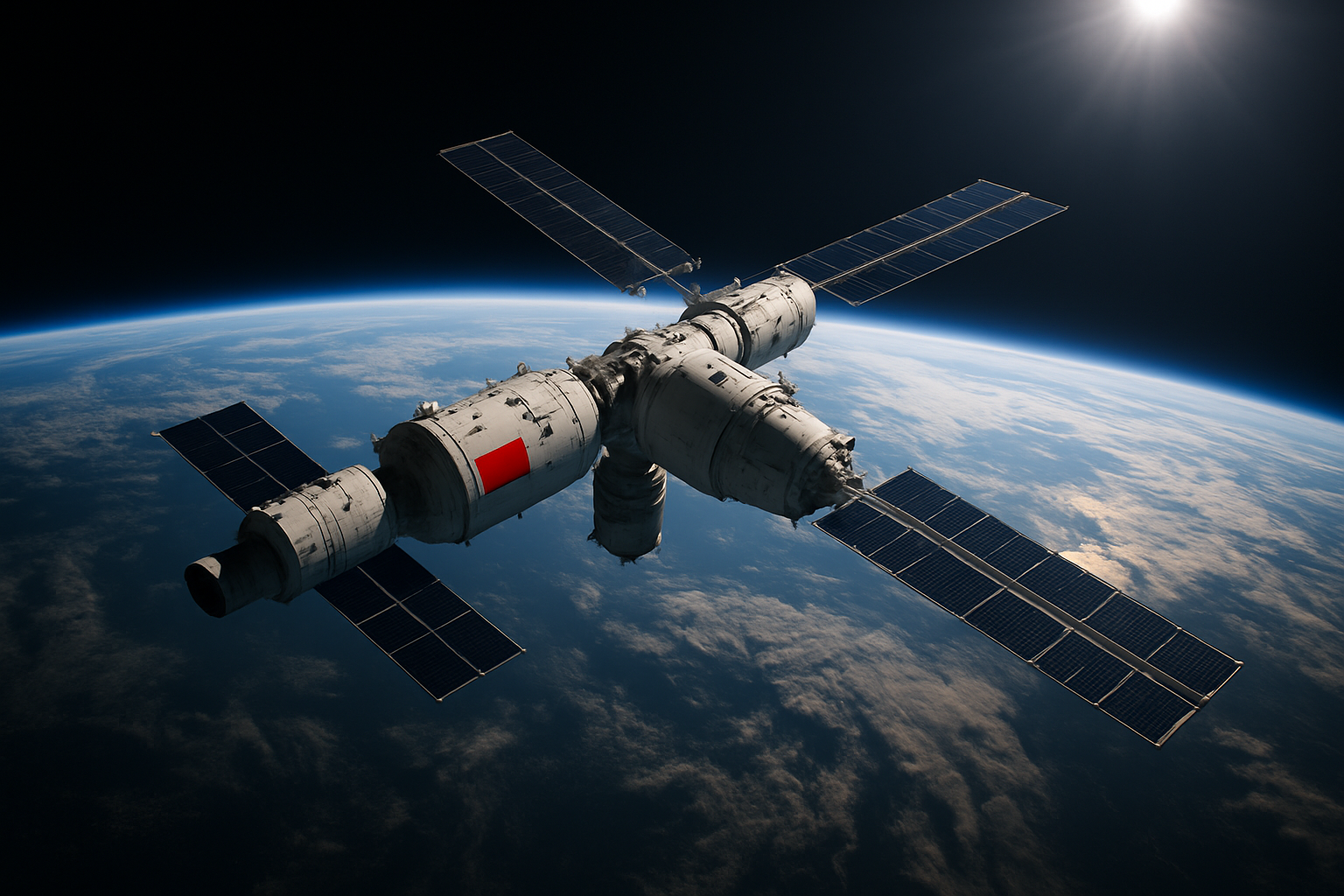
The three astronauts currently stationed aboard China's Tiangong space station will extend their mission by approximately one month beyond the standard six-month duration, Chinese state broadcaster CCTV announced on Friday, as the crew seeks to maximize scientific research opportunities during this critical phase of China's space program development.
The Shenzhou-21 crew, who launched from the Jiuquan Satellite Launch Centre on October 31, were originally scheduled to return to Earth at the end of April after completing their standard six-month mission. However, mission controllers have now approved an extension that will keep the astronauts in orbit until late May, allowing them to conduct additional experiments and research activities aboard the world's newest operational space station.
Technical Challenges and Safety Considerations
The mission extension comes after engineers successfully addressed technical challenges that have affected recent Chinese space operations. In November 2025, a crack was discovered in a window of the Shenzhou-20 spacecraft, which had forced the previous crew to extend their stay beyond the planned duration. The current extension for the Shenzhou-21 crew appears to be driven primarily by scientific objectives rather than technical necessities, representing a maturation of China's space operations capabilities.
This extension demonstrates China's growing confidence in long-duration spaceflight operations, as the country continues to develop its human spaceflight capabilities alongside international competitors. The Tiangong station has been designed to support extended missions, with robust life support systems and regular cargo resupply capabilities that enable flexible mission durations based on scientific priorities.
China's Rising Space Capabilities
The mission extension occurs during what industry experts have termed the "space economy golden age," a period characterized by unprecedented international space activity and commercial development. China's space program has achieved remarkable milestones throughout 2026, including breakthrough artificial intelligence applications for lunar research and successful deployment of advanced orbital servicing technologies.
"China's systematic approach to space exploration has enabled steady progression without the market pressures facing commercial operators."
— Space Industry Analysis, March 2026
Earlier this year, Chinese scientists at the Shanghai Institute of Technical Physics achieved a historic breakthrough by using artificial intelligence to determine the chemical composition of the Moon's far side for the first time in history. This achievement, based on analysis of Chang'e-6 samples, provided the first detailed mapping of lunar regions representing nearly half of the Moon's surface that remains permanently facing away from Earth.
Additionally, China's Hukeda-2 orbital servicing mission in March 2026 demonstrated revolutionary "octopus tentacle" robotic arm technology for satellite refueling and debris disposal operations, positioning China as a leader in the emerging orbital servicing market projected to be worth billions as the space economy exceeds $1 trillion by 2030.
International Context and Competition
The Tiangong mission extension comes amid intensifying international space competition, particularly with NASA's Artemis program achieving historic milestones in 2026. NASA's Artemis II mission successfully completed humanity's first crewed lunar flyby since Apollo 17 in 1972, ending a 54-year gap in human deep space exploration. The mission achieved a new human distance record of 406,777.8 kilometers from Earth during its 10-day journey.
China has announced plans for crewed lunar missions by 2030, directly competing with NASA's timeline for establishing a permanent lunar presence. This competition has driven both nations to accelerate their space exploration programs, with NASA committing a historic $20 billion toward a permanent lunar surface base by 2030.
The international nature of current space development is also evident in China's cooperation with emerging space nations. Pakistan has selected astronaut candidates for future Tiangong missions scheduled for late 2026, demonstrating the democratization of space access that characterizes the current era of space exploration.
Scientific Research Priorities
The extended mission will allow the Shenzhou-21 crew to conduct additional research across multiple scientific disciplines. China's space station research program focuses on areas including materials science, biological experiments in microgravity, Earth observation, and space medicine research that will be crucial for future long-duration missions to the Moon and Mars.
Space medicine research has become increasingly important as various nations plan extended missions beyond Earth orbit. Recent research by European scientists has revealed that microgravity seriously disrupts human reproductive processes, making natural reproduction extremely difficult in space environments—a critical concern for permanent space settlements that China and other nations are planning.
The research conducted aboard Tiangong directly supports China's broader space exploration goals, including the development of technologies and protocols necessary for sustainable human presence beyond Earth orbit. This research parallels similar work being conducted aboard the International Space Station, where astronauts like French astronaut Sophie Adenot have been conducting record-breaking eight-month missions studying lung tissue cultivation and Space-Associated Neuro-Ocular Syndrome (SANS).
Economic and Strategic Implications
The mission extension reflects China's strategic approach to space exploration during a period of unprecedented global space economic growth. The space economy is projected to exceed $1 trillion by 2030, driven by satellite constellations, space-based manufacturing, and emerging technologies like orbital servicing and space-based data centers.
China's systematic government-led approach to space development contrasts with the commercial-driven models employed by companies like SpaceX, which completed a trillion-dollar IPO in June 2026. While commercial space companies face market pressures and technical challenges, China's state-directed program enables long-term strategic planning and steady technological advancement.
The Tiangong station serves as a crucial platform for China's space ambitions, providing a permanent human presence in low Earth orbit that supports both scientific research and technological development. The station's successful operation demonstrates China's capability to sustain complex space operations, a prerequisite for the nation's planned lunar exploration program.
Future Implications
The successful extension of the Shenzhou-21 mission reinforces China's position as a major space power during a critical period in human space exploration. As nations worldwide invest billions in space infrastructure and compete for lunar resources, China's steady advancement in human spaceflight capabilities positions the country as a key player in determining humanity's cosmic future.
The research and operational experience gained from extended Tiangong missions directly supports China's preparation for lunar exploration, where astronauts will need to operate independently for months without the possibility of rapid return to Earth. This experience will prove invaluable as China works toward its goal of landing astronauts on the Moon by 2030.
As the "space economy golden age" continues to unfold, missions like the extended Shenzhou-21 stay demonstrate how space exploration has evolved from brief experimental flights to sustained operations that advance both scientific knowledge and technological capabilities. The success of such missions will determine whether humanity successfully transitions to becoming a truly spacefaring civilization capable of permanent presence beyond Earth.