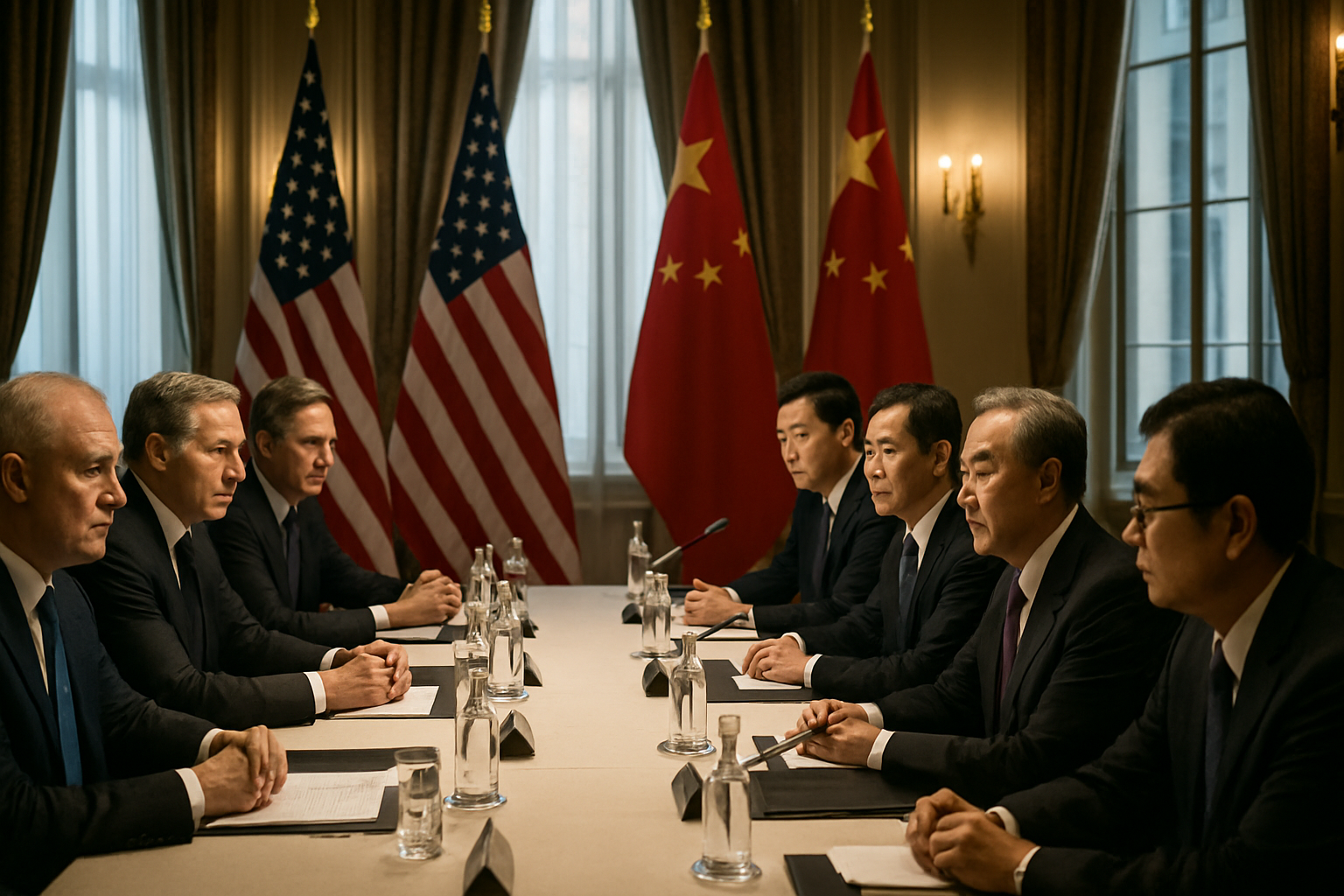
Top Chinese and American economic officials launched crucial high-level talks in Paris on Sunday to iron out trade disputes and prepare the ground for President Donald Trump's anticipated meeting with Chinese President Xi Jinping at the end of March.
The discussions, held at the Paris headquarters of the Organisation for Economic Co-operation and Development (OECD), are being led by US Treasury Secretary Scott Bessent and Chinese Vice Premier He Lifeng. The talks represent a critical diplomatic opportunity to address lingering trade frictions before Trump's planned visit to Beijing.
Focus on Key Trade Issues
The negotiations are expected to concentrate on several pivotal areas of US-China economic relations, including the restructuring of US tariffs on Chinese goods, the flow of Chinese-produced rare earth minerals and magnets to American buyers, American high-technology export controls, and Chinese purchases of US agricultural products.
These discussions come against the backdrop of significantly altered trade dynamics following the US Supreme Court's historic 6-3 ruling in February that struck down Trump's global tariff authority under the International Emergency Economic Powers Act (IEEPA). The constitutional ruling has forced the Trump administration to recalibrate its trade strategy ahead of the crucial Beijing summit.
Constitutional Constraints Shape Negotiations
The Supreme Court's application of the "major questions doctrine" has fundamentally changed the leverage dynamics between the two economic superpowers. Chief Justice John Roberts authored the majority opinion ruling that IEEPA "does not authorize the president to impose tariffs" without congressional authorization, effectively removing what had been Trump's primary economic pressure tool.
"The constitutional ruling removes a key leverage tool weeks before the Beijing summit, but it may paradoxically create space for more substantive long-term economic arrangements."
— Senior US Trade Official
In response to the Court's decision, Trump had immediately escalated to 15% tariffs using Section 122 of the Trade Act of 1974, but this alternative framework faces a 150-day congressional countdown and its own legal challenges.
China's Strengthened Position
Beijing has welcomed the Supreme Court ruling as vindication of its position, and the timing has coincided with China's own strategic economic initiatives. Most notably, China announced zero-tariff access for 53 African countries beginning May 1, 2026 - the most comprehensive China-Africa trade expansion in modern history.
China's enhanced global position is further bolstered by its control of 60% of global critical minerals production and 90% of refining capacity, providing significant leverage in negotiations with the United States and other Western nations.
Preparing for the Trump-Xi Summit
The Paris talks are viewed as essential groundwork for Trump's planned March 31-April 2 visit to Beijing, which will mark his first official trip to China during his second term. The summit builds upon a February 4 "lengthy and detailed" phone call between Trump and Xi that covered Taiwan tensions, trade relations, the Iran nuclear situation, and the Ukraine war.
During that call, Xi emphasized a "mutual respect" approach and called for 2026 to be a "year of peaceful coexistence and cooperation," signaling China's willingness to engage diplomatically despite ongoing tensions.
Taiwan Remains Central Issue
Taiwan tensions continue to complicate US-China relations, with Chinese military pressure having intensified throughout 2025. Aircraft activity around Taiwan increased by 23% in 2025, with daily deployments designed to "exhaust" the Taiwan population, according to defense analysts.
Xi has called Taiwan "the most important issue" in China-US relations and urged "prudence" regarding US weapons supplies to the island during his February conversation with Trump.
Economic Realities and Congressional Pushback
Despite extensive tariff policies implemented during Trump's first term and early second term, the US trade deficit remains at $901.5 billion annually as of December 2025 - essentially unchanged from previous levels. This demonstrates the structural nature of trade imbalances that cannot be resolved through tariffs alone.
Congressional resistance to Trump's trade approach has also grown, with the House passing legislation 219-211 to end Canada tariffs, featuring six Republican defections - the first significant bipartisan rebuke of Trump's trade authority in his second term.
Global Context and Strategic Competition
The Paris summit occurs within a broader context of evolving global power dynamics. The New START treaty between the US and Russia expired on February 5, marking the first time in over 50 years without nuclear constraints between the superpowers. Additionally, ongoing negotiations regarding Iran's nuclear program and the Ukraine conflict add complexity to US-China strategic considerations.
"This is a critical test of whether diplomatic engagement backed by constitutional constraints rather than aggressive economic threats can produce sustainable frameworks for managing the defining geopolitical relationship of the 21st century."
— International Relations Expert
Expected Outcomes and Future Implications
Success in Paris and Beijing will likely be measured by the establishment of competition management mechanisms rather than breakthrough agreements. The focus is expected to center on agricultural purchases, technology cooperation, financial services access, and critical minerals partnerships.
The constitutional constraints on Trump's trade authority may paradoxically create opportunities for more substantive long-term economic arrangements, as both sides seek predictable frameworks for managing their complex relationship.
The outcome of these negotiations will serve as a template for major power economic competition management in an increasingly multipolar world, with implications extending far beyond bilateral US-China relations to the broader international economic order.