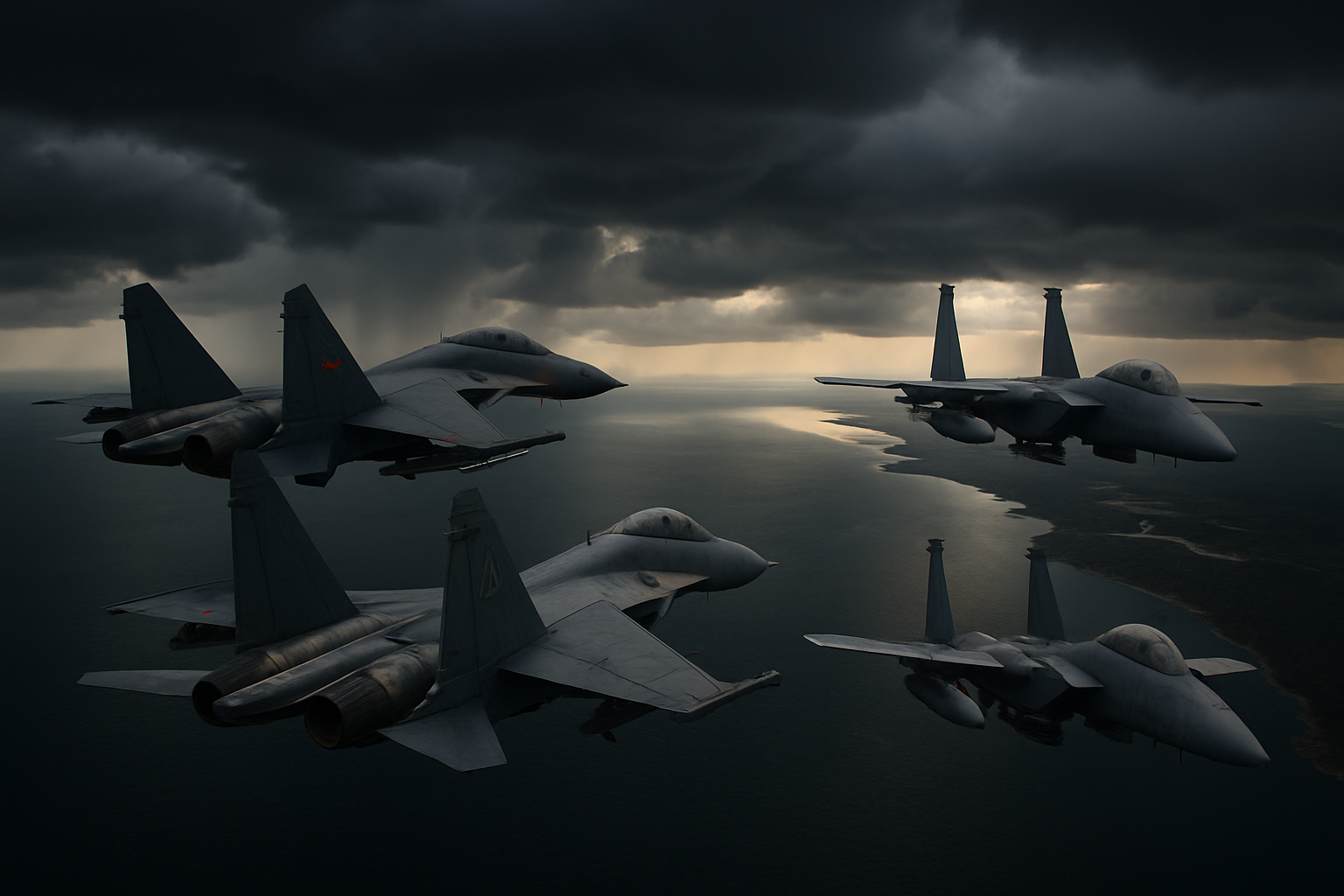
Chinese and US fighter jets engaged in a rare aerial confrontation over the Yellow Sea this week, marking one of the most significant military face-offs between the superpowers in months as tensions continue to rise across multiple global flashpoints.
The incident involved approximately ten US Forces Korea (USFK) F-16 warplanes that took off from Osan Air Base in Pyeongtaek, located about 60 kilometers south of Seoul, according to multiple international reports. The American aircraft flew over international waters in the Yellow Sea, operating in the airspace between South Korea's and China's respective air defense identification zones.
Brief But Tense Standoff
As the F-16s approached the Chinese coast, Beijing scrambled its own jets to the area in response to what it perceived as a provocative US military exercise. The encounter resulted in what sources described as "a brief aerial face-off," though neither side violated the other's official airspace.
The confrontation occurred following what was characterized as a rare US Air Force exercise that prompted rapid Chinese military response. While the exact duration and specific details of the standoff remain classified, aviation experts note that such direct encounters between Chinese and American military aircraft have become increasingly uncommon in recent years.
"This represents a significant escalation in military posturing between the two nations," said Dr. Michael Chen, a defense analyst at the Seoul Institute for Strategic Studies. "The fact that both sides maintained discipline and avoided airspace violations likely prevented this from becoming a much more serious incident."
Regional Security Implications
The Yellow Sea confrontation comes at a particularly sensitive time for regional security, with multiple ongoing conflicts and diplomatic negotiations creating a complex web of international tensions. The Korean Peninsula has long served as a focal point for great power competition, with US forces maintaining a significant presence in South Korea while China asserts its influence as North Korea's primary ally.
South Korean officials closely monitored the situation but have not issued public statements regarding the incident. However, defense sources in Seoul indicate that the confrontation has heightened concerns about potential miscalculation between the world's two largest military powers.
"Any direct military encounter between Chinese and American forces carries the risk of escalation that could have far-reaching consequences for regional stability."
— Admiral James Richardson, Former US Naval Operations Chief
The incident underscores the growing military competition in the Asia-Pacific region, where both nations have been expanding their presence and conducting increasingly frequent exercises. China has significantly increased its military activities around Taiwan and in the South China Sea, while the United States has strengthened its defense partnerships with regional allies.
Context of Global Military Tensions
This aerial confrontation occurs against the backdrop of multiple international crises that have strained US-China relations and heightened global military tensions. The ongoing conflict in Ukraine has complicated great power dynamics, while tensions in the Middle East and other regions have forced both nations to reassess their strategic priorities.
Recent months have seen increased military activities across several theaters, including significant naval deployments in the Middle East and enhanced defense cooperation between various allied nations. The Yellow Sea incident represents another data point in what many analysts describe as a new era of great power competition.
Military experts note that both China and the United States have been conducting more frequent exercises in disputed or sensitive areas, testing each other's resolve while attempting to demonstrate strength to regional allies and partners.
Air Defense Identification Zones
The confrontation took place in the complex airspace between Chinese and South Korean Air Defense Identification Zones (ADIZ), areas where nations claim the right to identify and monitor aircraft for security purposes. These zones often overlap or create gray areas where different nations' security interests intersect.
ADIZ boundaries have become increasingly contentious in the Asia-Pacific region, with China's declaration of an ADIZ over the East China Sea in 2013 drawing international criticism. The zones serve as early warning systems but do not represent sovereign airspace, creating potential for misunderstanding and confrontation.
Aviation safety protocols require clear communication between military forces operating in such areas, though the specific communications between Chinese and American pilots during this week's encounter have not been disclosed.
Historical Precedents and Protocols
Direct military encounters between Chinese and US forces have occurred periodically over the past two decades, with varying degrees of tension and diplomatic fallout. The most notable incident occurred in 2001 when a Chinese fighter jet collided with a US Navy EP-3 surveillance aircraft near Hainan Island, resulting in the death of the Chinese pilot and a diplomatic crisis.
Since then, both militaries have established communication protocols and confidence-building measures designed to prevent accidents and manage tensions when their forces operate in proximity. However, the effectiveness of these measures depends on the specific circumstances and the political climate at the time of each encounter.
Recent years have seen both cooperation and competition between the two militaries, with periods of suspended military-to-military communications alternating with efforts to maintain professional relationships at the operational level.
Regional Allied Responses
The Yellow Sea confrontation has implications beyond bilateral US-China relations, affecting the complex network of alliances and partnerships throughout the Asia-Pacific region. South Korea's position is particularly delicate, as it maintains security ties with the United States while pursuing economic cooperation with China.
Japan, another key US ally in the region, has been closely monitoring developments and coordinating with American forces on regional security matters. The incident may prompt renewed discussions about defense cooperation and contingency planning among US allies in the region.
Regional partners are likely to view this confrontation through the lens of broader geopolitical competition, assessing how it might affect their own security calculations and diplomatic strategies.
Looking Ahead
As tensions continue to simmer across multiple global theaters, the Yellow Sea confrontation serves as a reminder of the potential for military incidents between major powers. Both China and the United States face the challenge of pursuing their strategic interests while avoiding escalation that could lead to broader conflict.
The incident underscores the importance of maintaining communication channels and professional military relationships even amid broader political tensions. As both nations navigate an increasingly complex international environment, the ability to manage military encounters safely becomes crucial for global stability.
Defense analysts will be watching closely for any additional military activities or diplomatic responses that might indicate how both sides interpret this latest confrontation and its implications for their broader strategic relationship.