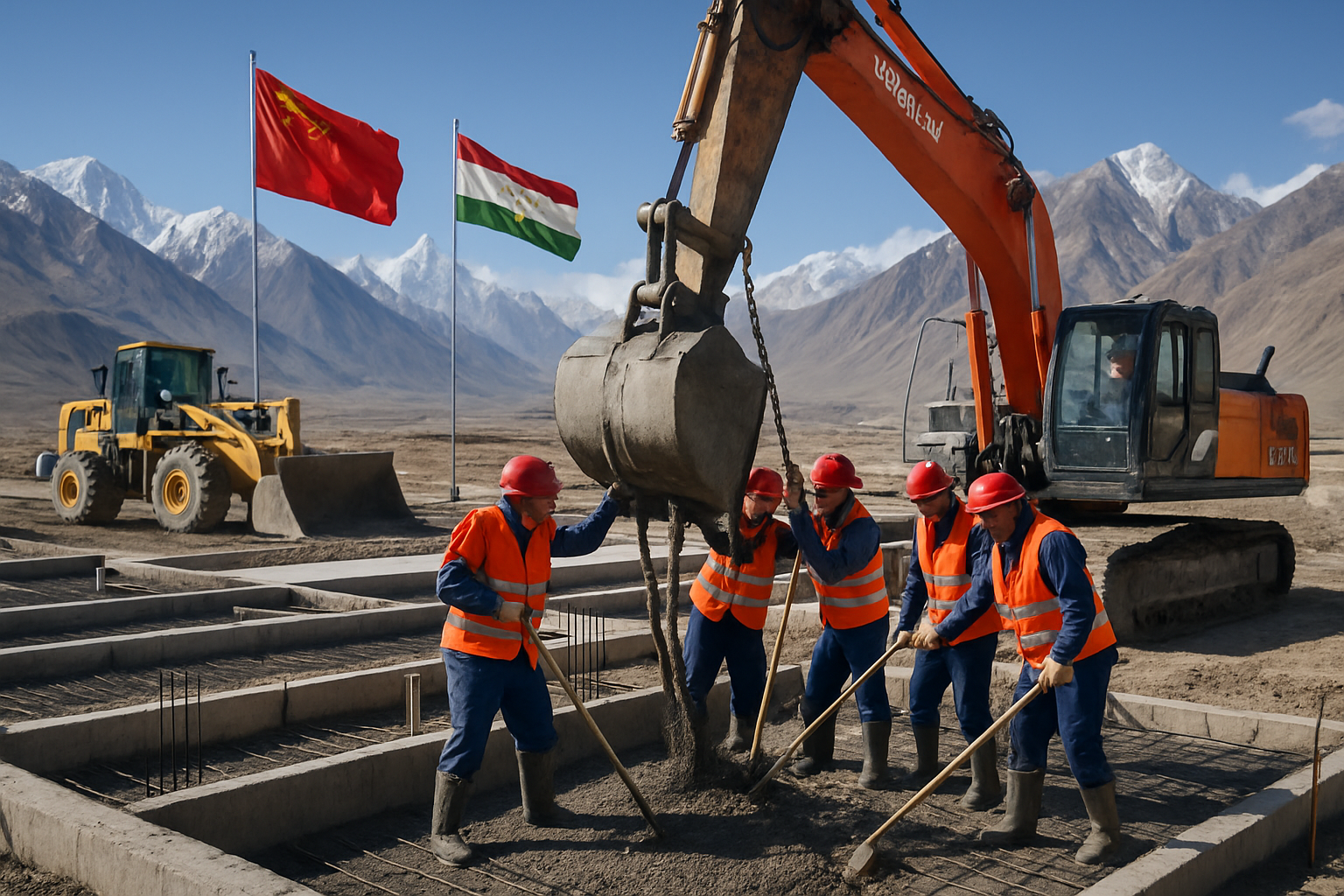
China has established a new administrative county in Xinjiang's strategic border region while simultaneously expanding its Belt and Road Initiative through a groundbreaking $1 billion wind energy partnership in Kazakhstan, demonstrating the dual nature of Beijing's economic expansion strategy in Central Asia.
The creation of Cenling county in Xinjiang Uyghur Autonomous Region, announced on March 26, positions China closer to the volatile borders with Afghanistan and Pakistan-administered Kashmir. Located near the Karakoram Mountains and the narrow Wakhan Corridor—a remote strip of Afghan territory separating Tajikistan from Pakistan—the new administrative unit falls under Kashgar Prefecture, historically a gateway between China and Central and South Asia.
This marks the third new county established in Xinjiang within just over a year, following the creation of Hean and other administrative divisions, reflecting Beijing's systematic approach to strengthening control over strategically sensitive frontier regions. The timing coincides with China's broader infrastructure expansion across the Belt and Road Initiative network.
Kazakhstan Wind Power Breakthrough
Simultaneously, China's economic influence extends through Kazakhstan's launch of its first gigawatt-scale wind power project, with Shanghai Electric Group serving as a lead contractor for the ambitious Mirny wind power initiative. The project, officially inaugurated on Thursday, represents a convergence of Chinese technology, Kazakh energy resources, and French investment collaboration.
The 1-gigawatt facility is expected to generate approximately 4 billion kilowatt-hours of electricity annually while reducing carbon dioxide emissions by more than 3.2 million tonnes each year. With a 31-month completion timeline and commissioning scheduled for the fourth quarter of 2028, the project exemplifies the sophisticated international partnerships that characterize contemporary Belt and Road projects.
"This project represents the evolution of China's global infrastructure strategy from simple construction to comprehensive technological partnerships that benefit all parties involved."
— Infrastructure analyst at Beijing International Studies University
Strategic Border Consolidation
The establishment of Cenling county reflects China's systematic approach to border security and administrative control in regions of geopolitical sensitivity. The location's proximity to the Wakhan Corridor—a narrow strip of Afghan territory that provides the only direct border between Afghanistan and China—underscores the strategic importance of this administrative reorganization.
Chinese authorities have not disclosed specific details about Cenling's boundaries or subdivisions, maintaining the pattern of incremental administrative expansion that has characterized Xinjiang development over recent years. This approach enables Beijing to strengthen institutional control while avoiding the international attention that larger, more dramatic administrative changes might generate.
The region's historical significance as part of the ancient Silk Road trade routes adds contemporary relevance to China's infrastructure investments. Modern transportation and communication networks in these remote areas serve dual purposes: supporting economic development while ensuring governmental presence in strategically critical border zones.
Belt and Road Energy Integration
The Kazakhstan wind project demonstrates how China's Belt and Road Initiative has evolved beyond basic infrastructure construction toward comprehensive technological and financial partnerships. Shanghai Electric Group's involvement provides advanced wind turbine technology, integrated energy solutions, and ongoing technical support that creates long-term partnerships rather than simple commercial transactions.
Chinese companies' participation in Central Asian energy projects leverages Beijing's manufacturing capabilities in renewable energy technology. China controls approximately 60% of global critical minerals production and 90% of processing capacity for materials essential to wind energy systems, providing Chinese firms with significant competitive advantages in international projects.
The collaboration with French companies in the Kazakhstan project illustrates the multilateral character of contemporary Belt and Road initiatives. Rather than exclusively Chinese ventures, these projects increasingly involve European, American, and local partners, creating more complex but potentially more sustainable international cooperation frameworks.
Economic Expansion Context
These developments occur within the broader context of China's dramatic economic expansion across multiple continents. Recent announcements include zero-tariff access for 53 African countries beginning May 1, 2026—the most comprehensive China-Africa trade expansion in modern history. This policy will eliminate import duties on all products from African nations maintaining diplomatic relations with Beijing.
The African tariff elimination, combined with infrastructure projects spanning from Kazakhstan to Peru's Chancay Port, demonstrates the global scope of Chinese economic strategy. Each initiative serves multiple objectives: securing energy and resource supplies, creating markets for Chinese technology and services, and establishing diplomatic influence through economic partnerships.
Memory chip shortages affecting global technology manufacturing until 2027, combined with China's dominance in critical materials processing, position Chinese companies advantageously in international infrastructure competitions. Western nations' efforts to diversify supply chains through initiatives like the US-EU-Japan Critical Minerals Partnership face challenges replicating the scale and integration of Chinese capabilities.
Regional Security Implications
The Xinjiang administrative expansion and Central Asian energy partnerships reflect China's comprehensive approach to regional security through economic integration. Border areas strengthened through administrative control and economic development create more secure foundations for Chinese interests while reducing potential instability from neighboring regions.
Afghanistan's continued political and economic challenges, combined with Pakistan's complex security situation, make Chinese border region development both economically rational and strategically necessary. Administrative consolidation enables more effective coordination of security measures, economic development programs, and diplomatic initiatives across sensitive border areas.
Energy partnerships with stable countries like Kazakhstan provide alternatives to potentially vulnerable supply chains through more volatile regions. Diversified energy sources and transportation routes reduce Chinese dependence on any single relationship while creating multiple avenues for regional influence.
Global Infrastructure Competition
These Chinese initiatives occur amid intensifying global competition for infrastructure influence and technological partnerships. The European Union's efforts to develop alternative financing mechanisms, America's renewed focus on bilateral partnerships, and India's infrastructure initiatives in South Asia create multiple options for countries seeking development partnerships.
However, China's integrated approach—combining administrative expansion, technological leadership, financial resources, and diplomatic engagement—provides competitive advantages that alternative frameworks struggle to match. The combination of immediate financing, advanced technology, and long-term partnerships creates comprehensive packages appealing to countries with urgent development needs.
Success in projects like the Kazakhstan wind facility and effective administration of new regions like Cenling county will influence international perceptions of Chinese capabilities and reliability as a development partner. These concrete achievements may prove more persuasive than diplomatic rhetoric in attracting future partnerships.
Future Trajectory
The parallel development of border administrative expansion and international energy partnerships suggests China's economic strategy will continue balancing domestic consolidation with global expansion. Securing strategic border regions while building technological partnerships with neighboring countries creates foundations for sustained regional influence.
Climate change pressures affecting global energy systems provide opportunities for Chinese renewable energy technology exports. The Kazakhstan project's success could serve as a template for similar initiatives across Central Asia, Southeast Asia, Africa, and Latin America, where Chinese companies possess technological and financial advantages.
International responses to these Chinese initiatives will largely determine whether economic expansion continues through primarily cooperative frameworks or increasingly competitive dynamics. Countries balancing Chinese partnerships with alternative relationships will shape the future structure of global economic cooperation during this crucial period of infrastructure development and energy transition.