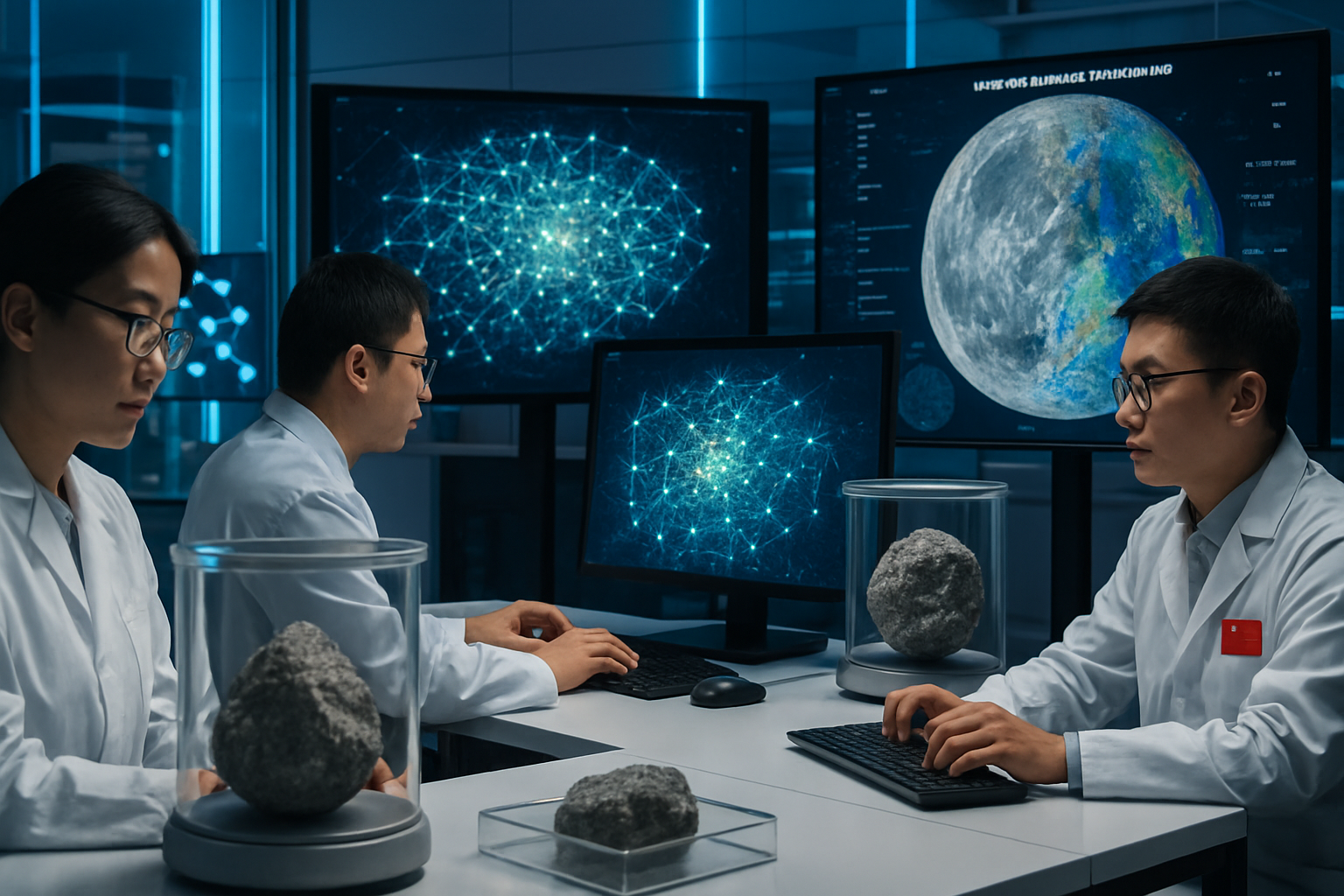
Chinese scientists have achieved a groundbreaking milestone in lunar research, using artificial intelligence to determine the chemical composition of the Moon's far side for the first time, unlocking secrets that have puzzled astronomers for decades and providing critical insights for humanity's expanding space exploration efforts.
Nearly half of the Moon's surface – the far side which permanently faces away from Earth – had long remained chemically unmapped, representing one of lunar science's most enduring mysteries. But samples collected during China's historic Chang'e-6 mission, combined with advanced AI technologies, have enabled a team led by the Shanghai Institute of Technical Physics (SITP) to crack this lunar chemical code.
Revolutionary AI Analysis of Lunar Samples
The breakthrough represents a convergence of traditional space exploration with cutting-edge artificial intelligence, demonstrating how modern computational power can unlock secrets from physical samples collected hundreds of thousands of miles from Earth. The Chang'e-6 mission, which successfully returned samples from the Moon's far side, provided researchers with unprecedented material to analyze.
Using sophisticated AI models, the Chinese research team was able to process and interpret complex chemical signatures that would have taken human researchers significantly longer to decode. The artificial intelligence systems were trained to identify specific molecular patterns and elemental compositions within the lunar samples, providing detailed chemical maps of regions never before characterized.
Significance for Global Space Exploration
This achievement comes at a critical moment in space exploration history, occurring during what experts describe as the transition from the "AI revolution to space economy golden age." The research provides essential data that will inform not only Chinese space missions but also international lunar exploration efforts, including NASA's Artemis program and other nations' space initiatives.
The chemical composition data from the Moon's far side offers crucial insights for future mission planning, helping scientists understand resource distribution, geological history, and potential hazards that astronauts and robotic missions might encounter. This information is particularly valuable as multiple nations prepare for sustained lunar presence and eventual permanent bases.
"This breakthrough demonstrates how AI can accelerate scientific discovery in space exploration, allowing us to extract maximum value from precious lunar samples."
— Shanghai Institute of Technical Physics Research Team
Context of International Space Competition
The Chinese breakthrough occurs amid intensifying international competition in space exploration. While NASA's Artemis II mission faces continued delays due to technical challenges including hydrogen leaks and helium system failures, China's space program continues advancing methodically with successful sample return missions and technological innovations.
This research success contrasts with ongoing challenges facing other space programs. NASA's Space Launch System rocket has experienced persistent technical issues, pushing the Artemis II lunar flyby mission beyond its planned March 2026 timeline. The mission, carrying four astronauts including Canadian Jeremy Hansen, would represent the first crewed mission beyond Earth orbit since Apollo 17 in 1972.
Meanwhile, the global space industry is experiencing unprecedented growth, with SpaceX preparing a potential June 2026 IPO that could value the company at over $1 trillion. International cooperation continues through programs like Pakistan's historic astronaut selection for China's Tiangong space station mission scheduled for October-November 2026.
Scientific and Technological Implications
The AI-driven analysis of lunar far side samples represents more than just a single scientific achievement – it demonstrates a methodology that could revolutionize how space agencies approach sample analysis from other celestial bodies. The techniques developed for this lunar research could be applied to future Mars samples, asteroid materials, and specimens from other moons in our solar system.
The research builds upon China's growing expertise in both artificial intelligence and space exploration. The nation has been systematically developing capabilities in autonomous space operations, following successful AI-planned Mars rover missions and advancing its reusable spacecraft program through the Shenlong initiative.
Global Impact and Future Missions
The chemical mapping of the Moon's far side provides invaluable data for the international space community. Understanding the composition and distribution of materials on the lunar surface is essential for planning sustainable lunar exploration, including the establishment of permanent bases and resource utilization programs.
This breakthrough coincides with broader developments in space exploration, including continued International Space Station operations where crew members are conducting critical research on space medicine challenges like Space-Associated Neuro-Ocular Syndrome (SANS) and lung tissue cultivation – studies essential for future long-duration missions to the Moon and Mars.
The timing is particularly significant as the global space economy undergoes rapid transformation. Commercial space companies are developing space-based data centers to address the ongoing global memory crisis, while nations worldwide are recognizing space capabilities as essential infrastructure rather than experimental endeavors.
Looking Forward
As humanity stands on the threshold of becoming a truly spacefaring civilization, discoveries like the Chinese AI-powered lunar analysis represent crucial building blocks for sustainable space exploration. The research demonstrates how international scientific cooperation and technological innovation can advance our understanding of the cosmos.
The success of this AI-driven lunar research also highlights the importance of preserving and analyzing space samples with the most advanced tools available. As space missions become more frequent and sophisticated, the ability to extract maximum scientific value from collected materials will be crucial for advancing human knowledge and capabilities in space.
This breakthrough serves as a testament to the power of combining traditional space exploration with modern artificial intelligence, pointing toward a future where AI-assisted research accelerates our understanding of the universe and supports humanity's expansion beyond Earth.