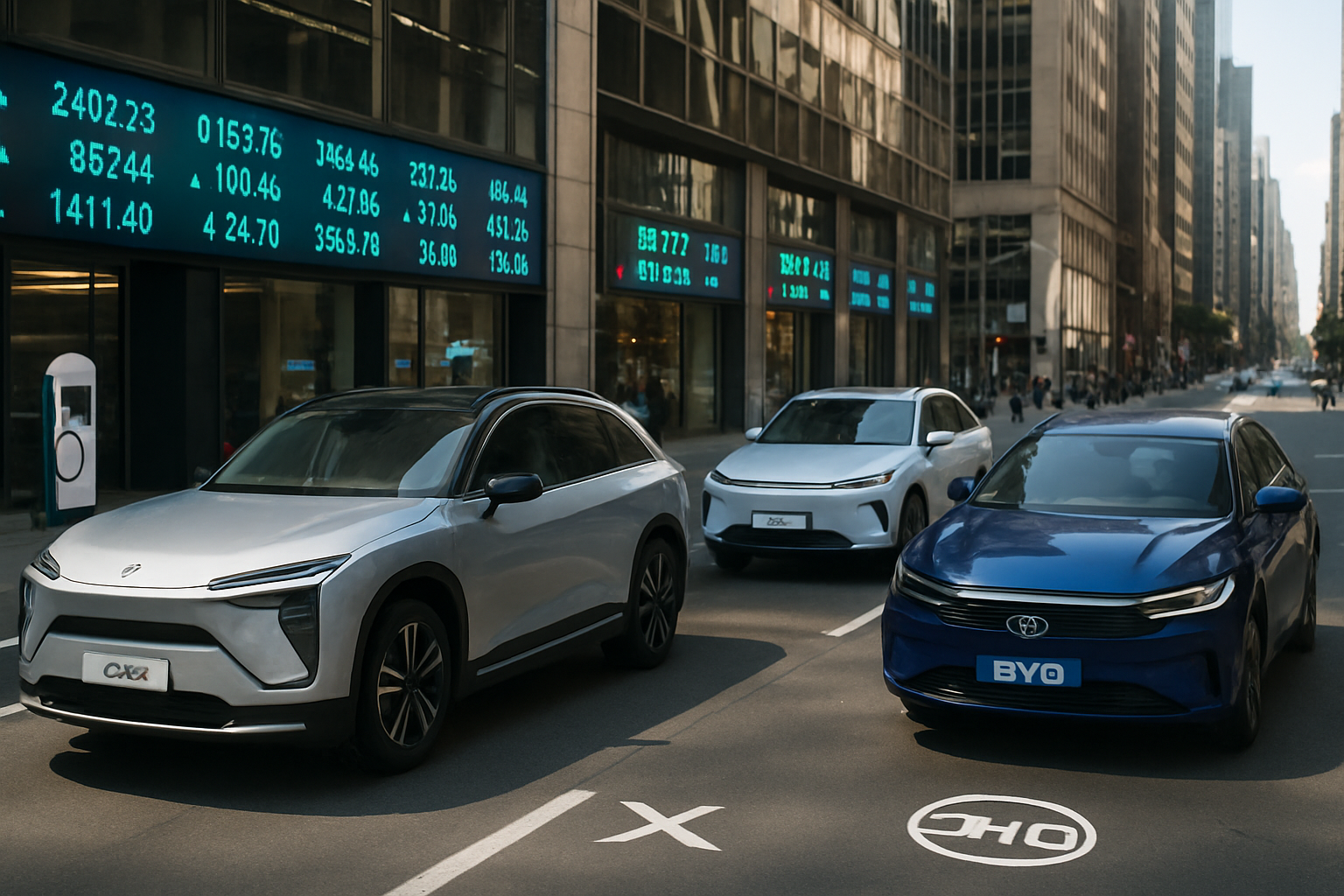
Chinese electric vehicle stocks experienced their strongest rally in months as export data exceeded expectations and innovative business models emerged to democratize EV access, positioning the sector for accelerated global expansion despite ongoing supply chain challenges.
Leading the charge in Hong Kong trading, Nio surged 6.6% to HK$52 during Monday's session, reaching levels not seen since October, while BYD climbed 5.6% to HK$111—its highest point since October 2. The rally came against a backdrop of broader market weakness, highlighting investors' renewed confidence in the electric vehicle sector's export potential and technological innovations.
Revolutionary Business Model Transforms EV Accessibility
Concurrent with the stock surge, XEV announced the European rollout of its groundbreaking Customer-to-Manufacturer (C2M) ecosystem in Turin, Italy. This direct-order model represents a paradigm shift in EV ownership by separating vehicle purchases from battery services, addressing two critical barriers to mass adoption: high upfront costs and concerns over battery depreciation.
Under the C2M model, customers purchase the XEV vehicle while leasing battery capacity, significantly reducing initial investment requirements. This approach tackles what industry analysts have identified as the primary psychological and financial obstacles preventing mainstream EV adoption across European markets.
"This move will allow large enterprises to quickly enter the new energy sector by getting an early foothold in the industry"
— XEV Corporate Statement
The timing proves strategic as our historical analysis reveals European markets have reached a critical inflection point. Since March 2026, crisis-driven demand has converged with technological readiness, creating unprecedented acceleration conditions for EV adoption. Swedish automotive data confirms EVs are now "often cheaper than gasoline and diesel cars," representing a fundamental shift from environmental choice to economic necessity.
Export Growth Drives Stock Performance
The stock rally reflects robust export performance data showing Chinese EV manufacturers maintaining global leadership despite supply chain constraints. China currently controls 60% of critical materials production and 90% of refining capacity for lithium, cobalt, and rare earth elements—strategic advantages that enable technological breakthroughs like BYD's Megawatt Flash Charging system, which delivers 400km range in just 5 minutes.
Regional expansion data supports investor optimism. Ecuador achieved remarkable 460.6% growth in EV sales during March 2026, with BYD leading at 418 units representing a 375% increase. Colombia recorded 5,083 electric vehicles in March, nearly doubling February figures, demonstrating sustained momentum across Latin American markets.
This export success occurs amid significant infrastructure investment globally. Austria doubled its EV charging capacity by adding 1,000 stations, while Estonia maintains European leadership with 88% renewable electricity and continental Europe's largest battery storage system serving 90,000 households.
Technological Breakthroughs Support Market Confidence
Chinese manufacturers continue demonstrating technological superiority through breakthrough innovations. BYD's Blade Battery 2.0 achieves 10-70% charging in 5 minutes while functioning effectively at -30°C, addressing cold weather performance concerns that have historically limited EV adoption in northern markets.
Battery longevity studies now exceed early predictions, with Tesla Model S vehicles from 2012-2014 retaining 85-92% capacity after 200,000+ miles, and Nissan Leaf models from 2011-2013 maintaining 75-85% capacity after a decade of operation. These findings suggest practical lifespans of 15-20 years, fundamentally improving total cost of ownership calculations and supporting robust used EV markets.
Market Transformation Amid Global Challenges
The EV sector's resilience becomes more remarkable considering persistent supply chain challenges. Memory chip shortages continue driving semiconductor prices to six times normal levels, affecting vehicle control systems until new fabrication facilities come online in 2027. However, Chinese manufacturers benefit from integrated supply chains that provide competitive advantages during constraint periods.
Vehicle-to-grid technology advancement enables EVs to function as mobile energy storage systems, charging during off-peak renewable generation and discharging during high demand periods. This capability addresses utility concerns while creating additional economic value for EV owners—a feature particularly relevant as Caribbean markets demonstrate EV owners save $75 per $100 compared to gasoline costs despite electricity rate increases.
Strategic Implications for Global Markets
The convergence of strong export performance and innovative business models signals a maturation of Chinese EV strategy beyond simple cost competition. Companies like XEV are addressing fundamental market access issues through financial innovation, while technological leaders like BYD continue pushing performance boundaries that eliminate traditional EV limitations.
Urban-rural adoption disparities persist, with homeowners and rural residents maintaining advantages through home charging access versus apartment dwellers facing infrastructure barriers. However, workplace charging initiatives and vehicle-to-grid capabilities are expanding urban solutions, potentially accelerating mass adoption in dense population centers.
The January 2026 milestone of the 18th consecutive month exceeding 1.5°C pre-industrial levels emphasizes transportation electrification urgency. Chinese manufacturers appear positioned to benefit from accelerating climate policy implementation while their innovative business models remove traditional adoption barriers.
Looking Forward
The stock surge and business model innovation represent early indicators of the EV market's next evolution phase. As traditional barriers dissolve through technological advancement and financial innovation, the industry faces unprecedented coordination requirements across energy systems, infrastructure development, materials supply chains, and regulatory frameworks.
Success depends on sustained international cooperation, strategic technology and infrastructure investments, and adaptive management responding to rapid market changes during this most significant automotive transformation in modern history. The Chinese EV sector's current momentum suggests it may define competitive dynamics for the decisive climate action decade ahead.