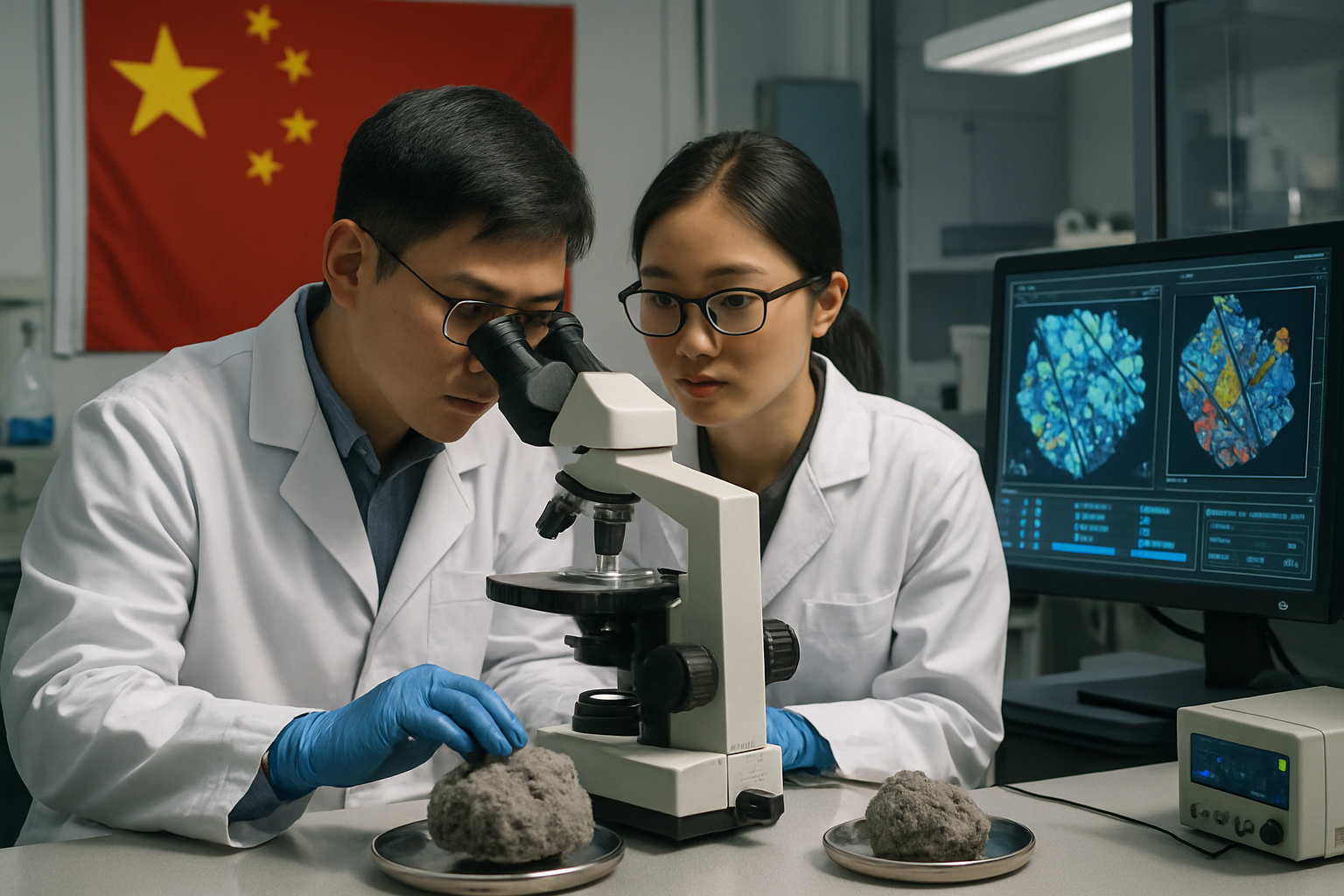
Chinese scientists have made a groundbreaking discovery by identifying two new lunar minerals from samples brought back to Earth by China's Chang'e-5 mission, according to reports from Xinhua news agency. This achievement represents a significant advancement in lunar geology and further establishes China's growing prominence in space exploration during what experts are calling the "space economy golden age."
The discovery, announced on April 26, 2026, marks another milestone in China's systematic approach to lunar exploration, building upon their previous achievements including the historic Chang'e-6 mission that successfully mapped the Moon's far side using artificial intelligence. These newly identified minerals provide crucial insights into the Moon's formation and geological evolution, information that will prove invaluable for future lunar missions and potential settlement planning.
Chang'e-5 Mission Success and Sample Analysis
The Chang'e-5 mission, which successfully returned lunar samples to Earth, represents one of the most complex automated space missions ever conducted. The spacecraft collected materials from the lunar surface using sophisticated drilling and scooping techniques, securing approximately 1.73 kilograms of lunar regolith and rock samples from the Oceanus Procellarum region.
Chinese researchers at leading institutions, including the Shanghai Institute of Technical Physics, employed advanced analytical techniques to examine these precious samples. The discovery process involved cutting-edge spectroscopic analysis and AI-powered pattern recognition systems, similar to those used in the Chang'e-6 mission's breakthrough analysis of the Moon's far side chemical composition.
Scientific Significance of the Discovery
The identification of two new lunar minerals expands our understanding of the Moon's diverse geological composition and provides new insights into the processes that shaped our nearest celestial neighbor. These minerals, formed under the unique conditions of the lunar environment, offer a window into approximately 4.5 billion years of geological history.
"This discovery represents a major step forward in lunar science and demonstrates the continued value of sample return missions for advancing our understanding of planetary formation."
— Leading Chinese Planetary Scientist
The minerals were likely formed through processes unique to the lunar environment, including the absence of atmospheric weathering, extreme temperature variations, and bombardment by cosmic radiation and micrometeorites over geological timescales. Understanding these formation processes provides valuable information for planning future lunar settlements and resource utilization strategies.
International Context and Space Race Developments
This discovery comes during a period of unprecedented international competition in lunar exploration. China's steady advancement contrasts with challenges faced by other space programs, including NASA's Artemis II mission delays and SpaceX's Starship development setbacks. The systematic, government-led approach adopted by China's space program has enabled consistent progress without the market pressures affecting commercial space ventures.
The timing of this announcement coincides with China's plans for crewed lunar missions by 2030, positioning the nation as a major competitor in the emerging lunar economy. Meanwhile, NASA has committed $20 billion toward establishing a permanent lunar base by 2030, the largest space infrastructure investment in the agency's history.
Technological Integration and AI Breakthroughs
The mineral discovery builds upon China's previous achievements in AI-assisted lunar research. Earlier in 2026, Chinese scientists at the Shanghai Institute of Technical Physics achieved a historic breakthrough by using artificial intelligence to determine the Moon's far side chemical composition through Chang'e-6 samples—the first detailed mapping of permanently hidden lunar regions representing nearly half of the Moon's surface.
This technological integration demonstrates China's leadership in combining traditional geological analysis with advanced artificial intelligence capabilities, creating new methodologies that could revolutionize planetary science research across the solar system.
Implications for Future Lunar Missions
The identification of new lunar minerals has significant implications for future missions and potential lunar settlement planning. Understanding the complete mineral composition of different lunar regions is crucial for:
- Identifying potential resources for in-situ resource utilization (ISRU)
- Planning safe landing sites for future crewed missions
- Developing technologies for lunar habitat construction
- Understanding the Moon's geological history and formation processes
These discoveries will inform China's ambitious plans for lunar exploration and complement international efforts under frameworks like the Artemis Accords. The scientific data generated from these mineral analyses will be valuable for the global space community as humanity prepares for a sustained lunar presence.
Space Economy Golden Age Context
The mineral discovery occurs during what industry experts call the transition to a "space economy golden age," with global space economy projections exceeding $1 trillion by 2030. China's consistent achievements in lunar exploration position the nation strategically within this expanding economic sector.
Recent developments include SpaceX's preparation for a potentially trillion-dollar IPO in June 2026, NASA's successful Artemis II mission completion ending a 54-year gap in human deep space exploration, and increasing international cooperation through programs like Pakistan's astronaut candidates for China's Tiangong station.
The convergence of scientific discovery, technological innovation, and economic opportunity represents a watershed moment in human space exploration, with lunar mineral discoveries playing a crucial role in enabling future cosmic expansion.
Future Research Directions
The successful identification of these new minerals establishes a foundation for continued lunar research and exploration. Future missions will likely focus on more detailed geological surveys, expanded sample return operations, and the development of technologies for processing lunar materials.
As China advances toward its goal of crewed lunar missions by 2030, these mineral discoveries provide essential scientific groundwork for mission planning and resource utilization strategies. The research methodologies developed for this discovery will also prove valuable for analyzing samples from other celestial bodies, including potential Mars samples and asteroid materials.
The achievement represents another milestone in humanity's expanding presence beyond Earth, contributing to the knowledge base necessary for establishing permanent extraterrestrial settlements and advancing our understanding of planetary formation throughout the solar system.