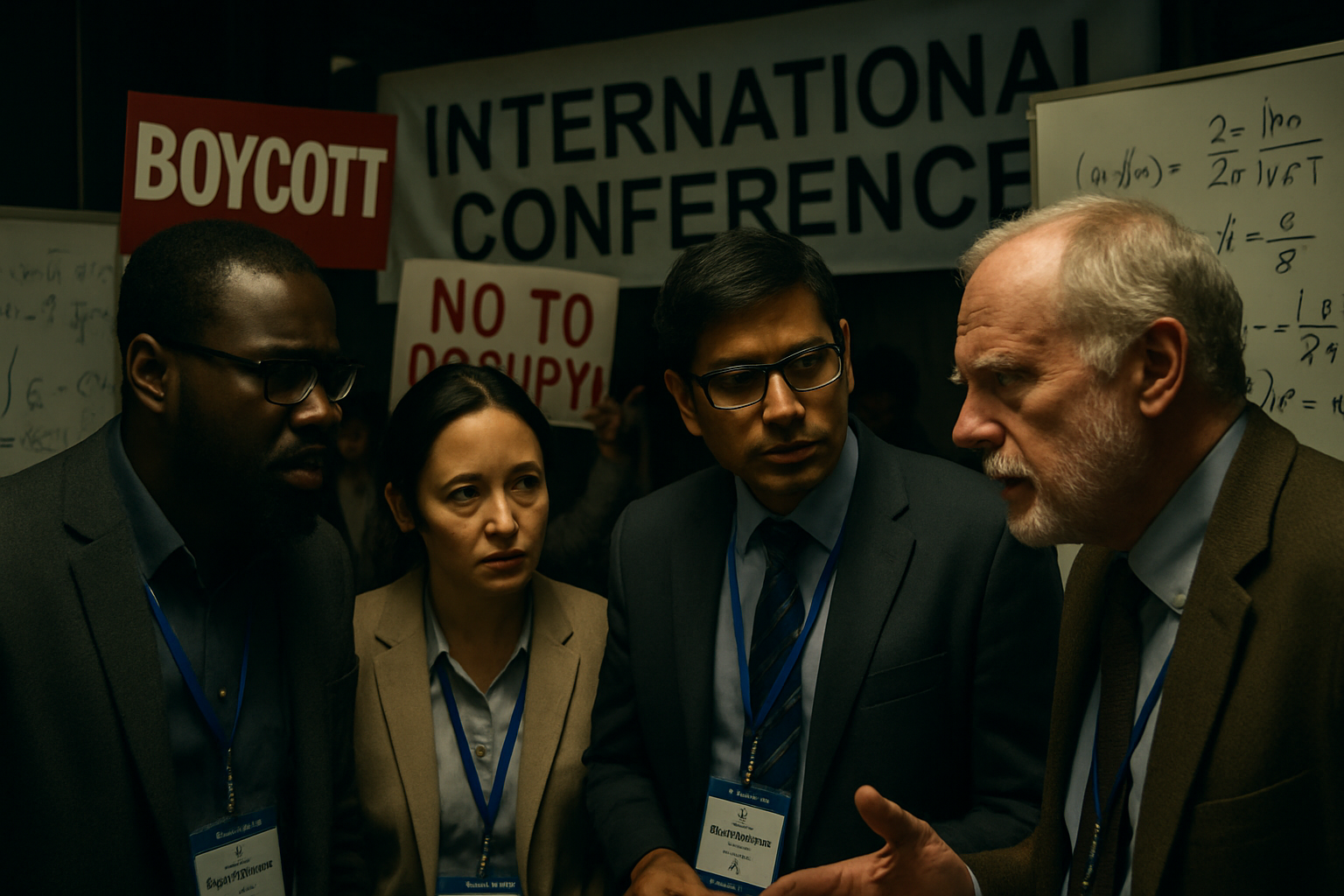
China's mathematical community stands at a critical crossroads as mounting global pressure intensifies for a boycott of the 2026 International Congress of Mathematicians (ICM) in Philadelphia, with over 2,300 mathematicians from at least 76 countries signing a petition to "move the 2026 ICM out of the US" and pledging not to participate in what is considered the world's most prestigious mathematics conference.
The International Congress of Mathematicians, historically regarded as the pinnacle of mathematical achievement and the venue for awarding the prestigious Fields Medal—often called the "Nobel Prize of Mathematics"—faces unprecedented opposition due to its scheduled July hosting in Philadelphia. The boycott movement represents the most significant academic protest against U.S. international leadership in decades, creating profound implications for global scientific cooperation.
The Scale of Global Opposition
The petition against U.S. hosting has gained remarkable momentum across international academic circles, with mathematicians from diverse geographical regions and institutional backgrounds expressing unified opposition. The 2,300+ signatures represent a substantial portion of the global mathematical elite, including numerous Fields Medal winners, university department heads, and leading researchers whose participation traditionally defines ICM's prestige and legitimacy.
This coordinated resistance transcends typical academic disagreements, reflecting deeper concerns about U.S. foreign policy, institutional integrity, and the politicization of scientific gatherings. The breadth of international opposition—spanning 76 countries—demonstrates that dissatisfaction extends far beyond traditional geopolitical rivals, encompassing allied nations and neutral academic institutions.
China's Mathematical Renaissance and Strategic Dilemma
The boycott debate occurs during China's remarkable mathematical ascendancy, with six Chinese mathematicians emerging as leading 2026 Fields Medal contenders—unprecedented representation reflecting sustained investment in mathematical research and education, particularly in pure mathematics, algebra, and algebraic geometry. This historic achievement positions China as a mathematical superpower capable of significantly influencing ICM's success or failure.
"The Chinese mathematical community has worked decades to achieve this level of international recognition. The question now is whether principle outweighs professional advancement."
— Academic source familiar with Chinese mathematical leadership deliberations
China's mathematical excellence extends beyond individual achievements to systematic institutional development. The success builds on comprehensive educational infrastructure, international cooperation through academic exchanges, and strategic investment in fundamental research. Chinese universities now rank among global leaders in mathematical output, publication quality, and international collaboration networks.
The Fields Medal Context and Timing Significance
The ICM's central role in awarding Fields Medals—given every four years to mathematicians under 40 who have made outstanding contributions—adds extraordinary stakes to the boycott decision. The 2026 competition is shaping up as the most internationally diverse in award history, with Chinese mathematicians holding unprecedented representation among frontrunners.
Wang Hong, a 35-year-old Chinese mathematician at New York University, achieved a remarkable dual victory winning two prestigious mathematics prizes within four days in April 2026, cementing her status as the overwhelming Fields Medal frontrunner. This achievement represents the first time a Chinese mathematician captured both major mathematical honors in a single week, occurring during what experts describe as the "Scientific Renaissance of 2026."
The potential absence of leading Chinese mathematicians could fundamentally alter the Fields Medal landscape, potentially delegitimizing awards that exclude the world's most accomplished young researchers due to political protest rather than academic merit.
Educational Excellence Foundation
China's mathematical achievements reflect broader educational transformation within the "2026 Educational Technology Renaissance." Success stories include systematic teacher development, advanced computational resources, cross-cultural academic exchange, and AI-powered verification systems that have democratized access to advanced mathematical tools.
Vietnamese mathematical success provides additional context—six Vietnamese mathematicians also emerged as Fields Medal contenders, demonstrating broader East Asian mathematical excellence. Professor Phung Ho Hai became the first Vietnamese scientist winning Germany's prestigious Humboldt Research Award for algebra and algebraic geometry research, illustrating the regional emergence of mathematical powerhouses traditionally dominated by European and North American institutions.
Historical Precedents and Academic Freedom Implications
The ICM boycott movement represents the most significant challenge to academic internationalism since Cold War-era restrictions on scientific cooperation. Unlike previous protests focused on specific political events, this movement questions fundamental assumptions about separating scientific collaboration from political disagreement.
Mathematical research traditionally exemplifies pure intellectual pursuit transcending national boundaries. The ICM has historically maintained political neutrality, hosting conferences during periods of international tension while preserving academic freedom and scientific integrity. The current boycott movement challenges this tradition, suggesting that mathematical community engagement implies endorsement of host nation policies.
Academic freedom advocates argue that scientific progress depends on open collaboration regardless of political disagreements. Mathematical breakthroughs often require international cooperation, shared resources, and cross-cultural intellectual exchange that boycotts could permanently damage.
International Cooperation and Global Context
The boycott debate occurs within broader global scientific cooperation evolution. Recent achievements demonstrate unprecedented international collaboration despite traditional multilateral funding challenges. Bilateral partnerships and peer-to-peer knowledge sharing networks drive innovation through distributed cooperation models allowing culturally responsive research while maintaining evidence-based standards.
The "Golden Age of Astronomical Observation" and advanced analytical techniques, including DNA sequencing for biodiversity research and sophisticated mathematical modeling for theoretical breakthroughs, enable previously impossible insights through international cooperation. Mathematical research particularly benefits from this collaboration, with breakthrough discoveries often requiring diverse perspectives and complementary expertise.
"Mathematics knows no borders. The most profound discoveries emerge from collaboration across cultures, institutions, and ideological differences. A boycott risks undermining decades of progress toward truly global mathematical community."
— International mathematics collaboration researcher
Economic and Strategic Implications
The mathematical boycott carries substantial economic implications across multiple sectors. Mathematical advances enhance cybersecurity, financial modeling, and engineering capabilities essential for national competitiveness. Countries investing in fundamental research position themselves as high-value market leaders while contributing to collective knowledge advancement.
China's mathematical investment demonstrates prevention-first scientific approaches with superior cost-effectiveness compared to reactive crisis management, creating sustainable competitive advantages. Mathematical research increasingly intersects with practical applications in artificial intelligence, quantum computing, and cryptographic security systems essential for modern digital infrastructure.
The integration of pure theoretical work with modern computational approaches contributes to fields with implications for technological advancement and economic development. Mathematical excellence increasingly determines national capacity for innovation-driven development strategies essential for competing in global high-technology markets.
Decision Framework and Community Pressure
Chinese mathematical institutions face complex decision-making processes involving academic leadership, government oversight, international relationships, and individual researcher autonomy. The choice affects not only immediate participation but long-term positioning within global mathematical networks.
Academic institutions must balance multiple considerations: maintaining international relationships, supporting faculty research opportunities, responding to student interests, and preserving institutional reputation. Government involvement adds additional complexity, with decisions potentially interpreted as official policy positions rather than academic autonomy.
Individual mathematicians face personal dilemmas between career advancement, professional integrity, political principle, and community solidarity. Young researchers particularly struggle with decisions affecting long-term academic trajectories and international recognition opportunities.
Alternative Approaches and Future Implications
Some Chinese institutions explore compromise approaches, including partial participation, alternative gatherings, or symbolic protest while maintaining academic engagement. These strategies attempt to balance political expression with scientific collaboration needs.
Virtual participation options, parallel conferences, and delayed recognition ceremonies could provide middle-ground solutions preserving academic relationships while expressing political dissent. However, such approaches risk creating permanent divisions within the international mathematical community.
The precedent established by Chinese participation or non-participation will influence future academic boycott movements, international conference hosting decisions, and the relationship between scientific collaboration and political activism for decades to come.
Global Mathematical Community at Crossroads
The 2026 ICM controversy represents a defining moment for international academic cooperation. The mathematical community's response will establish precedents for addressing political disagreements within scientific contexts, balancing academic freedom with political expression, and maintaining global collaboration amid increasing geopolitical tensions.
Success in navigating this crisis requires unprecedented coordination between governments, academic institutions, and individual researchers to ensure that scientific advancement serves human welfare rather than becoming a casualty of political conflict. The stakes extend beyond mathematics to the broader principle of international scientific cooperation essential for addressing global challenges requiring coordinated intellectual resources.
As the July deadline approaches, the Chinese mathematical community's decision will significantly influence not only the immediate success of ICM 2026 but the future structure of international academic cooperation in an increasingly polarized world. The choice between academic engagement and political protest may well define the trajectory of global mathematical collaboration for the next generation.