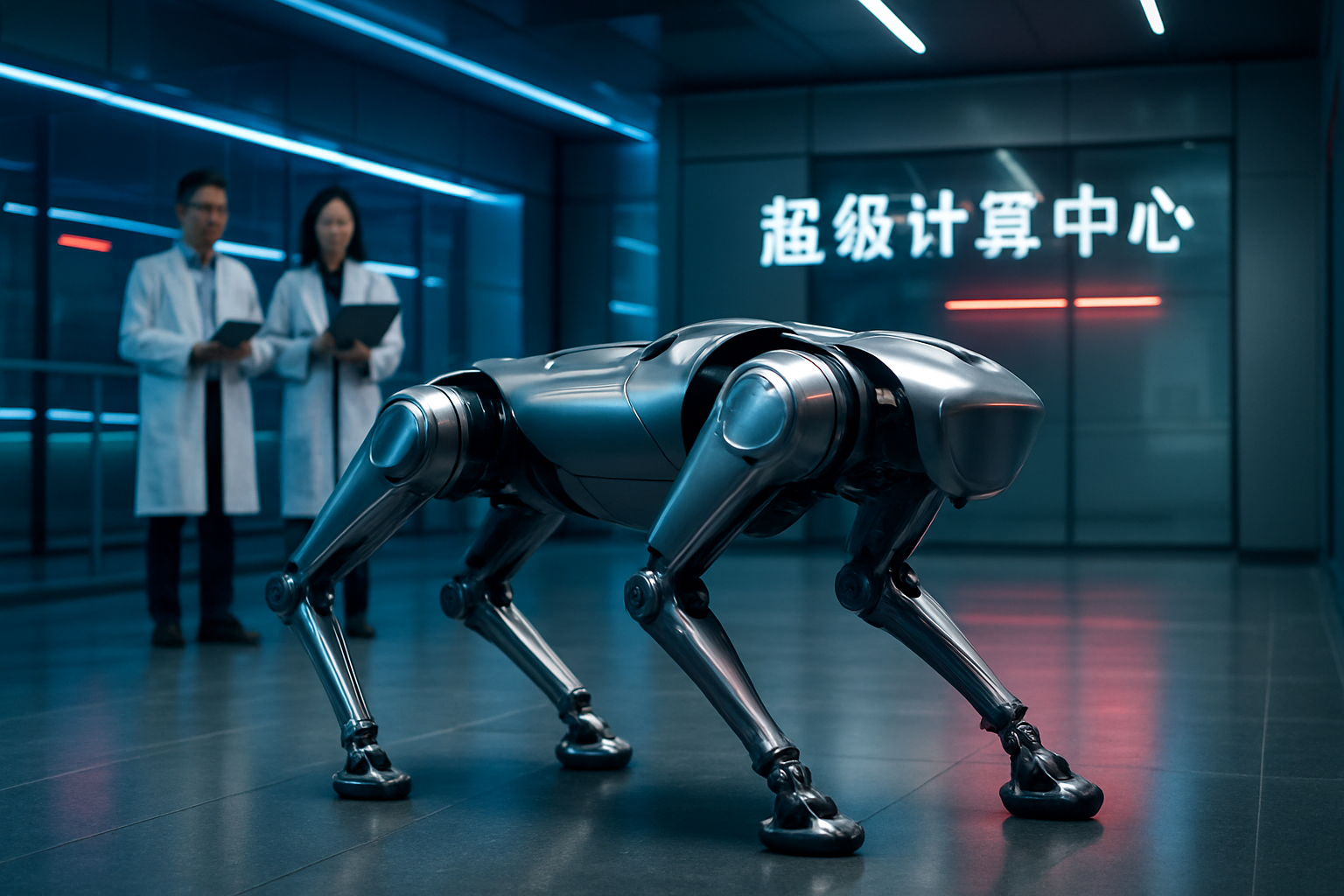
Chinese robotics companies are increasingly banking on quadruped robots as major revenue drivers, with AgiBot's recent decision to spin out its four-legged robotics unit into a new subsidiary called AgiQuad marking a significant strategic pivot in China's AI-powered robotics industry.
The move by AgiBot was specifically designed to drive large-scale growth so that the quadruped unit would not "live in the shadow of the humanoid robot giant," according to Qiu Heng, chief operating officer of the newly formed subsidiary. This strategic separation represents a broader industry trend as Chinese companies seek to diversify their robotics portfolios amid intensifying global competition.
Strategic Industry Transformation
The quadruped robotics focus comes during what industry experts characterize as a critical "civilizational choice point" where artificial intelligence transitions from experimental technology to essential business infrastructure. This shift is occurring alongside massive infrastructure investments despite global challenges, including a sixfold surge in memory semiconductor prices affecting Samsung, SK Hynix, and Micron operations until 2027.
Chinese companies are pursuing a "human-centered automation" approach that emphasizes reskilling over displacement while addressing the country's "4-2-1 demographic problem" – where single children must support four aging parents and grandparents. This demographic pressure is driving systematic AI and robotics deployment as a strategic response to maintain productivity despite an unprecedented aging population transition.
Market Dynamics and Competition
The quadruped robotics sector represents part of China's comprehensive demographic-driven AI strategy. Major companies like Unitree Robotics have scaled humanoid production from 5,500 to 20,000+ units in 2026, demonstrating the fastest laboratory-to-commercial transition in global robotics history. This expansion occurs alongside significant corporate commitments, with Midea Group investing 60 billion yuan ($8.7 billion) over three years for AI and embodied intelligence development.
"In technology, standing still means falling behind. We must position our quadruped division to capture the growing market demand while maintaining our leadership in humanoid development."
— Qiu Heng, Chief Operating Officer, AgiQuad
The strategic pivot to quadruped robots reflects practical considerations as companies seek more immediate commercial applications. Four-legged robots offer advantages in industrial environments, security applications, and outdoor operations where stability and mobility are crucial. Unlike humanoid robots, which face complex engineering challenges in bipedal locomotion, quadruped designs have proven more reliable for current commercial deployment.
Global Context and Infrastructure Challenges
This development occurs within a broader transformation of the global AI landscape. The "SaaSpocalypse" has eliminated hundreds of billions in traditional software market capitalization as AI systems demonstrate direct replacement capabilities for conventional solutions. Despite infrastructure constraints, massive investments continue with Alphabet committing $185 billion to AI infrastructure in 2026 and Amazon planning over $1 trillion in AI development through the decade.
The global semiconductor crisis has paradoxically spurred innovation in memory-efficient algorithms and sustainable deployment strategies, potentially democratizing AI access through constraint-driven development. World Bank projections indicate AI water demand could reach 4.2-6.6 billion cubic meters by 2027 for data center cooling alone, equivalent to 4-6 times Denmark's annual consumption.
International Implications and Regulatory Landscape
Chinese robotics advancement occurs amid intensifying international regulatory frameworks. Spain implemented the world's first criminal executive liability framework for tech platforms, France has conducted AI cybercrime raids, and the UN established an Independent Scientific Panel of 40 experts for the first fully independent global AI assessment body under Secretary-General António Guterres.
This regulatory intensification represents the most sophisticated global technology governance since internet commercialization, aimed at preventing regulatory arbitrage while ensuring uniform standards. The multipolar AI landscape emerging includes Chinese technological sovereignty initiatives, European regulatory frameworks, and American corporate investments, creating distributed capabilities that prevent single-entity dominance.
Success Models and Human-AI Collaboration
The Chinese approach contrasts with Western strategies through its emphasis on human-AI collaboration rather than wholesale replacement. Successful integration models documented globally include Canada's AI teaching assistants maintaining critical thinking standards, Malaysia's world-first AI-integrated Islamic school, and Singapore's WonderBot 2.0 heritage education system.
These models demonstrate that AI amplification tools serving human goals consistently outperform replacement mechanisms. Common success factors include sustained human development commitment, comprehensive stakeholder engagement, and cultural sensitivity in implementation. Chinese companies are adopting similar approaches, treating AI and robotics as enhancement tools while maintaining social stability during technological transformation.
Economic and Strategic Implications
China's AI-demographic strategy carries implications extending far beyond national borders, given the country's position as the world's second-largest economy and largest manufacturing base. The success or failure of this approach could provide a template for other aging societies worldwide facing similar technological adaptation challenges during 21st-century demographic transitions.
Prevention-first approaches demonstrate superior economic outcomes through reduced crisis costs, improved workforce productivity, and enhanced international competitiveness. China achieved a logistics automation efficiency record of 13.9% of GDP ratio through systematic AI implementation, while securing zero-tariff access to 53 African countries by May 2026, demonstrating how technological capabilities can support expanded international engagement.
Future Outlook
The window for coordinated international action is narrowing as AI development accelerates. Success depends on resolving infrastructure constraints while maintaining innovation momentum, developing sustainable business models that prioritize human welfare, and fostering international cooperation that balances competitiveness with stability.
Industry experts identify April 2026 as a critical juncture determining whether AI serves human flourishing versus becoming an exploitation tool beyond democratic accountability. Decisions being made now will establish human-AI relationship patterns for decades ahead, requiring unprecedented coordination among governments, companies, institutions, and civil society.
The most promising path involves sophisticated human-AI collaboration that amplifies capabilities while preserving creativity, cultural understanding, and ethical reasoning that define human potential. For Chinese robotics companies, the focus on quadruped robots represents a strategic bet that practical, commercial applications will drive the next phase of AI and robotics adoption globally.