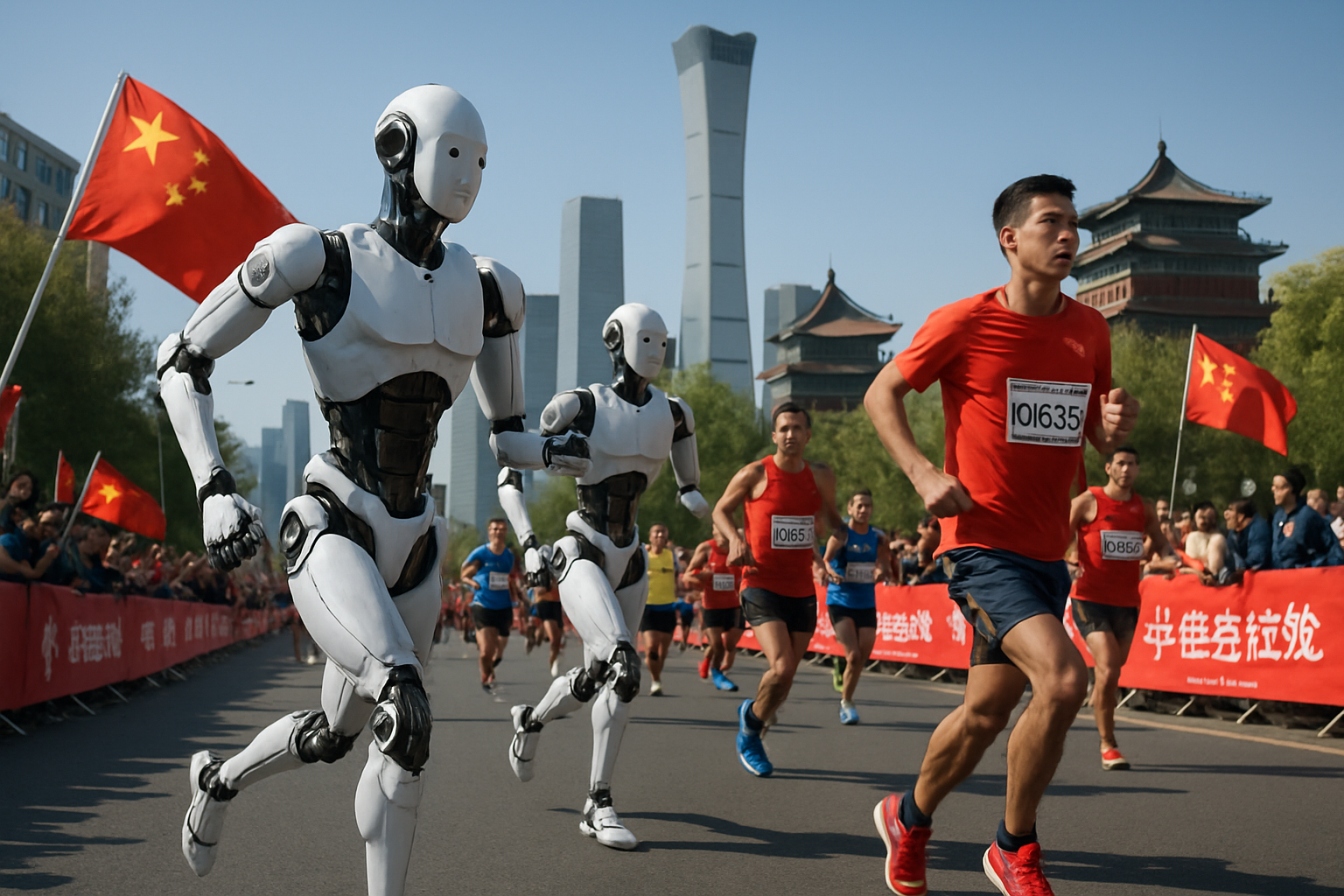
Chinese humanoid robots achieved a historic breakthrough in athletic performance on April 19, 2026, as the winning robot completed Beijing's half marathon in just 50 minutes and 26 seconds - approximately seven minutes faster than the human world record.
The second edition of Beijing's robot half marathon featured over 300 humanoid robots competing in the largest competitive robotic athletic event in history. The event demonstrated China's dramatic advancement in robotics technology, representing what experts call the transition from experimental laboratory prototypes to superhuman athletic performance.
Record-Breaking Performance
The winning robot's time of 50 minutes and 26 seconds obliterated expectations and showcased the rapid evolution of bipedal robotics. Swedish robotics expert Tom Andersson commented on the achievement, stating "This can only be done in China," highlighting the scale and ambition of the Chinese robotics program.
The performance represents a dramatic improvement from the 2025 inaugural event, when many robots failed to complete the course. This year's competition demonstrated advanced balance, endurance, and AI decision-making capabilities as robots navigated complex urban terrain and varying weather conditions.
Spectators gathered along the course route, with crowds particularly enthusiastic at the 11-kilometer mark, where supporters chanted "Come on, Shandian!" - the name of one of the leading robotic competitors. The atmosphere combined traditional marathon excitement with the novelty of witnessing artificial athletes push the boundaries of what machines can achieve.
Strategic Context: China's Demographic Solution
The robot marathon success represents more than athletic achievement - it's a crucial component of China's strategic response to what experts term the "4-2-1 demographic problem." This refers to the situation where single children must support four aging parents and grandparents, a consequence of decades of population control policies creating an inverted population pyramid.
Bank of America Global Research analysis reveals that China's AI and robotics development has emerged as a strategic response to mitigate the severe economic impacts of the world's most rapidly aging population. The systematic approach involves installing over 50% of the world's robots to offset labor shortages and sustain productivity despite demographic pressures.
Unitree Robotics, a leading Chinese manufacturer, scaled production from 5,500 humanoid units in 2025 to over 20,000 units in 2026, representing the fastest laboratory-to-commercial transition in robotics history. This scaling demonstrates China's commitment to transforming experimental technology into mass-market solutions.
Technological Advancement and Innovation
The Beijing marathon showcased sophisticated integration of artificial intelligence, advanced materials, and mechanical engineering. The competing robots demonstrated autonomous navigation, real-time decision-making, and adaptive responses to changing course conditions - capabilities that extend far beyond simple pre-programmed movements.
This technological prowess builds on China's comprehensive infrastructure advantages, as identified by Alibaba Chairman Joe Tsai. These include superior power grid infrastructure providing stable energy for AI computational requirements, strategic commitment to open-source AI models enabling collaborative development, and complete domestic manufacturing supply chains reducing vulnerability to geopolitical disruptions.
The robots competed alongside human participants in dedicated lanes, creating a framework for inclusive technological advancement. The positive spectator reception suggests a model for human-robot collaboration that amplifies capabilities rather than simply replacing human participation.
Global Competition and International Response
The Chinese achievement contrasts sharply with international efforts. BMW's deployment of two "Aeon" humanoid robots at a German manufacturing facility represents the scale gap between Chinese mass production and Western experimental approaches. While European initiatives focus on limited pilot programs, China has achieved systematic deployment across multiple industries.
The marathon victory occurs amid broader Chinese technological expansion, including precision clock breakthroughs, nationwide AI integration, and comprehensive worker transition programs. Unlike Western approaches that often involve mass layoffs, China emphasizes reskilling and human-AI collaboration to maintain social stability during technological advancement.
International governance bodies are taking notice. The UN has established an Independent Scientific Panel of 40 experts for AI assessment, representing the most sophisticated global technology governance effort since internet commercialization. However, coordination challenges persist as nations balance innovation with safety concerns.
Economic and Industrial Implications
China's robotics success supports broader economic transformation goals. The nation achieved a 13.9% GDP logistics automation efficiency record through systematic AI implementation, demonstrating measurable productivity gains that potentially offset demographic headwinds.
Despite facing a global semiconductor crisis with memory chip prices increasing sixfold, Chinese companies continue aggressive expansion by developing memory-efficient algorithms and alternative architectures. This constraint-driven innovation may actually provide competitive advantages in creating more efficient robotic systems.
The robotics advancement also supports China's international engagement strategy. The announcement of zero-tariff access for 53 African countries in diplomatic relations, effective May 1, 2026, represents the most comprehensive China-Africa trade expansion in modern history, demonstrating how technological capabilities enable expanded international partnerships.
Human-Centered Integration Model
The Beijing marathon demonstrates China's "human-centered automation" philosophy, where robots enhance rather than replace human capabilities. This approach contrasts with purely replacement-focused strategies and maintains social stability during rapid technological change.
Successful integration models globally support this collaborative approach. Canadian AI teaching assistants maintain critical thinking development, Malaysia operates the world's first AI-integrated Islamic school combining technology with traditional learning, and Singapore's WonderBot 2.0 heritage education demonstrates enhancement versus substitution approaches.
The marathon event itself exemplifies this philosophy - robots competed in dedicated lanes alongside human participants, creating excitement and inspiration rather than displacement. The enthusiastic crowd response suggests public acceptance of advanced robotics when implemented thoughtfully.
Looking Forward: Template for Global Innovation
The Beijing robot marathon provides a template for aging societies worldwide facing similar demographic transitions. China's success in maintaining productivity despite population decline could reshape global assumptions about the relationship between demographics and development.
Industry experts characterize April 2026 as a "civilizational choice point" where decisions determine whether AI serves human flourishing or becomes an exploitation tool. The Chinese model of systematic, comprehensive deployment combined with human-centered collaboration offers one path forward for this critical transition.
The marathon success represents a glimpse of a future where artificial intelligence amplifies human potential rather than threatening it. As the world's second-largest economy demonstrates the viability of collaborative technological advancement, other nations are closely monitoring these developments for insights into managing their own demographic and economic challenges.
The winning robot's 50-minute performance will be remembered not just as an athletic achievement, but as a milestone in humanity's evolving relationship with artificial intelligence - demonstrating technology's potential to address societal challenges while inspiring new forms of excellence.