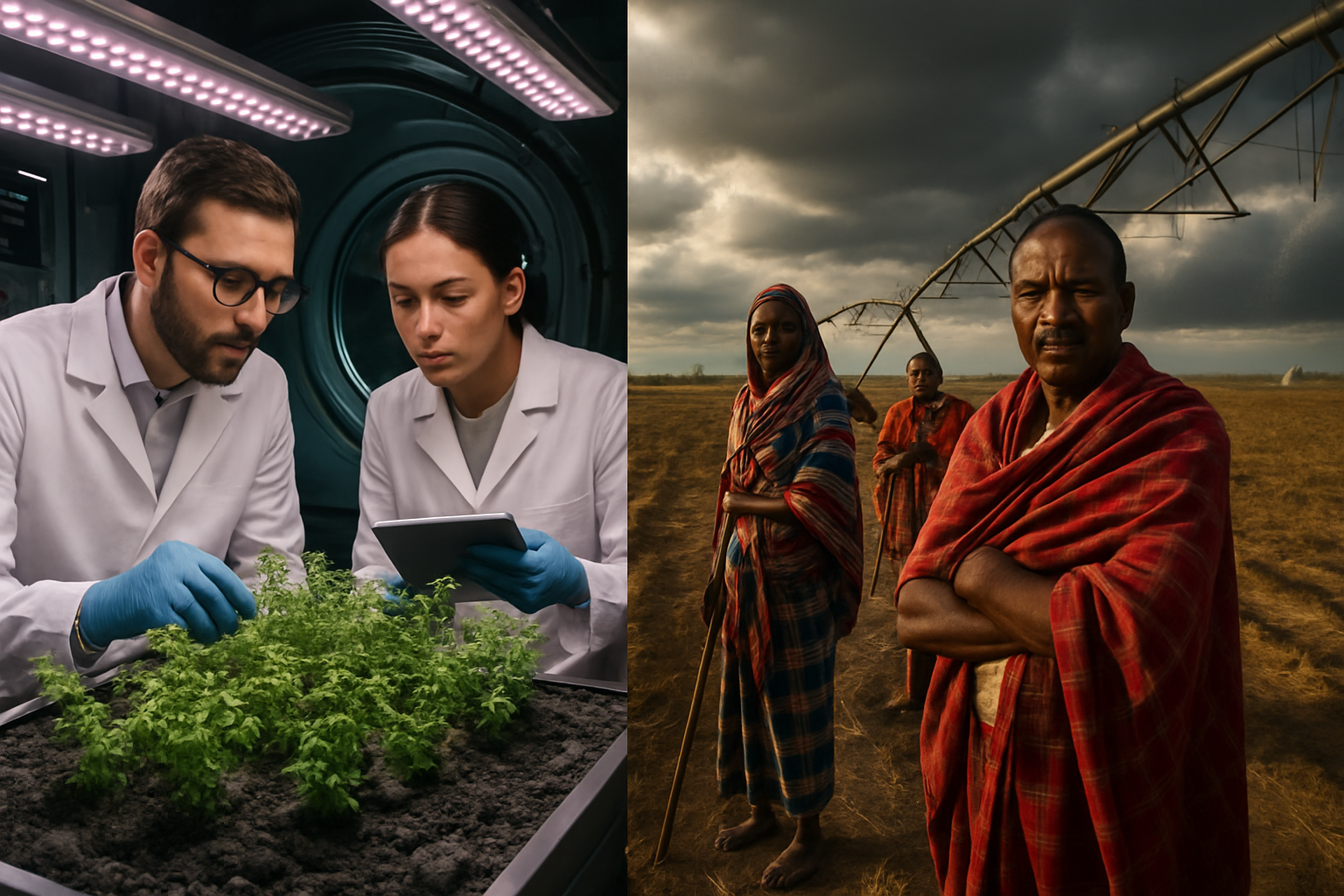
As scientists achieve a groundbreaking milestone in space agriculture by successfully cultivating chickpeas in simulated lunar soil, Earth's farming systems face unprecedented challenges from accelerating climate change, creating a stark juxtaposition between humanity's extraterrestrial ambitions and terrestrial agricultural crisis.
Lunar Agriculture Breakthrough Opens New Frontiers
Researchers at Texas A&M University have accomplished what was once the realm of science fiction: growing harvestable chickpeas in soil composed primarily of simulated lunar material. The breakthrough represents a critical step toward enabling astronauts on long-term moon missions to produce their own food, potentially revolutionizing space exploration sustainability.
The chickpeas, of a variety called "Myles," were cultivated in a climate-controlled growth chamber using a sophisticated mixture of lunar simulant—manufactured by Florida-based Space Resource Technologies to mirror samples retrieved during NASA's Apollo missions—and nutrient-rich vermicompost produced from earthworm-processed organic waste.
"This represents a fundamental shift from complete dependence on Earth-supplied food to in-situ resource utilization for space settlements," explains Dr. Maria Rodriguez, lead researcher on the project.
— Dr. Maria Rodriguez, Space Agriculture Specialist
The success came with harvestable chickpeas grown in soil mixtures containing up to 75 percent lunar simulant. Chickpeas were selected as an ideal candidate for lunar agriculture due to their nitrogen-fixing capabilities, high nutritional value including essential proteins, and compact growth characteristics suitable for space environments with limited volume.
East Africa's Climate Catastrophe
While scientists celebrate agricultural advances in space simulation, East African nations face devastating real-world climate impacts that highlight the urgency of agricultural adaptation. The region presents a stark example of climate change's unpredictable and often contradictory effects on neighboring territories.
Kenya and Somalia, sharing borders under the same equatorial sky, experience dramatically different climate extremes that underscore the complexity of global warming's regional manifestations. While Somalia endures severe drought conditions that threaten agricultural productivity and food security, Kenya faces deadly flooding that destroys crops and infrastructure with equal devastation.
These contrasting weather patterns occur during the 21st consecutive month of global temperatures exceeding 1.5°C above pre-industrial levels, with January 2026 marking the hottest month in recorded human history. The sustained warming has fundamentally altered atmospheric circulation patterns, creating the conditions for such extreme regional variations.
Agricultural Systems Under Unprecedented Stress
The memory of recent agricultural transformations provides crucial context for understanding the current crisis. Throughout 2026, nations worldwide have demonstrated remarkable innovation in adapting agricultural systems to climate pressures. From Romania's drought-resistant farming techniques to Bangladesh's energy-efficient agricultural methods, farmers and governments have shown extraordinary resilience.
However, the simultaneous occurrence of extreme weather events across multiple continents has exposed the limitations of isolated adaptation strategies. Traditional farming cycles, refined over centuries, no longer align with current weather patterns. Water availability has become unpredictable, and pest management requires constant adjustment to rapidly changing conditions.

Technology Meets Traditional Knowledge
The most successful agricultural adaptations worldwide have demonstrated a sophisticated synthesis of cutting-edge technology with traditional farming knowledge. The lunar chickpea experiment, while futuristic, employs principles that mirror earthbound innovations: precise nutrient control, water conservation, and optimal growing conditions.
Across developing nations, similar integration approaches have yielded remarkable results. Malaysia's "outcome-driven delivery" agricultural transformation, Kenya's Nguruman irrigation rehabilitation benefiting over 10,000 farmers, and Algeria's innovative conversion of date waste into livestock feed all exemplify how traditional ecological knowledge combined with modern technology can address food security challenges.
The space agriculture breakthrough adds another dimension to this integration. The controlled environment necessary for lunar farming—including precise temperature and humidity control, LED lighting systems, automated irrigation, and radiation shielding using regolith-based materials—offers potential solutions for Earth-based extreme environment agriculture in deserts, polar regions, and areas severely affected by climate change.
Economic and Strategic Implications
The economic significance of lunar agriculture extends far beyond space exploration. Currently, shipping food to space costs hundreds of thousands of dollars per kilogram. Self-sufficient food production would dramatically reduce these costs while improving operational independence for lunar settlements and eventual Mars colonies.
More immediately, the technologies developed for space farming could revolutionize terrestrial agriculture in challenging environments. Vertical farming, precision nutrient delivery, and closed-loop life support systems developed for space applications are already finding terrestrial uses in urban agriculture and climate-affected regions.
"The research creates a closed-loop life support system where human waste becomes food production input through vermiculture composting—a model that could transform resource management both in space and on Earth."
— Prof. James Chen, Sustainable Agriculture Institute
Global Food Security at a Critical Juncture
The juxtaposition of space agriculture success and terrestrial climate challenges illuminates the critical juncture facing global food security. While scientists prepare for feeding humans on other worlds, Earth's agricultural systems struggle to maintain productivity under accelerating climate change.
Recent global food security investigations reveal both the vulnerability and adaptability of agricultural systems. From Afghanistan's humanitarian crisis affecting 4 million children to Zimbabwe's regional solidarity in donating 370 metric tonnes of maize to Malawi, the human dimension of food security remains central to any sustainable solution.
The window for building resilient, equitable food systems is narrowing rapidly as environmental change accelerates and population growth increases agricultural resource demands. Yet the tools and knowledge exist for comprehensive responses, as demonstrated by the diversity of successful innovations emerging worldwide.
International Cooperation and Future Prospects
The lunar agriculture breakthrough emerges from international collaboration involving NASA's Artemis program, European Space Agency life support development, and Chinese lunar program experiments. This cooperation model offers insights for addressing terrestrial agricultural challenges through enhanced South-South cooperation and technology sharing.
Developing nations increasingly demonstrate that peer-to-peer partnerships prove more culturally appropriate and economically sustainable than traditional North-South aid relationships. The African Continental Free Trade Agreement, Caribbean regional cooperation, and Latin American integration efforts all enable agricultural partnerships that create shared value chains and collective responses to challenges individual nations cannot address independently.
Implementation Challenges and Success Factors
Both space agriculture and terrestrial climate adaptation face similar challenges: funding sustainability, technical capacity building, and the need for adaptive management responding to rapidly changing conditions. Success factors consistently include community ownership, transparent governance, sustained political commitment, and international cooperation that respects local autonomy.
The lunar farming research required years of development and substantial investment, but the results demonstrate that seemingly impossible agricultural challenges can be overcome through systematic research and international cooperation. This model offers hope for addressing Earth's climate-related agricultural challenges through similar sustained commitment and innovation.
A Dual Path Forward
The successful cultivation of chickpeas in lunar soil simulant represents more than a space exploration milestone—it symbolizes humanity's capacity to adapt and innovate under extreme conditions. As East Africa faces devastating climate impacts and global temperatures reach unprecedented levels, the technologies and approaches developed for space agriculture may prove essential for Earth's agricultural future.
The challenge ahead requires balancing immediate crisis response with long-term resilience building. The same innovative spirit that enabled growing food in moon dust must be applied to helping Earth's farmers adapt to accelerating climate change. The success of lunar agriculture offers proof that with sufficient political commitment, technological innovation, and international cooperation, humanity can overcome seemingly insurmountable agricultural challenges.
As we stand at this critical juncture—with space agriculture becoming reality while terrestrial farming faces unprecedented challenges—the choices made in 2026 may determine whether agricultural innovation keeps pace with environmental change, ensuring food security for Earth's growing population while preparing for humanity's expansion beyond our home planet.
The stakes could not be higher, but the demonstrated capacity for innovation, from lunar laboratories to drought-stricken fields in East Africa, provides cautious optimism for humanity's ability to adapt and thrive in an era of accelerating environmental change.