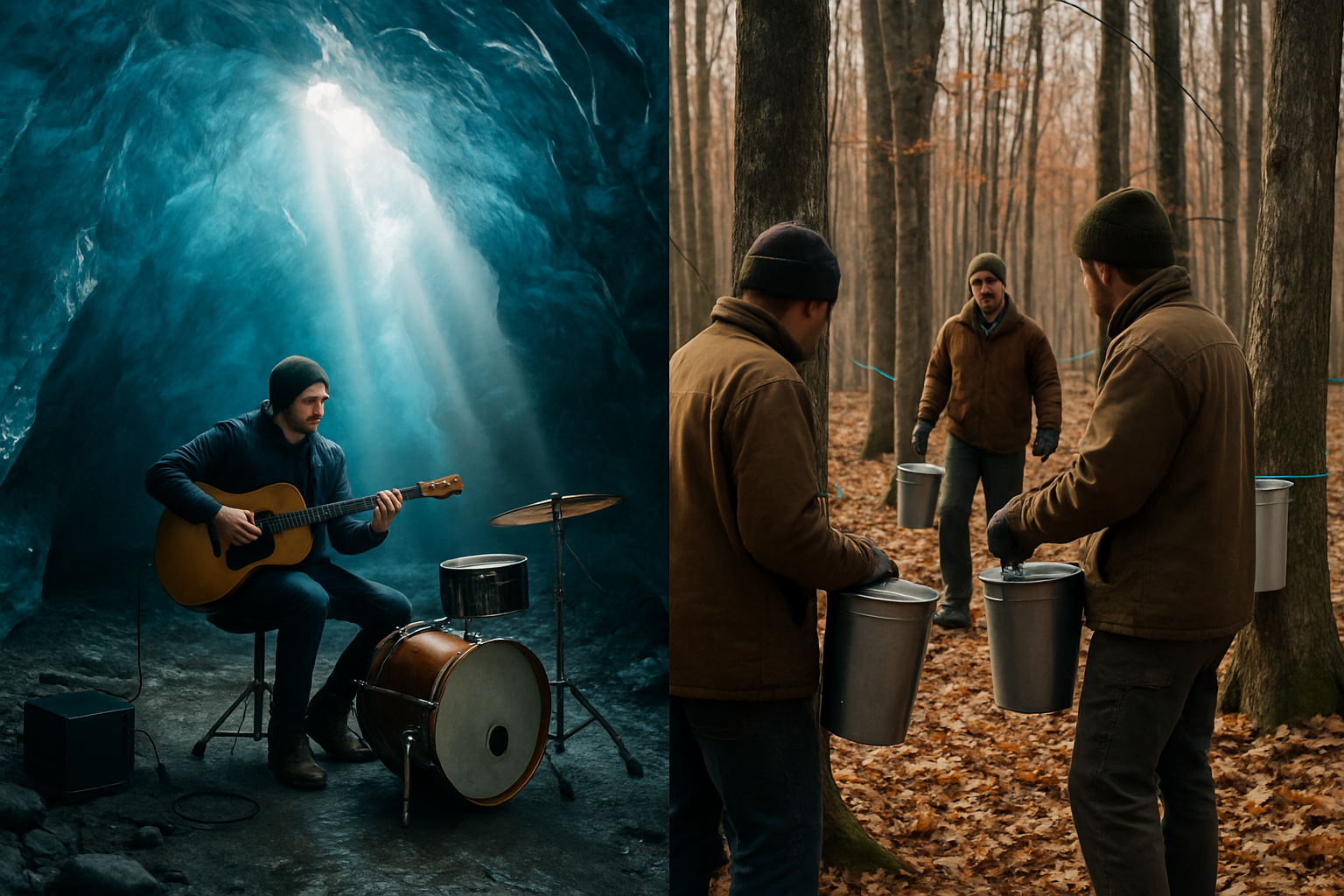
Swiss musician To Athena has performed inside a cave in a melting glacier to highlight devastating ice loss across the Alps, while Quebec's maple syrup industry—the world's largest producer—faces mounting climate pressures that threaten the province's $547 million annual harvest and centuries-old agricultural traditions.
The unprecedented artistic statement and agricultural crisis emerge during the 21st consecutive month that global temperatures have exceeded the critical 1.5°C threshold above pre-industrial levels, marking the longest sustained warming streak in recorded human history. These developments underscore how climate change is fundamentally reshaping both cultural expression and essential food production systems worldwide.
Cultural Resistance Through Artistic Expression
To Athena's performance inside the ice cave represents a growing movement of artists using their platforms to document and protest environmental destruction. The Swiss musician's choice of venue—a glacier cave that may not exist within the next decade—transforms art into environmental activism, creating a powerful visual metaphor for the urgency of climate action.
According to historical climate memory data, Alpine regions are experiencing temperature increases at nearly double the global average. German glaciers have lost over 25% of their total area in just two years, with complete disappearance expected by the 2030s. The Hindu Kush Himalayas, often called the "water tower of Asia," are losing ice at twice the rate since 2000, threatening water security for over 2 billion people who depend on glacial meltwater for daily survival.
"Climate change is no longer an abstract future threat but a present reality affecting ecosystems and communities worldwide."
— Climate Research Analysis, March 2026
Quebec's Maple Syrup Crisis: A Sweet Tradition Under Threat
Quebec's maple syrup industry, which produces approximately 70% of the world's supply, faces what experts describe as its greatest challenge since commercial production began. The province's unique geographic position and climate conditions have historically created optimal maple sap flow, but increasingly erratic weather patterns are disrupting this delicate natural process.
Recent climate data reveals that maple sap flows have begun weeks earlier than traditional timing, forcing producers to accelerate operations while simultaneously dealing with unpredictable temperature swings that can halt production entirely. The traditional sugar maple season, historically running from late February through early April, has become increasingly compressed and unpredictable.
Le Monde reports that the province is actively seeking ways to adapt its maple syrup production to increasingly unpredictable climate conditions. This adaptation challenge affects not only the 7,400 maple syrup producers across Quebec but also the broader agricultural economy that depends on predictable seasonal patterns.
The Science Behind the Crisis
The convergence of cultural and agricultural climate responses reflects deeper atmospheric changes documented by international climate monitoring systems. January 2026 marked the hottest month in recorded history, extending an unprecedented 22-month streak of temperatures exceeding the Paris Agreement's critical 1.5°C threshold.
For maple syrup production, optimal sap flow requires specific temperature conditions: freezing nights below -4°C followed by warm days above 4°C. Climate change has disrupted this natural cycle, creating what producers describe as a "climate volatility paradox" where extreme warming enables both heat records and devastating regional variations through disrupted atmospheric circulation patterns.
The World Meteorological Organization projects a 50-60% probability of El Niño development during July-September 2026, which could drive unprecedented temperatures by combining baseline warming with natural cycle amplification. This would potentially devastate both Alpine glacier stability and North American agricultural systems.
Economic and Cultural Implications
Quebec's maple syrup industry represents more than agricultural production—it embodies cultural heritage spanning centuries of Indigenous knowledge and French colonial traditions. The industry directly employs thousands and supports rural communities across the province, making climate adaptation essential for both economic survival and cultural preservation.
The economic implications extend globally, as Quebec's production dominance means that climate disruptions in the province affect maple syrup availability and pricing worldwide. The industry has invested heavily in technology to maximize sap collection efficiency, but fundamental climate pattern changes challenge technological solutions.
Similarly, To Athena's artistic intervention highlights how cultural responses to climate change are evolving beyond traditional protest methods. By performing within the very landscape under threat, artists create immediate, visceral connections between audiences and environmental destruction that statistics alone cannot convey.
International Context and Broader Implications
These developments occur within a broader pattern of climate impacts affecting food systems and cultural practices globally. Emergency response systems designed for sequential disasters are proving inadequate for simultaneous multi-continental climate emergencies, as evidenced by recent extreme weather events across Europe, Asia, and the Americas.
Research from 33,990 fish populations shows 7.2% population decline per 0.1°C of ocean warming, while Antarctic ice loss continues at a rate equivalent to the area of Vienna annually. These interconnected environmental changes demonstrate how local climate impacts—whether affecting Alpine glaciers or Quebec maple forests—are components of global environmental system breakdown.
The European Union's Civil Protection Mechanism has been repeatedly activated throughout 2026, with €246 million in assistance to Sweden and Denmark representing the largest coordinated European weather response on record. Yet experts warn this level of response remains insufficient for the scale and simultaneity of current climate challenges.
Adaptation Strategies and Innovation
Quebec maple syrup producers are pioneering climate adaptation strategies that combine traditional knowledge with modern technology. These include enhanced weather monitoring systems, modified tapping techniques to extend sap collection periods, and diversified production methods to maintain viability during irregular seasons.
The industry is also exploring expanded genetic research on maple trees to identify varieties more resilient to climate variability, while maintaining the unique flavor profiles that define Quebec maple syrup's international reputation. Some producers are experimenting with controlled environment techniques and extended collection seasons using technological innovations.
Cultural institutions are similarly adapting, with museums and performance venues developing climate-conscious programming that addresses environmental themes while preserving traditional artistic practices. To Athena's glacier performance exemplifies this evolution, using artistic expression to document and protest environmental destruction in real-time.
Looking Forward: A Critical Juncture
March 2026 represents what climate experts describe as a "watershed moment" for global climate preparedness, requiring choices between reactive crisis management and transformative infrastructure adaptation. Current climate conditions preview what could become routine environmental challenges by the 2030s without comprehensive climate action and adaptation investment.
The convergence of cultural expression and agricultural crisis demonstrates how climate change transcends traditional sector boundaries, requiring coordinated responses that integrate technological innovation, traditional knowledge, and community engagement. Success depends on unprecedented international cooperation, enhanced coordination across sectors, and sustained financial commitments recognizing environmental protection as essential infrastructure for human prosperity and planetary sustainability.
For Quebec's maple syrup industry, the coming years will test whether adaptation strategies can preserve both production capacity and cultural traditions. For artists like To Athena, the challenge lies in maintaining creative documentation of environmental change while advocating for the urgent action needed to prevent irreversible ecological collapse.
As the climate action window continues to narrow, these responses—both cultural and agricultural—provide templates for how human communities might adapt to and resist the accelerating environmental changes reshaping our planet. The question remains whether such efforts can scale rapidly enough to address the unprecedented pace of climate change affecting every aspect of human civilization.