Scientists are issuing urgent warnings about accelerating climate change effects as multiple environmental threats converge during what marks potentially the 24th consecutive month of global temperatures exceeding 1.5°C above pre-industrial levels—the longest sustained extreme warming in recorded human history.
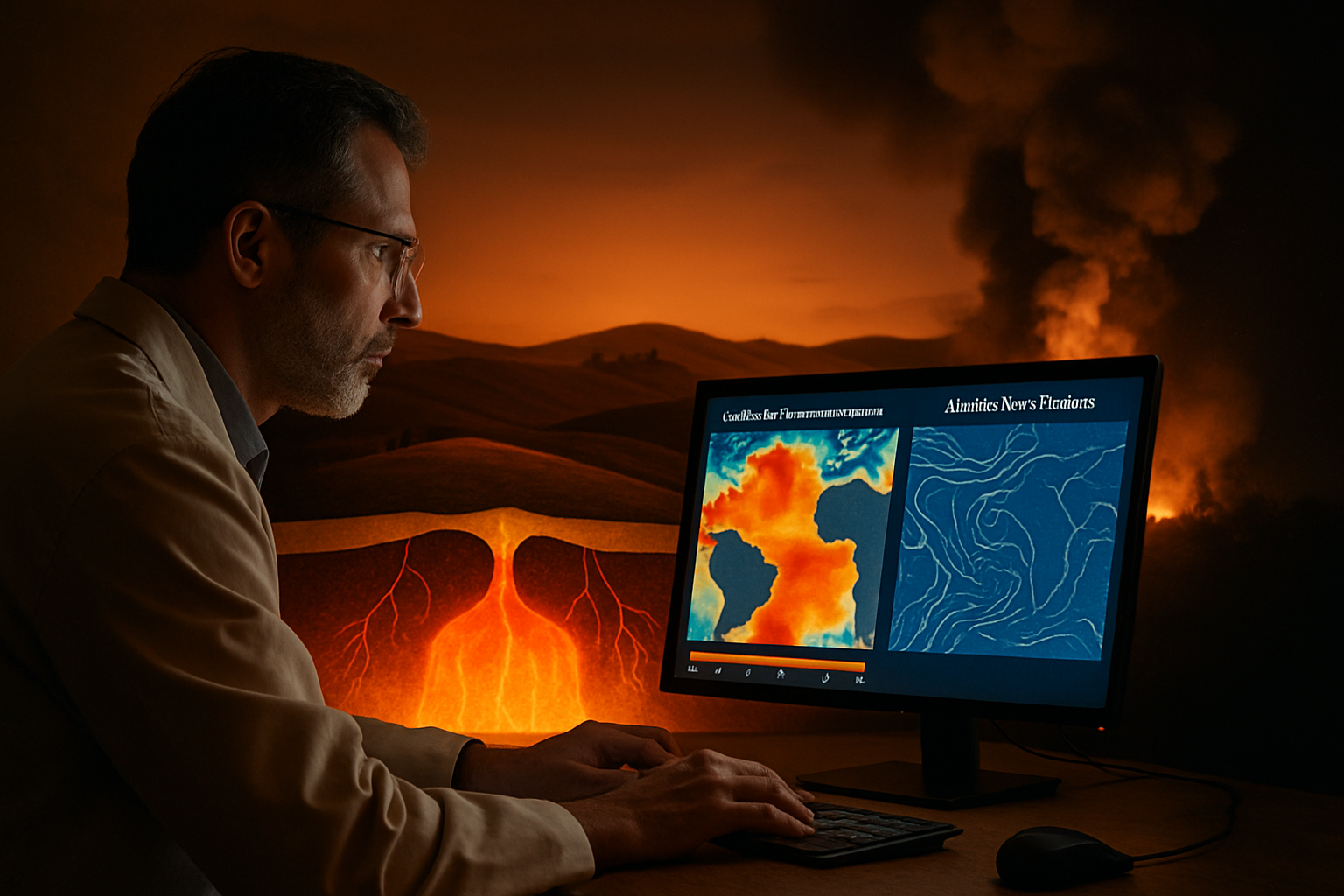
A comprehensive analysis of recent climate research reveals a troubling convergence of environmental crises spanning from increased wildfire activity to potential oceanic circulation collapse, and the unexpected discovery of massive magma chambers beneath one of Europe's most beloved tourist destinations.
Wildfire Risks Escalate as Night Provides Less Relief
New Canadian research published this week demonstrates that climate change is fundamentally altering fire behavior patterns, with nighttime and morning hours—traditionally crucial periods for firefighter recovery operations—providing significantly less reprieve than in previous decades.
The study, analyzing North American wildfire data spanning the past 50 years, shows a dramatic surge in what researchers term "fire-friendly hours" across the continent. These extended periods of conditions conducive to fire spread are increasingly bleeding into nighttime hours when temperatures historically dropped enough to reduce fire activity.
"Nights and mornings when temperatures are lower can help to give firefighters a crucial reprieve during wildfire suppression efforts. But our research shows these critical windows are shrinking."
— Lead Researcher, Climate Change and Wildfire Study
The implications for firefighting operations are severe. Emergency response crews have traditionally relied on cooler nighttime conditions to conduct backburning operations, reposition equipment, and allow exhausted personnel to rest. The McDougall Creek wildfire in West Kelowna, British Columbia, during summer 2023 exemplified these changing dynamics, where traditional nighttime lulls became increasingly unpredictable.
Atlantic Ocean Circulation Faces Critical Threat
Parallel research from Slovakia has highlighted concerning developments in Atlantic ocean circulation patterns, with scientists warning that key ocean currents could face significant disruption or even collapse. This builds on extensive previous research documented throughout 2026 showing the Atlantic Meridional Overturning Circulation (AMOC) approaching critical instability.
The AMOC system, which includes the Gulf Stream, transports approximately 15 times more water than all the world's rivers combined. This massive oceanic conveyor belt delivers warm tropical waters northward to Europe and North America while carrying cold, dense water southward along the ocean floor.
Previous studies have indicated the AMOC could weaken by up to 51% by 2100, significantly exceeding earlier estimates. Such a collapse would have catastrophic implications for weather patterns across Europe and North America, potentially affecting billions of people through dramatic temperature changes, altered precipitation patterns, and disrupted seasonal predictability.
Historical memory data from extensive climate monitoring reveals that Norwegian research has confirmed the circulation system is "closer to collapse than previously anticipated," with circulation patterns showing concerning signs of instability throughout early 2026.
Massive Magma Discovery Beneath Tuscany
In a startling geological discovery, scientists have identified thousands of cubic kilometers of magma beneath Tuscany, one of Italy's most popular tourist destinations. The finding is particularly remarkable because the region shows none of the typical signs associated with active volcanic activity.
Tuscany, renowned for its rolling hills, vineyards, Renaissance art, and historic cities like Florence and Siena, attracts millions of visitors annually. The discovery raises questions about potential future volcanic activity in a region not previously considered volcanically active.
The research reveals extensive underground magma chambers that had remained undetected due to the absence of surface volcanic indicators typically associated with such geological features. While there is no immediate threat indicated, the discovery fundamentally changes scientists' understanding of the geological structure beneath one of Europe's most culturally and economically significant regions.
Global Climate Context Unprecedented
These individual threats emerge within the context of unprecedented global climate acceleration. January 2026 was confirmed as the hottest month in recorded history, extending a warming streak that has now potentially reached 24 consecutive months above the critical 1.5°C threshold.
Climate memory data spanning multiple months of 2026 reveals that human-induced climate change has completely overridden natural cooling mechanisms, including La Niña effects that typically reduce global temperatures. The World Meteorological Organization projects a 50-60% probability of El Niño development between July and September 2026, potentially driving temperatures into unprecedented territory through the combination of baseline warming and natural cycle amplification.
This sustained warming has created what climate scientists describe as a "climate volatility paradox"—where global heat records coincide with devastating regional extremes through disrupted atmospheric circulation and altered polar vortex patterns.
Emergency Response Systems Overwhelmed
The convergence of multiple environmental threats is exposing critical weaknesses in global emergency response systems designed for sequential rather than concurrent disasters. Traditional mutual aid mechanisms are proving inadequate as multiple continents face simultaneous environmental emergencies.
Historical data from 2026 shows that emergency services have been operating at or beyond capacity limits globally, with transportation networks, power grids, and communication systems repeatedly failing as extreme weather exceeds operational parameters designed for historical climate conditions.
The European Union's Civil Protection Mechanism has been repeatedly activated throughout 2026, including a €246 million assistance package for Sweden and Denmark—the largest coordinated European weather response on record. However, even this unprecedented response proved insufficient for the scale and simultaneity of current challenges.
Infrastructure Adaptation Becomes Essential
Climate adaptation experts warn that April 2026 represents a critical watershed moment in global climate preparedness. The choice between reactive crisis management and transformative infrastructure adaptation has become increasingly urgent as traditional seasonal patterns—relied upon for centuries to guide infrastructure design, agricultural planning, and emergency preparedness—prove increasingly unreliable.
"Building back better" climate-resilient infrastructure has evolved from an optional enhancement to an essential survival strategy in what experts term a "permanent climate volatility era."
Current conditions provide a preview of what could become routine in the 2030s without comprehensive climate adaptation investment. The window for effective climate action is narrowing rapidly as ecological systems approach critical thresholds that could trigger irreversible changes to global food security, climate stability, and human settlements.
Technology and Traditional Knowledge Integration
Successful environmental responses increasingly require sophisticated integration of cutting-edge technology with traditional ecological knowledge and community-based management systems. Advanced monitoring capabilities—including satellite imagery, environmental DNA sampling, and AI-powered analysis—provide rapid threat response tools, but prove insufficient without community engagement and generations of traditional environmental knowledge.
This synthesis represents a fundamental evolution in environmental protection methodology, moving beyond purely technological or traditional approaches toward comprehensive frameworks that combine scientific rigor with cultural sensitivity and community ownership.
Economic Implications Mount
The economic implications of converging environmental threats are massive. Agricultural sectors are mounting billions in losses as extreme weather destroys crops and disrupts supply chains during critical growing seasons. Tourism industries face extended cancellations and infrastructure damage during peak revenue periods. Recovery timelines have fundamentally shifted from weeks to months or years, representing a permanent change in disaster response planning.
Environmental protection is increasingly recognized as essential infrastructure for human prosperity rather than a regulatory burden. Countries implementing comprehensive environmental protection demonstrate greater economic resilience and attract sustainable investment across multiple sectors.
International Cooperation at Breaking Point
Environmental challenges transcend political boundaries through atmospheric systems, ocean currents, and species migrations that operate regardless of borders. The simultaneity of disasters is testing mechanisms designed to help stable regions assist isolated emergencies, requiring fundamental restructuring of international cooperation frameworks.
Success depends on unprecedented coordination, enhanced multi-sector cooperation, and sustained financial commitments recognizing environmental protection as essential infrastructure for planetary sustainability.
Critical Action Window Closing
Environmental scientists warn that the window for effective climate action is narrowing rapidly. Ecological systems are approaching critical thresholds that could potentially trigger irreversible changes affecting global food security, climate stability, and human settlements.
Tools, knowledge, and cooperation frameworks exist for comprehensive environmental protection, but their implementation requires unprecedented speed and coordination during what experts call the "decisive climate action decade."
The convergence of extreme weather conditions, infrastructure vulnerabilities, and emergency response limitations underscores the urgent need for coordinated international action. Additional weather systems developing in the Atlantic and Pacific regions suggest that current crisis conditions may persist for weeks or months, potentially establishing a "new normal" of extreme weather frequency and intensity that permanently challenges traditional emergency response frameworks.
The fundamental question facing humanity is whether we can organize and implement solutions rapidly enough to maintain planetary habitability during Earth's most environmentally challenging period in recorded history. The choices made in the coming months may prove decisive for climate resilience strategies affecting generations to come.