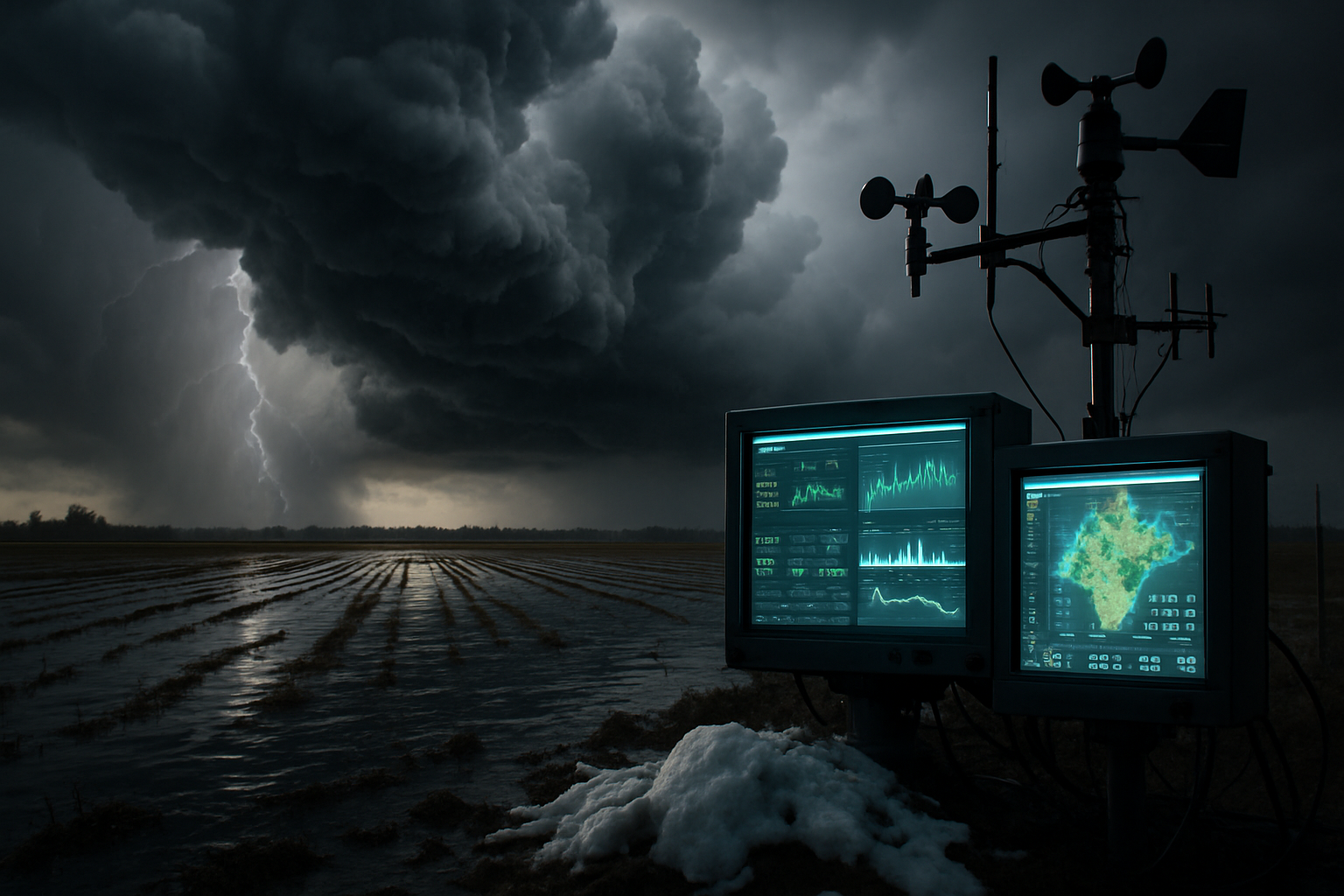
The World Meteorological Organization confirms that the cooling La Niña phase is approaching its end, setting the stage for a probable return of El Niño conditions as early as this autumn—a development that could drive global temperatures to unprecedented levels during what is already the longest sustained warming period in recorded human history.
As scientists monitor this critical transition, extreme weather events are simultaneously devastating communities across three continents. Austria's meteorological services report the imminent conclusion of La Niña's tempering influence on global temperatures, while France endures its wettest February since records began in 1959, and Latvia faces mounting flood risks threatening agricultural communities whose livelihoods depend on increasingly unpredictable seasonal patterns.
Historic Rainfall Shatters European Records
France has experienced catastrophic precipitation levels, with February 2026 marking the most rain-soaked month since meteorological measurements commenced 67 years ago. The deluge has exceeded even the previous record holder from 1970, creating a winter season that ranks as the 8th wettest on record with rainfall 35% above normal levels.
The unprecedented moisture has saturated soils across the country, overwhelming drainage systems designed for historical weather patterns rather than the extreme conditions now becoming routine. Agricultural regions face the dual threat of immediate flood damage and longer-term soil degradation, while urban areas struggle with infrastructure never intended to handle such sustained precipitation.
"The intensity and duration of these rainfall events represents a fundamental shift in our regional climate patterns," explains a senior meteorologist at Météo-France. "What we're witnessing isn't just weather—it's the manifestation of larger atmospheric changes that are rewriting the rules of European seasonal cycles."
Agricultural Crisis Looms Across Continents
In Latvia, the convergence of unusual weather patterns poses severe risks to farming communities, particularly those operating near rivers and floodplains. The Zemnieku Saeima agricultural association warns that escalating flood risks could inflict devastating losses on farmers whose operations have become increasingly vulnerable to climate volatility.
The threat extends beyond immediate crop damage. Farmers across the Baltic region report that traditional planting and harvesting schedules—refined over generations—no longer align with actual weather patterns. This temporal displacement forces agricultural communities to operate without the seasonal predictability that has historically guided food production systems.
"Our ancestors could predict seasonal changes with remarkable accuracy, but climate change has disrupted patterns that sustained agriculture for centuries."
— Baltic Agricultural Research Institute
The agricultural sector faces compound challenges as extreme weather events occur with unprecedented frequency and intensity. Farmers must now prepare for scenarios that combine traditional seasonal risks with entirely new climate realities, from unseasonable flooding during planting season to heat stress during traditionally cooler months.
The End of Natural Climate Moderation
The approaching conclusion of La Niña represents more than a routine climate cycle transition. During normal conditions, La Niña provides crucial cooling effects that moderate global temperatures, offering temporary respite from the warming trend driven by greenhouse gas concentrations. However, even these natural cooling mechanisms have proven insufficient against the accelerating pace of human-induced climate change.
January 2026 marked the 19th consecutive month that global temperatures exceeded 1.5°C above pre-industrial levels—a threshold scientists consider critical for maintaining climatic stability. This sustained warming period represents the longest such streak in recorded history, demonstrating that human activities have fundamentally altered Earth's atmospheric systems beyond natural recovery mechanisms.
When La Niña's cooling influence ends and potentially transitions to El Niño conditions—which typically elevate global temperatures—the world may experience temperature increases that eclipse all previous records. Climate models suggest that an El Niño event occurring during the current baseline warming could push global temperatures into unprecedented territory.
Infrastructure Struggles Against Climate Reality
The extreme weather patterns currently affecting Europe expose critical vulnerabilities in infrastructure systems designed for historical rather than contemporary climate conditions. Transportation networks, power grids, and emergency services operate beyond their intended parameters as extreme events become both more frequent and more severe.
French flood management systems, engineered based on decades of historical data, now confront rainfall volumes that consistently exceed their design capacity. Similar challenges face drainage systems, agricultural infrastructure, and urban planning frameworks across the continent. The recurring nature of these extreme events means that recovery periods—traditionally used for repairs and upgrades—have become insufficient between successive climate impacts.
Emergency services report capacity strain as they respond to overlapping crises rather than isolated events. The traditional model of regional mutual aid, where neighboring areas provide assistance during localized emergencies, breaks down when extreme weather affects multiple regions simultaneously.
Economic Cascades Through Global Systems
The economic implications of this climate transition extend far beyond immediate weather damage. Agricultural productivity faces disruption across multiple growing regions, potentially affecting global food security and commodity prices. The combination of European flooding, Baltic agricultural risks, and the prospect of intensified El Niño conditions creates a complex web of economic vulnerabilities.
Tourism industries dependent on predictable seasonal patterns must adapt to increasingly erratic weather conditions. Winter sports regions face uncertainty about snow coverage, while coastal areas must prepare for more frequent storm surge events. The accumulating adaptation costs represent a massive reallocation of economic resources toward climate resilience rather than traditional development priorities.
Supply chain disruptions, already evident in current extreme weather events, could intensify significantly under El Niño conditions. The phenomenon historically correlates with altered precipitation patterns across multiple continents, affecting everything from agricultural harvests to manufacturing operations in climate-sensitive regions.
Scientific Monitoring at Critical Junctures
The World Meteorological Organization coordinates global climate monitoring as natural systems transition between phases of unprecedented volatility. Current conditions challenge forecasting capabilities developed for more stable climate patterns, as the interaction between human-induced warming and natural climate cycles creates scenarios without historical precedent.
Research institutions across affected regions work to document and understand these changes, but the rapid pace of climate system evolution outstrips traditional scientific timelines. The transition from La Niña to potential El Niño conditions occurs against a backdrop of sustained global warming that amplifies the effects of natural climate variability.
Climate scientists emphasize that current monitoring systems, while sophisticated, were designed for a climate regime that no longer exists. The challenge involves not just tracking current conditions but developing new predictive frameworks for a fundamentally altered global climate system.
Adaptation Becomes Survival Strategy
The convergence of La Niña's end, record European rainfall, and mounting agricultural pressures represents a critical test of human adaptive capacity. Communities that successfully navigate these challenges demonstrate approaches that may prove essential as climate volatility increases.
France's response to record flooding includes both immediate emergency measures and longer-term infrastructure adaptations. Latvia's agricultural sector explores climate-resilient farming techniques while maintaining food production capabilities. These localized adaptations contribute to a global learning process about living with accelerated climate change.
The approaching El Niño transition provides a preview of climate conditions that may become routine in the 2030s without significant global climate action. The choices made during this critical period—in adaptation strategies, infrastructure investment, and international cooperation—may determine whether human societies can maintain stability during an era of unprecedented climate volatility.
International Cooperation Under Pressure
The global nature of climate pattern transitions demands unprecedented international coordination. Weather systems cross political boundaries, making unilateral adaptation efforts insufficient for comprehensive climate resilience. The European experience with extreme rainfall, combined with global temperature patterns, illustrates how regional climate impacts connect to planetary systems.
Success in managing the transition from La Niña to potentially dangerous El Niño conditions requires coordinated monitoring, shared adaptation strategies, and mutual aid mechanisms designed for simultaneous rather than sequential climate emergencies. Traditional frameworks for international disaster response face challenges when multiple regions experience extreme events concurrently.
The window for effective climate action narrows as natural climate cycles amplify rather than moderate human-induced warming. The scientific consensus indicates that current conditions represent a critical juncture for global climate stability, with the potential El Niño transition serving as a harbinger of accelerating climate change impacts.
As meteorologists track the evolution of La Niña's cooling influence, the world prepares for a climate future that may test the limits of human adaptability. The transition from natural climate moderation to potential El Niño amplification of warming trends marks not just a meteorological shift, but a defining moment in humanity's relationship with Earth's changing climate systems.