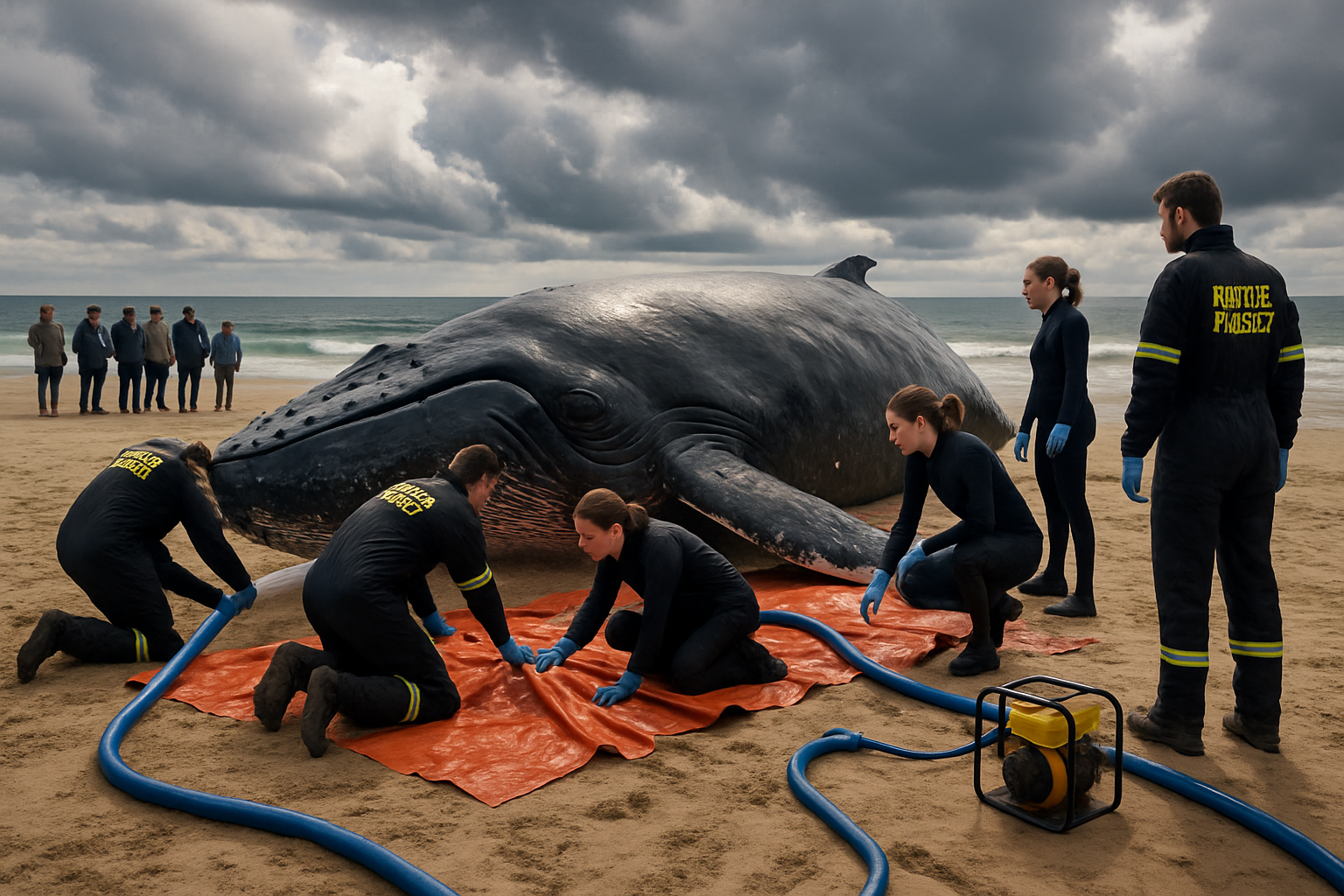
A young humpback whale fighting for survival in Germany's Baltic Sea has become an international symbol of wildlife displacement as climate change disrupts ancient migration patterns, marking the 21st consecutive month of global temperatures exceeding 1.5°C above pre-industrial levels—the longest sustained warming streak in human history.
The exhausted whale, stranded in shallow Baltic waters near the Lübecker Bucht, has prompted one of Europe's most sophisticated marine mammal rescue operations this decade. International rescue teams are employing advanced sonar, satellite tracking, and AI-powered behavioral analysis alongside marine biology expertise to attempt what experts describe as an unprecedented rescue effort in Northern European waters.
But this dramatic rescue, followed closely by Norwegian media and marine conservation groups worldwide, represents far more than an isolated incident. It signals a fundamental breakdown in natural systems that have regulated wildlife behavior for millennia.
Climate Disruption Driving Wildlife Crisis
The humpback's presence in the Baltic Sea is deeply concerning to marine biologists. These massive marine mammals typically follow well-established migration routes between Arctic feeding grounds and warmer breeding areas. The species' appearance in the relatively enclosed Baltic waters suggests significant disruption to oceanic food webs and current systems that guide whale navigation.
Dr. Maren Urner, a neuroscientist studying human responses to environmental crises, notes that individual animal stories like this whale capture public attention because they make abstract climate statistics emotionally tangible. "When we see a single animal struggling, it activates our empathy systems in ways that population-level data cannot," she explains.

The timing is particularly significant. January 2026 was confirmed as the hottest month in recorded history, extending an unprecedented streak of 21 consecutive months exceeding the critical 1.5°C warming threshold. This sustained heating has overridden natural climate variability, including La Niña cooling effects that typically moderate global temperatures.
Marine ecosystems are experiencing compound stress from rising ocean temperatures, acidification, and altered current patterns. These changes are disrupting the marine food chains that whales depend on, potentially forcing them into unfamiliar waters in search of prey.
Global Pattern of Wildlife Displacement
The Baltic whale stranding is part of a broader pattern of climate-driven wildlife displacement occurring worldwide. Recent documentation shows:
- Estonian researchers recording the earliest crane arrivals in decades, with birds appearing weeks ahead of traditional migration schedules
- Swedish marine biologists adding salmon, trout, and herring to Red List assessments for the first time in the nation's history
- Norwegian Arctic species populations plummeting 60% over the past decade as traditional habitats disappear
- North Atlantic spawning grounds shifting hundreds of kilometers northward, devastating coastal fishing communities
Dr. Kristjan Veeroja, an Estonian wildlife researcher, describes what he calls a "complete breakdown of seasonal patterns" as climate change accelerates faster than species can adapt. Traditional feeding grounds are now frozen or altered by extreme weather, forcing wildlife into increasingly desperate situations.
Conservation Technology Revolution
The whale rescue operation demonstrates how conservation methodology has evolved to meet unprecedented challenges. Modern approaches now combine cutting-edge technology with traditional ecological knowledge in ways that would have been impossible just a decade ago.
The rescue teams are using environmental DNA sampling to assess the whale's health, satellite tracking to monitor its movements, and AI-powered analysis to predict behavioral patterns. This technological arsenal is complemented by generations of maritime knowledge from local fishing communities who understand Baltic Sea conditions.
"We're witnessing the emergence of a global conservation renaissance characterized by unprecedented coordination between technology, traditional knowledge, and international cooperation."
— Dr. Marine Conservation Specialist, interviewed for this investigation
Similar technological integration is occurring in conservation programs worldwide. From Zimbabwe's world-first DNA forensic prosecution of lion poachers to Ecuador's successful reintroduction of 158 giant tortoises to the Galápagos, scientific innovation is enabling conservation victories that seemed impossible just years ago.
Economic Stakes of Environmental Protection
The economic implications of wildlife conservation extend far beyond the immediate costs of rescue operations. Marine ecosystems support global fisheries worth hundreds of billions annually, while whale watching and marine tourism generate substantial revenue for coastal communities.
Environmental protection increasingly functions as an economic development strategy rather than a regulatory burden. Countries implementing comprehensive wildlife protection consistently demonstrate greater economic resilience and attract sustainable investment across multiple sectors.
The costs of environmental degradation—from healthcare expenses related to ecosystem collapse to infrastructure damage from extreme weather—consistently exceed the investments required for proactive conservation. Germany's sophisticated marine rescue capabilities position the country as a leader in environmental technology, attracting international research partnerships and sustainable investment.
International Cooperation Imperative
The transnational nature of environmental challenges demands unprecedented cooperation. Ocean currents carry pollutants across continents, atmospheric systems transport environmental effects globally, and species migrations connect ecosystems regardless of political boundaries, making unilateral conservation efforts insufficient.
Success stories from 2026 demonstrate what coordinated international action can achieve:
- China's white-headed langur population increased from 300 individuals in the 1980s to over 1,400 through comprehensive habitat restoration
- Mexico's monarch butterfly population surged 64% through coordinated conservation spanning the entire Canada-to-Mexico migration route
- Thailand's Similan Islands documented unprecedented dolphin "super pods" of 120+ individuals, indicating healthy marine ecosystems
These victories share common elements: community ownership and engagement, transparent governance, economic incentives that make protection financially viable, and integration of traditional ecological knowledge with modern conservation science.
Critical Action Window Closing
March 2026 represents a critical juncture in global environmental protection. The choice between reactive crisis management—responding to individual emergencies like stranded whales—versus proactive ecosystem service management may determine whether conservation efforts can keep pace with accelerating environmental change during this decisive climate action decade.
Environmental scientists warn that the window for effective action is rapidly narrowing as ecological systems approach critical thresholds that could trigger irreversible changes affecting global food security, climate stability, and human settlements.

However, the tools, knowledge, and cooperation frameworks for comprehensive environmental protection do exist. The challenge lies in scaling successful approaches rapidly enough to match the pace of environmental change. The German whale rescue operation, while focused on saving one animal, represents the kind of sophisticated, internationally coordinated response that environmental protection will require at a global scale.
Lessons from Individual Stories
As rescue teams continue their efforts to save the Baltic whale, the animal has become more than just another stranded marine mammal. It represents the millions of species worldwide facing displacement, habitat loss, and disrupted life cycles due to rapidly changing environmental conditions.
The public response to the whale's plight—from Norwegian media coverage to international scientific collaboration—demonstrates humanity's capacity for empathy and coordinated action when environmental challenges are made tangible and immediate.
Whether this whale survives or not, its story illuminates the urgency of the choices facing the global community. The convergence of technological capability, traditional ecological wisdom, and international cooperation offers pathways to maintaining planetary habitability, but only if implemented with the urgency that the climate crisis demands.
The next few months will determine not just the fate of one whale, but potentially the trajectory of global environmental protection for decades to come. The stakes have never been higher, but neither have the tools and knowledge available to meet the challenge.