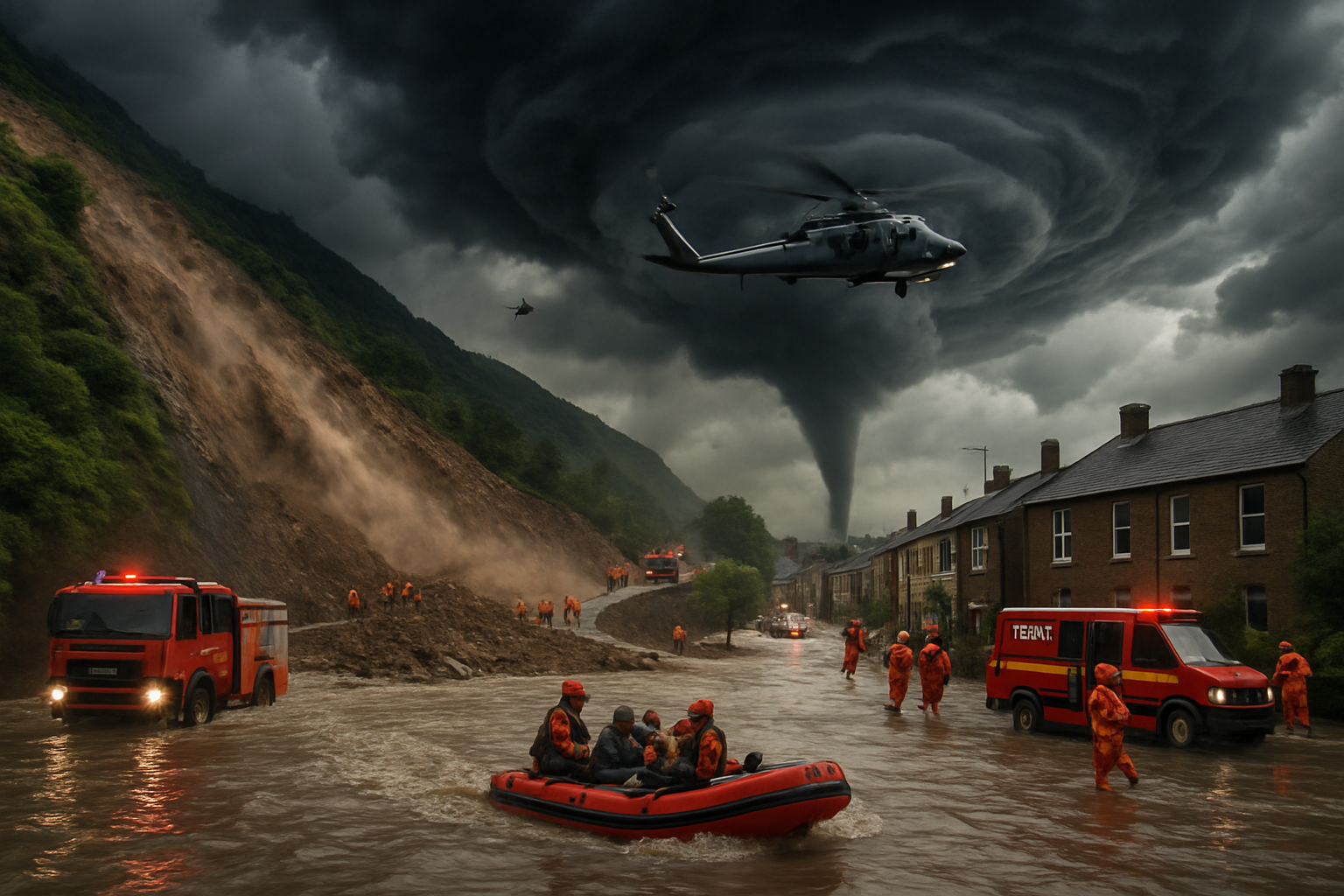
The world is facing an unprecedented environmental emergency as March 2026 marks the 21st consecutive month of global temperatures exceeding 1.5°C above pre-industrial levels—the longest sustained warming streak in recorded human history.
Simultaneous extreme weather disasters across Australia, Canada, New Zealand, and Sweden are overwhelming emergency response systems designed for sequential rather than concurrent crises, revealing fundamental weaknesses in global climate adaptation infrastructure.
Australia's Dual Climate Threats
In Far North Queensland, residents are bracing for potential flooding as Cyclone Narelle, now tracking towards the Northern Territory, threatens communities still recovering from previous extreme weather events. The cyclone represents another challenge in what meteorologists describe as an increasingly volatile climate system.
Australia's emergency management agencies are grappling with what the Australian Fire Emergency Services Authority (AFAC) terms "compound disasters"—multiple emergency types occurring concurrently rather than sequentially, fundamentally challenging traditional resource allocation and mutual aid mechanisms.
Canada's Fraser Valley Crisis
British Columbia's Fraser Valley is experiencing severe weather conditions with heavy rains triggering mudslides in Coquitlam that forced the evacuation of at least 40 homes. Emergency responders conducted a dramatic airlift rescue of one couple trapped by the mudslide, highlighting the immediate human cost of these extreme weather events.
The mudslide has caused significant infrastructure damage, wiping out road infrastructure and power lines across the region. Two evacuation alerts have been issued along the Chilliwack River, with authorities warning residents to avoid flood-prone areas as conditions continue to deteriorate.
New Zealand's Geological Instability
New aerial images reveal the devastating scale of Northland's Helena Bay hill landslide, with clearance operations uncovering hundreds of boulders—many larger than cars—scattered across the landscape. The landslide has created significant safety hazards and transportation disruptions in the region.
Sweden's Agricultural Disruption
In Sweden, a barn has collapsed following a landslide, prompting ongoing animal rescue operations. The incident demonstrates how extreme weather events are affecting not just human infrastructure but agricultural systems and livestock welfare across Northern Europe.
Global Temperature Milestone
January 2026 was confirmed as the hottest month in recorded history, with human-induced climate change now fundamentally overriding natural cooling mechanisms, including La Niña effects. The World Meteorological Organization indicates a 50-60% probability of El Niño development during July-September 2026, potentially driving temperatures to unprecedented levels.
"What we're seeing is a climate volatility paradox where sustained global warming enables both heat records and devastating regional extremes through disrupted atmospheric circulation patterns."
— Climate Research Scientist
Emergency Response Systems Under Strain
Traditional mutual aid mechanisms, designed for sequential regional disasters, are proving inadequate when multiple continents face simultaneous emergencies. Emergency services across affected regions report operating at or beyond capacity limits, with transportation networks, power grids, and communication systems repeatedly exceeding their operational parameters.
The European Union's Civil Protection Mechanism has been repeatedly activated, with Sweden and Denmark receiving €246 million in assistance—the largest coordinated European weather response on record. However, experts warn that even these enhanced cooperation frameworks are insufficient for the scale and simultaneity of current challenges.
Infrastructure Vulnerabilities Exposed
Critical infrastructure systems designed based on historical climate patterns are failing under current extreme conditions. From Australia's flood defenses to Canada's transportation networks, the gap between infrastructure design specifications and actual climate conditions continues to widen.
Recovery timelines have fundamentally shifted from weeks to months or years, representing a paradigm change in disaster response approaches. The concept of "building back better" with climate-resilient infrastructure has evolved from an optional enhancement to an essential survival strategy.
Economic and Social Devastation
The agricultural sector is experiencing mounting losses as extreme weather destroys crops and disrupts supply chains during critical growing seasons. Tourism industries face extended cancellations and infrastructure damage during peak revenue periods.
Mental health services report increased demand for support related to climate anxiety and repeated trauma from extreme weather events. Vulnerable populations require extended support as traditional community resilience mechanisms are overwhelmed by the frequency and intensity of disasters.
International Cooperation at Breaking Point
Environmental challenges transcend political boundaries, with atmospheric systems, ocean currents, and climate effects operating regardless of borders. The simultaneity of disasters across multiple continents is testing cooperation mechanisms designed for stable regions to assist others during isolated emergencies.
Success in addressing these challenges requires unprecedented international cooperation, enhanced multi-sector coordination, and increased financial commitments that recognize environmental protection as essential infrastructure for human prosperity and planetary sustainability.
Adaptation Imperatives
March 2026 represents a watershed moment in global climate preparedness, forcing a choice between reactive crisis management and transformative infrastructure adaptation. Traditional seasonal patterns that have guided infrastructure design, agricultural planning, and emergency preparedness for centuries are no longer reliable frameworks.
Current conditions provide a preview of what may become routine in the 2030s without immediate and comprehensive climate adaptation investment. The window for effective climate action is narrowing as ecological systems approach critical thresholds that could trigger irreversible changes affecting global food security, climate stability, and human settlements.
Technology and Traditional Knowledge Integration
Successful environmental responses increasingly require sophisticated integration of cutting-edge technology with traditional ecological knowledge and community-based management. Australia's combination of advanced meteorological forecasting with Indigenous fire management, and Estonia's integration of agricultural wisdom with modern climate monitoring, represent the evolution of environmental protection strategies.
Strategic Significance
The convergence of extreme weather events, infrastructure vulnerabilities, and emergency response limitations in March 2026 underscores the urgent need for coordinated international action. The choices made in the coming months regarding adaptation strategies, infrastructure investment, and international cooperation may prove decisive for global climate resilience strategies affecting generations.
Tools, knowledge, and cooperation frameworks exist for comprehensive environmental protection, but success depends on unprecedented speed and coordination through sustained international cooperation and political commitment that recognizes environmental protection as essential infrastructure for planetary sustainability.
The question is no longer whether transformative climate action is needed, but whether humanity can organize and implement solutions rapidly enough to maintain planetary habitability during Earth's most environmentally challenging period in recorded history.