
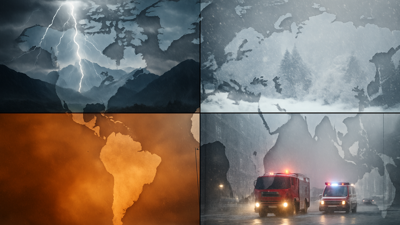
A catastrophic convergence of extreme weather events across four continents has exposed critical vulnerabilities in global emergency response systems, as rising river levels force evacuations in New Zealand while Sweden faces its worst drought conditions in decades and Bangkok endures 19 consecutive days of dangerous heat.
The crisis unfolds during what climate scientists believe could mark the 24th consecutive month of global temperatures exceeding the critical 1.5°C threshold above pre-industrial levels—the longest sustained extreme warming period in recorded human history. From the Tauweru River threatening homes near Carterton, New Zealand, to groundwater levels plummeting across southern Sweden, these simultaneous disasters represent a fundamental shift in how climate change manifests globally.
New Zealand Faces Renewed Flooding Crisis
Emergency operations in New Zealand's Wairarapa region have evacuated multiple homes along Gladstone Road near Carterton as the Tauweru River reaches dangerous levels. The evacuations come as the country continues recovering from previous flooding disasters that have repeatedly tested infrastructure designed for historical rather than current climate conditions.
New Zealand's emergency management officials warn that traditional flood defenses, built around predictable seasonal patterns, are proving inadequate against the increasingly volatile weather systems that have characterized 2026. The nation has experienced multiple severe weather events this year, creating a cascading effect where recovery efforts from one disaster are interrupted by the next.
Sweden Confronts Historic Drought Emergency
In stark contrast to New Zealand's flooding, Sweden is preparing for its most severe water shortage in decades. Hydrogeologist Calle Hjerne from the Geological Survey of Sweden (SGU) warned at a recent press conference that groundwater levels in Skåne province have reached critically low levels after two consecutive years of below-normal rainfall.
"It is likely that we will issue more warnings going forward. The water situation looks tough in southern Sweden heading into summer,"
— Calle Hjerne, Hydrogeologist at SGU
The drought conditions threaten agricultural operations across southern Sweden just as farmers prepare for the critical growing season. Traditional water management systems, developed over centuries to handle Nordic climate patterns, are struggling to adapt to the new reality of extended dry periods punctuated by intense but brief rainfall events.
Bangkok's Unprecedented Heat Emergency
Thailand's capital has endured 19 consecutive days of dangerous heat index levels, with temperatures and humidity combining to create conditions that pose significant public health risks. The sustained extreme heat represents an unprecedented challenge for a metropolitan area of over 10 million people, straining energy infrastructure as air conditioning demand reaches historic peaks.
Public health authorities have issued emergency protocols advising residents to avoid outdoor activities during peak hours and maintain constant hydration. The heat emergency in Bangkok exemplifies how urban areas worldwide are becoming testing grounds for humanity's ability to maintain habitability during climate extremes.
Emergency Response Systems Under Unprecedented Strain
The simultaneity of these disasters represents a fundamental challenge to traditional emergency response frameworks, which were designed around the assumption that extreme weather events would be sequential rather than concurrent across multiple continents. Emergency management experts have identified this shift toward "compound disasters"—multiple emergency types occurring simultaneously across vast geographic areas—as requiring fundamental restructuring of international cooperation mechanisms.
Traditional mutual aid systems, where stable regions assist areas experiencing isolated emergencies, break down when multiple continents face disasters simultaneously. The European Union's Civil Protection Mechanism has been repeatedly activated throughout 2026, including a record €246 million assistance package for Sweden and Denmark, yet these coordinated responses prove insufficient for the scale and simultaneity of current challenges.
Infrastructure Vulnerabilities Exposed
Transportation networks, power grids, and communication systems designed around historical climate patterns are repeatedly failing as extreme weather exceeds operational parameters. Recovery timelines have fundamentally shifted from weeks to months or years, representing a paradigmatic change in disaster response approaches.
The concept of "building back better" with climate-resilient infrastructure has evolved from an optional enhancement to an essential survival strategy for communities facing permanent climate volatility. Traditional seasonal patterns that guided infrastructure design, agricultural planning, and emergency preparedness for centuries are no longer reliable frameworks.
Economic and Social Devastation Mounting
Agricultural operations face mounting losses as extreme weather destroys crops and disrupts supply chains during critical growing seasons. Tourism industries experience extended cancellations and infrastructure damage during what should be peak revenue periods. Mental health services report increased demand for treatment of climate anxiety and repeated trauma as families face the potential loss of generational properties multiple times within a single decade.
The economic implications extend far beyond immediate disaster costs. Vulnerable populations—including elderly residents, children, and those with respiratory conditions—are disproportionately affected by the compounding stresses of repeated extreme weather events. Business extinction threatens entire economic sectors as recurring disruptions make long-term planning increasingly impossible.
Climate Science Context: The 24th Consecutive Month
January 2026 remains the hottest month in recorded history, extending an unprecedented warming streak that has now potentially reached 24 consecutive months above the critical 1.5°C threshold. Human-induced climate change has completely overridden natural cooling mechanisms, including La Niña effects that would typically moderate global temperatures.
The World Meteorological Organization projects a 50-60% probability of El Niño development between July and September 2026, which could drive temperatures into unprecedented territory by combining baseline warming with natural cycle amplification. This "climate volatility paradox" enables both sustained global warming and devastating regional extremes through disrupted atmospheric circulation and polar vortex patterns.
Technology-Tradition Integration Success Stories
Despite the overwhelming challenges, some successful responses demonstrate sophisticated synthesis of cutting-edge technology with traditional ecological knowledge. Estonia operates continental Europe's largest battery storage system, powering 90,000 households with 88% renewable electricity. Finland has implemented "transformative adaptation" approaches, establishing proactive systems for permanent volatility rather than reactive responses to exceptional events.
Advanced monitoring techniques—including satellite imagery, environmental DNA sampling, and AI analysis—provide rapid threat response capabilities, but their effectiveness requires community engagement and local expertise. These hybrid approaches offer resilience through multiple pathways for addressing complex, interconnected challenges.
International Cooperation at Breaking Point
Environmental challenges transcend political boundaries as atmospheric and ocean systems transport climate effects globally, making unilateral adaptation insufficient. The simultaneity of disasters is testing cooperation mechanisms developed under the assumption that stable regions could assist others experiencing isolated emergencies.
Success requires unprecedented international cooperation, enhanced multi-sector coordination, and sustained financial commitments recognizing environmental protection as essential infrastructure rather than a regulatory burden. Traditional frameworks require fundamental restructuring for an era of permanent climate volatility affecting multiple continents simultaneously.
A Watershed Moment for Climate Action
April 2026 represents a critical juncture in global climate preparedness, forcing a choice between reactive crisis management and transformative infrastructure adaptation. Current conditions provide a preview of routine circumstances in the 2030s without comprehensive climate adaptation investment. The window for effective climate action is narrowing rapidly as ecological systems approach critical thresholds that could trigger irreversible changes affecting global food security, climate stability, and human settlements.
Additional weather systems are developing in the Atlantic and Pacific regions, and authorities remain on high alert globally. The persistence of crisis conditions for weeks or months could establish a "new normal" characterized by extreme weather frequency and intensity that permanently challenges traditional response frameworks.
"We are witnessing a convergence of extreme weather, infrastructure vulnerabilities, and emergency response limitations that underscores the urgent need for coordinated international action. The question is no longer whether transformative climate action is needed, but whether humanity can organize and implement solutions rapidly enough to maintain planetary habitability during Earth's most environmentally challenging period in recorded history."
— Emergency Management Expert Assessment
The tools, knowledge, and cooperation frameworks exist for comprehensive environmental protection, but they require unprecedented speed of coordination and sustained international cooperation. Environmental protection must be recognized as essential infrastructure for human prosperity and planetary sustainability during this decisive climate action decade.
As emergency services worldwide operate at or beyond capacity limits, and as traditional mutual aid mechanisms prove inadequate for simultaneous global crises, the events of April 2026 may be remembered as the moment when humanity was forced to fundamentally reimagine its relationship with a rapidly changing planet.